
We evaluated 8+ AI agent builder platforms across orchestration architecture, deployment flexibility, voice capability, extensibility, and total cost of ownership.
Our findings show that Rasa is the best overall AI agent builder for enterprise teams that need self-hosted deployment, composable skills, and full code-level control over agent behavior.
Cognigy leads for high-volume voice automation, and Decagon is the top pick for rapid deployment speed.
The category winners are:
Best AI Agent Builder Platforms: Quick Comparison
How We Evaluated These AI Agent Builder Platforms
Our team evaluated each platform across seven weighted dimensions. We’ve analyzed aggregated user reviews from G2 and Capterra, reviewed public pricing, tested deployment workflows, and consulted with enterprise engineering teams running conversational AI in production.
We prioritized platforms that enterprise buyers in regulated industries (financial services, telco, healthcare, government) would encounter during a real evaluation cycle.
Each platform was assessed on its production-readiness, not on demo-day performance.
Our Scoring Methodology
Top 8 Best AI Agent Builders for Enterprise in 2026
#1. Rasa: Best AI Agent Builder Overall
Rasa is the developer platform for enterprise AI agents, used by Deutsche Telekom, Autodesk, and hundreds of enterprises to build, orchestrate, and own AI agents across voice and chat.
Our findings show that Rasa is the best choice for enterprise engineering teams (1,000+ employees) in regulated industries that require self-hosted deployment, multi-agent orchestration, a composable skills architecture, and full code-level control over agent behavior.

Product Overview
Here’s how Rasa solves the problems/gaps other platforms struggle with:
Problem 1: Most enterprise teams hit the same wall with AI agents: logic scattered across dozens of disconnected prompts, no shared state between channels, and no way to reuse what works.
The first agent takes months. The second takes just as long because nothing transfers.
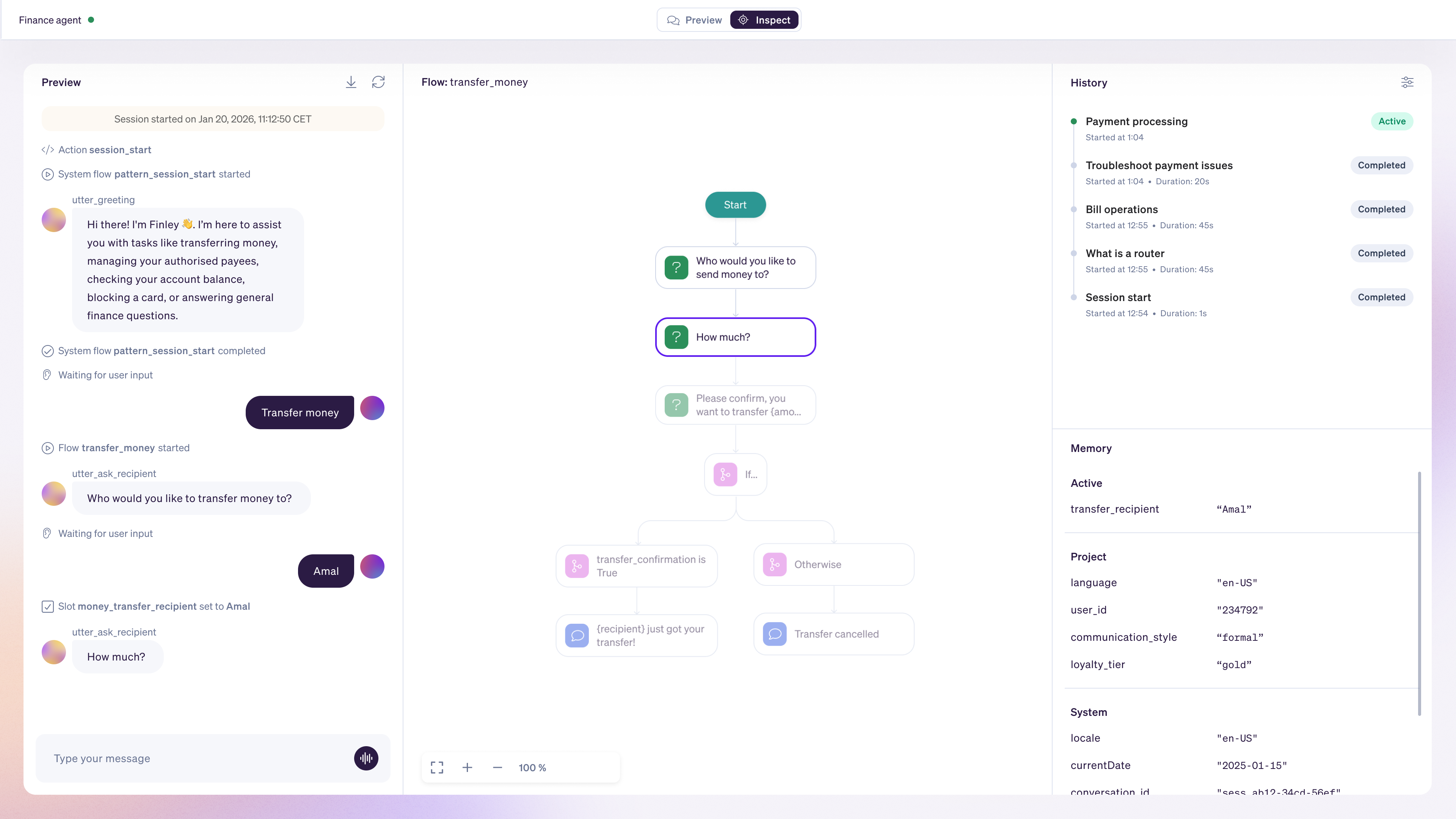
Rasa’s Solution: Rasa provides reusable agent building blocks called skills. Each skill can operate anywhere on a spectrum between autonomous reasoning and strict business logic, depending on the task. Teams own their agent logic and runtime, while Rasa handles memory, context sharing, and orchestration across both general and domain-specific skills. Skills can be shared across your organization to help teams build faster and manage agents at scale — build once, reuse anywhere.
Deutsche Telekom's internal IT team uses this approach to serve 10,000+ employees across German and English, with non-technical IT experts designing new flows in Rasa Studio while developers focus on the complex integrations underneath.
Problem 2: The second problem is trust. Every enterprise buyer we spoke with during this evaluation raised the same concern: "How do we use LLMs without risking wrong answers in production?"
Rasa’s Solution: Rasa's architecture answers this directly. The LLM handles dialogue understanding (interpreting what the customer actually means, even when they phrase things ambiguously) and generates internal commands that drive the conversation forward. But the LLM does not control business logic or decide what actions the agent takes.
Deterministic business rules and flows control every action the agent takes. Rasa’s patented dialogue manager combines LLM fluency with deterministic logic in one system, so there are no hallucinations in your business rules. This is why regulated enterprises adopt Rasa over pure-LLM alternatives.
One prospect we encountered during research put it simply: their previous platform hallucinated responses and could not reliably access internal systems.
The Rasa platform resolved both issues by keeping the AI's role narrow and the business logic explicit.
Problem 3: The third gap most platforms leave open is cross-channel continuity. A customer starts a chat, is transferred to a phone agent, and then follows up via email.
Rasa’s Solution: On most platforms, context resets at every handoff. Rasa's multi-agent orchestration maintains shared state, clean handoffs, and unified memory across channels. The customer never repeats themselves.
The agent retains full state, conversation history, and intent across chat, voice, SMS, and internal systems. This is not channel-switching. It is a single continuous conversation that happens to move across surfaces.
For enterprises running both voice and digital support, this eliminates the fragmented experience that erodes customer trust.
Product Demo
Pricing
Rasa offers these pricing tiers:
- Developer Edition (Free): Full access to Rasa. One bot per company, free and valid for up to 1,000 external conversations/month (100 for internal agents). Community support via the Rasa Forum. Designed for individual developers exploring agent projects.
- Enterprise (Custom): Premium support, dedicated CSM, advanced security features, custom onboarding. Contact Rasa for a quote.
Pricing is based on annual conversation volume, not per-user or per-seat.
Integrations
Native: MCP server integration (beta), A2A (Agent-to-Agent) protocol (beta), custom Action Server.
Backend integrations built through Action Server custom actions and MCP server connectivity, connecting to CRM, ERP, ticketing, and contact center systems. Voice Gateway for telephony integration.
Extensible: Teams can replace or extend core modules (RAG pipeline, rephraser, command generator, NLU pipelines) without waiting on the vendor roadmap. Supports any LLM provider.
Setup
- Initial deployment timelines vary by complexity.
- Rasa provides onboarding support and dedicated implementation specialists on the Enterprise tier.
- Self-hosted in your environment from day one.
Tradeoffs
- Rasa requires a builder mindset. This is not a point-and-click chatbot tool. Teams need either internal engineering resources or a systems integration partner.
- The learning curve is steeper than vendor-packaged alternatives like Decagon or Sierra. That tradeoff is the price of ownership.
Support
- Rasa Studio lets non-technical team members (such as conversation designers and IT subject matter experts) design flows without writing code.
- Community support via the Rasa Forum.
- Documentation at rasa.com/docs.
- Learning resources at learning.rasa.com.
Mini Case Study
Deutsche Telekom deployed Rasa's CALM framework for internal IT support and now resolves 50% of service desk inquiries autonomously, reducing human agent workloads by 30%.
The system serves 10,000+ employees in German and English with proactive support features.
Non-technical IT experts design conversational flows in Rasa Studio, freeing developers to focus on strategic projects.
See How Rasa Handles Enterprise Agent Orchestration
#2. Decagon: Best for Rapid AI Concierge Deployment

Decagon is an AI-native customer support platform that deploys production-ready agents in 3-6 weeks.
The platform is best for mid-market and growth-stage teams (200-2,000 employees) that need speed to first deployment and want AI auto-resolution across chat, voice, email, and SMS.
Product Overview
- Decagon's unified AI engine uses Agent Operating Procedures (AOPs), natural-language instructions that compile into executable logic. This lets non-technical teams define agent behavior without code.
- Test-driven simulations validate behavior before deployment.
- Sub-second latency on voice through optimized inference infrastructure.
Pricing
- Custom pricing only.
- According to industry reports, most enterprise deployments start at around the low six figures annually.
- Pricing depends on conversation volume, channels, and integrations.
- No public tiers.
Integrations
- CRM, ticketing, and backend system integrations through APIs.
- No self-hosted or on-premise option.
- Vendor-managed infrastructure.
Setup
- 3-6 weeks to production.
- Decagon handles implementation, infrastructure, and scaling.
- Fastest time-to-value in this category.
Tradeoffs
- A vendor-packaged model means you rent the experience. Works well for narrow, defined use cases but breaks down when agents need to span multiple systems, teams, or channels with shared state.
- No self-hosted deployment, which eliminates Decagon for regulated industries with hard data sovereignty requirements.
- Reusability across use cases is limited.
No public G2/Capterra profile with sufficient review volume for aggregated scoring.
#3. Sierra: Best for Brand-Level CX Consistency
Sierra builds AI agents as brand ambassadors, not just support tools.
Best for large consumer brands that want their agent to feel like a natural extension of the brand, with long-lasting personalization and a consistent tone.
Product Overview
- Sierra's 'constellation of models' architecture coordinates multiple specialized models for different conversation aspects.
- It has a strong CX/LTV growth narrative, with emphasis on customer lifetime value rather than one-off support interactions.
Pricing
- Custom enterprise pricing only.
- Sierra targets large consumer brands and does not publish tiers.
Integrations
- E-commerce, CRM, and customer data platform integrations.
- Cloud-hosted, vendor-managed runtime.
Setup
Custom implementation timelines. Typically, weeks to months, depending on brand customization depth and integration complexity.
Tradeoffs
- Vendor-packaged model with dependency on Sierra's runtime.
- Cannot evolve agents independently post-launch.
- Consumer-brand-first positioning; enterprises in regulated industries with on-premise requirements will find the deployment model restrictive.
- The 'agent data platform' framing has been questioned by technical evaluators as standard conversation state management rather than a true data platform.
No public G2/Capterra profile.
#4. Kore.ai: Best for Out-of-the-Box Suite Completeness
Kore.ai offers the broadest feature set in the enterprise conversational AI space: self-service automation, agent assist, and proactive outreach in a single platform.
Best for large enterprises (1,000+ employees) that want wide capability coverage without assembling best-of-breed components.
Product Overview
- Modules for Automation AI (customer-facing), Contact Center AI (agent assist and routing), and Agent AI (employee-facing).
- Supports LLM integration and proprietary NLU.
- Low-code builder for rapid prototyping.
- Pre-built connectors for major enterprise systems.
- 100+ language support.
Pricing
- Automation AI starts at $50/month (Essential) and $150/month (Advanced). Enterprise contracts are custom and typically start around $300,000/year.
- Billing uses 15-minute sessions: a 31-minute conversation counts as three billing sessions.
- Cost forecasting can be unpredictable at scale.
Integrations
- Native integrations with Salesforce, SAP, ServiceNow, Oracle, and major CRM/ERP systems.
- Open API for custom enterprise connectors.
- 100+ language support.
Setup
- Enterprise implementations typically take 2-6 months.
- Requires dedicated developers, project managers, and AI specialists.
- Learning curve is steep for non-technical users.
Tradeoffs
- Breadth over depth.
- Configuration complexity is high; multiple reviewers note a steep learning curve.
- Session-based billing creates surprises at scale.
- For teams needing deep code-level extensibility, Kore.ai's configuration-menu approach feels restrictive.
G2: 4.7/5 (60+ reviews).
#5. Cognigy: Best for Enterprise Voice Automation at Scale

Cognigy is built for large-scale contact center automation with particular strength in voice. Handles tens of thousands of concurrent voice calls across 100+ languages.
NICE acquired Cognigy for $955 million in 2025.
Best for high-volume contact centers (5,000+ agents) with primary voice automation needs.
Product Overview
- LLM orchestration combined with visual conversation design, AI Ops Center for monitoring, and pre-built skills for common enterprise workflows.
- Voice gateway integration, agent copilot capabilities, and knowledge AI modules.
- Contact-center-grade reliability and scale.
Pricing
- No public pricing.
- Enterprise contracts average approximately $115,000/year (Vendr data), with large deployments exceeding $300,000 annually.
- Separate billing for voice, chat, and LLM workloads plus add-on modules.
Integrations
- Major contact center platforms, CRM, and ERP.
- On-premise deployment available.
- AWS Marketplace listing available.
- Deployed by Mercedes-Benz, Nestlé, Lufthansa, and other global enterprises.
Setup
- Enterprise implementations typically take 3-6 months.
- Requires engineering support for advanced workflows and LLM orchestration.
- Cognigy Academy provides training resources.
Tradeoffs
- Contact-center-focused positioning limits broader agent use cases beyond support automation.
- Advanced workflows require engineering support.
- Community support is limited (no Discord/Slack, light GitHub).
- The NICE acquisition introduces questions about long-term platform independence and roadmap direction.
Gartner Peer Insights: 4.6/5.
#6. Botpress: Best for Developer Prototyping & Community

Botpress is a developer-friendly platform with a low barrier to entry and an active community. Over one million bots deployed.
Best for development teams (10-200 employees) that need fast prototyping with a visual builder and LLM-agnostic architecture.
Product Overview
- Fully LLM-agnostic: supports OpenAI, Anthropic, Mistral, and custom models.
- Visual builder (Botpress Studio) with full API and ADK access.
- 190+ pre-built integrations.
- Knowledge base training and conversation analytics.
Pricing
- Free pay-as-you-go tier for solo developers.
- Team plan at $495/month with 50,000 messages and 3 bots.
- Enterprise pricing is custom.
- AI token consumption is billed separately (Botpress-managed or bring-your-own-key).
Integrations
- 190+ pre-built integrations covering CRM, support tools, WhatsApp, Slack, Facebook Messenger, and web channels.
- Self-hosted option on the Enterprise tier.
Setup
- Same-day for basic bots.
- Production deployments with custom integrations take 1-4 weeks.
- Documentation and YouTube tutorials are well-reviewed.
Tradeoffs
- Excels at getting a first bot live quickly but lacks enterprise-grade orchestration and governance at scale.
- Limited regulated-environment support on lower tiers.
- Better suited for prototyping and mid-market than production systems handling complex multi-agent coordination.
G2: 4.5/5 (50+ reviews).
#7. Voiceflow: Best for Conversational Design Teams

Voiceflow is a visual, collaborative workspace for designing and deploying AI agents using a drag-and-drop canvas.
Originally an Alexa skill builder, now a broader conversational AI design tool.
Best for product/design teams (5-50 people) that prioritize visual prototyping and collaborative workflow design.
Product Overview
- Drag-and-drop canvas for prototyping conversation flows.
- Supports GPT-4, Claude, and other LLMs on paid plans.
- Knowledge base training, analytics dashboard, transcript review.
- Voice deployment via Twilio/Vonage.
Pricing
- Free Starter tier.
- Pro: $60/month per editor (10,000 credits, 20 agents).
- Business: $150/month per editor (30,000 credits, unlimited agents).
- Each additional editor: $50/month.
- Credits cannot be topped up; agents stop when credits run out.
- Enterprise: custom.
Integrations
- Voice via Twilio/Vonage (billed separately).
- Web widget deployment.
- ISO/IEC 27001 and SOC-2 certified.
- White-label on Enterprise only.
- Limited native help desk integrations.
Setup
- Same-day for basic prototypes.
- Production deployments with voice and backend integrations require developer involvement and Twilio/Vonage configuration.
Tradeoffs
- Design-centric, not production-centric.
- Per-editor pricing penalizes teamwork (5-person team on Business = $750/month).
- Credit exhaustion stops agents mid-operation.
- Limited code-level extensibility for deep backend integration.
- Cloud-only.
- Not built for enterprise-scale orchestration.
G2: 4.4/5 (100+ reviews).
#8. DIY (LangChain, CrewAI, Custom Builds): Best for Maximum Code Control

For teams with deep engineering resources, building from scratch with frameworks such as LangChain or CrewAI, or with custom Python/TypeScript code, offers maximum flexibility.
No vendor lock-in, any model, any tool.
Best for engineering-led teams (with 5+ dedicated AI engineers) that want to own every layer.
Product Overview
- Assemble exactly the components needed: LLM providers, vector databases, orchestration libraries, and custom tooling.
- Popular with engineering teams that want to evaluate and swap components freely.
Pricing
- Frameworks are free and open source.
- Real cost is engineering time: building and operating testing infrastructure, monitoring, audit trails, safety controls, deployment patterns, and ongoing maintenance.
- Hidden costs typically exceed platform license fees within 6 months.
Integrations
- Unlimited (you build everything custom).
- No pre-built connectors.
- Every integration is a custom engineering project.
Setup
- Months to production-ready. Typical timeline: 3-6 months to reach parity with the features a platform provides out of the box.
- Ongoing maintenance requires dedicated engineering headcount.
Tradeoffs
- The hidden cost is not building the agent; it is building everything around the agent: testing, monitoring, audit trails, safety controls, and deployment.
- Logic scatters across prompts and integrations.
- No built-in governance, composable skills, or centralized orchestration unless you build it yourself.
- Teams that start DIY for speed often find themselves six months in, having rebuilt half an enterprise platform without the documentation, support, or testing infrastructure that comes with one.
No aggregated review data.
How We Built This Guide
If you are evaluating AI agent builder platforms, you are likely dealing with one of four problems:
- Your current chatbot deflects to humans instead of resolving issues.
- Your agent logic is scattered across disconnected prompts with no governance.
- Your security team will not approve a SaaS vendor that touches customer data.
- Or you need voice and chat agents that maintain context across channels.
This guide is designed for enterprise AI leaders, CTOs, and contact center executives who need to make a build-vs-buy decision quickly.
Every platform listed includes exact pricing (where available), integration details, setup timelines, and honest tradeoffs so you can shortlist without scheduling 10 vendor demos.
What Features to Look For in an Enterprise AI Agent Builder
- Orchestration: If your agent logic is scattered across disconnected prompts, look for a coordination layer that routes context across skills, tools, channels, and teams with shared state.
- Composable Skills: If every new use case means rebuilding from scratch, look for reusable capability building blocks that deploy across journeys, channels, and agents.
- Self-Hosted / Sovereign Deployment: If your security team blocks SaaS vendors, look for platforms that run in your environment on your infrastructure with full data sovereignty.
- Voice Agent Capability: If your contact center needs automation beyond chat, look for production-grade voice with low latency, natural turn-taking, and cross-channel continuity.
- Code-Level Extensibility: If you hit limits with configuration menus, look for platforms where you can modify core engine modules, add custom actions, and integrate with MCP/A2A protocols.
- Observability and Governance: If you cannot trace why the agent made a specific decision, look for audit trails, decision logging, and full transparency into every response.
- Memory and Continuity: If customers repeat themselves across channels, look for persistent context management that carries state across sessions and touchpoints.
AI Agent Builder Pricing Comparison
Pricing in the AI agent builder category ranges from free developer tiers to $300,000+ annual enterprise contracts.
The billing model matters as much as the price: per-conversation, per-seat, per-session, and per-editor models create very different cost curves at scale.
What’s The Best AI Agent Builder for Regulated Industries?
Regulated industries have a hard constraint that eliminates most platforms: the agent must run in the customer's environment, and customer data must never leave.
Financial services teams need audit trails and policy enforcement. Healthcare organizations require HIPAA-grade infrastructure. Government agencies require sovereign deployment.
Rasa is purpose-built for this. Self-hosted deployment means your data never touches Rasa's servers, simplifying CISO security reviews by eliminating third-party data risk assessments. The hybrid CALM architecture eliminates hallucination risk by keeping deterministic business logic in control.
Among other platforms, Cognigy (now NICE) supports on-premise deployment for regulated contact centers, and Kore.ai offers on-premise options. Decagon, Sierra, and Voiceflow are cloud-only.
What’s The Best AI Agent Builder for Enterprise Voice and Chat?
Most AI agent builders are chat-first, with voice added as an afterthought. Voice punishes mistakes that chat forgives: latency above one second feels like incompetence, wrong assumptions feel risky, and recovery is harder when the customer is speaking.
Rasa's voice capability includes human-fluent turn-taking, emotional clarity, and cross-channel continuity. A customer starts in chat, switches to voice, and continues without repeating context. Same orchestration, same skills, same memory across channels.
Cognigy is the strongest voice alternative for high-volume contact centers (tens of thousands of concurrent calls). Other platforms in this guide either lack native voice or depend on third-party providers that add cost, latency, and complexity.
Which AI Agent Builder Is Right for Your Business?
Vendor-packaged (Decagon, Sierra): Choose if you have a narrow, well-defined use case, prioritize speed over long-term ownership, and your compliance allows cloud-hosted infrastructure.
Suite platform (Kore.ai, Cognigy): Choose if you want broad capability coverage, have the budget for enterprise contracts, and your team can handle configuration complexity.
DIY (LangChain, CrewAI): Choose if you have unlimited engineering resources, want maximum control, and accept months of infrastructure buildout before production.
Rasa: Choose if you need ownership and speed. You operate in a regulated industry. You need voice + chat continuity. You want composable skills that compound across use cases. And you need behavior to stay consistent as complexity grows.
FAQs
What is the best AI agent builder in 2026?
Based on our evaluation, Rasa is the best overall AI agent builder for enterprise teams.
It combines self-hosted deployment, composable skills, CALM hybrid architecture, and full code-level control starting at $35,000/year.
For rapid deployment speed, Decagon leads. For high-volume voice automation, Cognigy is the top choice.
How much does AI agent builder software cost?
Pricing ranges from free developer tiers (Rasa, Botpress) to $300,000+/year enterprise contracts (Kore.ai, Cognigy).
Rasa's Growth tier starts at $35,000/year for up to 500,000 conversations. Voiceflow starts at $60/month per editor. Enterprise solutions like Decagon and Sierra require custom quotes, typically starting in the low six figures.
What is the best AI agent builder for customer service?
Rasa, for enterprise teams needing orchestration across channels, self-hosted deployment, and full ownership of agent behavior.
For mid-market teams prioritizing speed, Decagon offers a 3-6 week go-live.
For high-volume contact centers, Cognigy handles tens of thousands of concurrent voice calls.
What is the best AI agent builder for regulated industries?
Rasa. Self-hosted deployment means customer data never leaves your environment. The CALM hybrid approach eliminates hallucination risk by keeping business logic in control.
In practice, self-hosted deployment simplifies CISO security reviews by removing third-party data handling from scope.
Cognigy and Kore.ai also offer on-premise options.
What is the difference between an AI agent builder and a chatbot builder?
Chatbots handle scripted conversations with rigid flows and intent matching.
AI agents take action across systems, enforce policies, and maintain context across channels and sessions.
The difference is orchestration (coordinating across capabilities), composable skills (reusable building blocks), and memory (persistent context).
Which AI agent builder offers full code-level control and the ability to extend core modules?
Rasa. Teams can replace or customize core modules: RAG pipeline, rephraser, command generator, conversation patterns, Action Server, and NLU pipelines.
MCP server integration enables tool connectivity, and A2A protocol supports cross-agent communication.
This framework-level extensibility is fundamentally different from configuration-only platforms.
Can an AI agent builder handle both voice and chat?
Yes, but quality varies. Rasa offers sovereign voice with cross-channel continuity (start in chat, finish on phone without repeating context).
Cognigy provides strong voice for high-volume contact centers.
Most other builders are chat-only or rely on third-party voice integrations (Twilio, Vonage), adding cost and latency.
What is the best no-code AI agent builder?
Voiceflow and Botpress offer visual, no-code builders for rapid prototyping.
Kore.ai's low-code interface is another option.
For enterprise scale, no-code alone is rarely sufficient. Look for platforms combining no-code for rapid iteration with pro-code for production depth.
How long does it take to deploy an AI agent builder?
Decagon deploys in 3-6 weeks (fastest).
Rasa deployment timelines vary by complexity; Swisscom went from prototype to production in 20 weeks using the CALM framework.
Kore.ai and Cognigy enterprise implementations typically take 3-6 months.
Botpress and Voiceflow can deploy basic bots the same day
What is the best AI agent builder for enterprise use?
Rasa, for teams that need ownership, orchestration, and production-grade deployment.
Evaluate using the three-path framework: vendor-packaged (fast, rented), enterprise platform (ownership + speed), or DIY (full control, massive overhead).
Filter by deployment model, orchestration, composability, voice readiness, and total cost of ownership.