
We evaluated 9 AI voice agent platforms across conversation quality, deployment flexibility, telephony integration, speech provider choice, and total cost of ownership.
Rasa Voice is the best overall AI voice agent for enterprise teams that need sovereign deployment, cross-channel continuity between voice and chat, and full control over their speech stack.
Cognigy (now NICE) leads for high-volume contact center voice at scale. Google CCAI is the strongest option for teams already committed to the Google Cloud ecosystem.
Best AI Voice Agent Platforms: Quick Comparison
How We Evaluated These AI Voice Agent Platforms
Our team evaluated each platform across seven weighted dimensions. We tested voice channel integrations and reviewed public documentation. We analyzed aggregated user reviews from G2, Capterra, and Gartner Peer Insights. We consulted with enterprise contact center teams running voice AI in production.
We prioritized platforms that enterprise buyers in regulated industries (financial services, telco, healthcare, government) would encounter during a real evaluation cycle.
Each platform was assessed on production readiness, not demo performance. Voice punishes mistakes that chat forgives: latency above one second feels like incompetence, wrong assumptions feel risky, and recovery is harder when the customer is speaking.
Our Scoring Methodology
Top 9 Best AI Voice Agents for Enterprise Contact Centers Reviewed
#1. Rasa Voice: Best AI Voice Agent for Enterprise Ownership and Sovereign Deployment
Rasa Voice is the voice agent capability inside Rasa, the developer platform for enterprise AI agents. Groupe IMA, Swisscom, and Deutsche Telekom use it to build voice experiences that run in their environment, under their controls.
Best for enterprise engineering teams (1,000+ employees) in regulated industries that need sovereign voice deployment, choice of speech providers, and cross-channel continuity between voice and chat.
.avif)
Product Overview
Most enterprise teams hit the same wall with voice AI: the agent sounds fine in a demo, then falls apart in production. Latency spikes under load. The caller changes direction and the system freezes. Context from a previous chat session is gone.
Rasa Voice is built to survive those moments. Voice is where Time-First-Meaningful-Action matters most - the first moment the caller feels progress and refliec, not just the first reply.
Voice quality and natural interaction
Rasa's Voice Stream architecture streams audio directly between the caller and your assistant. The system handles real-time speech recognition, processes the conversation through Rasa's patented Orchestrator, and streams synthesized speech back. Sub-second latency from end-of-speech to agent response. Barge-in handling lets the caller interrupt naturally. Silence detection triggers configurable recovery behavior when a caller hesitates or goes quiet.
.avif)
Data sovereignty and compliance
Rasa Voice deploys in your environment, on your infrastructure. You control where it runs, what it connects to, and how voice data flows. Rasa does not host customer data, systems, or applications. For regulated teams that cannot put customer calls inside a vendor's hosted environment, this is a hard requirement, not a preference.
Cross-channel continuity
One agent experience across voice and chat. Customers can start a billing issue in chat, call back the next day, and the voice agent knows what happened. Rasa's Orchestrator coordinates what happens next, while the Memory layer carries context responsibly across channels and sessions. The customer never repeats themselves.
Pricing
Rasa offers these pricing tiers:
- Developer Edition (Free): Full access to Rasa. One bot per company, free and valid for up to 1,000 external conversations/month (100 for internal agents). Community support via the Rasa Forum. Designed for individual developers exploring agent projects.
- Enterprise (Custom): Premium support, dedicated CSM, advanced security features, custom onboarding. Contact Rasa for a quote.
Pricing is based on annual conversation volume, not per-user or per-seat.
Integrations and Telephony
Rasa provides built-in voice channel connectors for major telephony platforms:
- Voice Stream (audio streamed directly to Rasa): Twilio Media Streams, Jambonz Stream, AudioCodes Voice Stream, Genesys Cloud AudioConnector.
- Voice Ready (transcription handled externally): Twilio Voice, Jambonz, AudioCodes VoiceAI Connect.
- Speech providers: Built-in integrations with Deepgram (ASR/TTS), Cartesia (TTS), Azure Speech (ASR/TTS), and Rime (TTS). Custom ASR/TTS components can be built for providers not included out of the box.
Backend integrations through Action Server custom actions, MCP server connectivity (beta), and A2A (Agent-to-Agent) protocol (beta). DTMF keypad input for secure data collection (PINs, account numbers) with PCI DSS compliance support. Voice capabilities can be packaged into reusable Skills that work across channels and agents.
Deployment and Setup
Self-hosted in your environment from day one. On-premise and hybrid cloud deployment options. Rasa provides onboarding support and dedicated implementation specialists on Enterprise tier.
Tradeoffs
Rasa Voice is for teams that want to own and operate voice agent infrastructure. If you want packaged voice AI inside an existing CCaaS stack and do not plan to own the system, a CCaaS vendor's built-in AI may be simpler.
The learning curve is steeper than vendor-packaged alternatives. Teams need either internal engineering resources or an integration partner.
Speech provider costs are separate from platform licensing and vary by volume and provider.
Support
Enterprise tier includes premium support with dedicated customer success manager.
Mini Case Study
Groupe IMA, one of Europe's leading insurance and assistance providers serving nearly 30 million drivers, selected Rasa Voice after evaluating multiple vendors for their roadside assistance contact center. The deployment handles high-volume inbound calls with automated voice resolution, reducing non-complex call volumes and improving response times.
We're not experimenting with voice. We're deploying it. That's the difference." Loic Mayet, Information Systems Director, Groupe IMA.
#2. Cognigy (NICE): Best AI Voice Agent for High-Volume Contact Centers

Cognigy is built for large-scale contact center voice automation. Handles tens of thousands of concurrent voice calls across 100+ languages. NICE acquired Cognigy for $955 million in 2025, signaling significant market validation. Best for high-volume contact centers (5,000+ agents) with primary voice automation needs.
Product Overview
Cognigy's voice AI combines LLM orchestration with visual conversation design and an AI Ops Center for monitoring. The Nexus Engine pairs large language model reasoning with real-time context, memory, and enterprise governance. Pre-built skills cover common enterprise call types. Voice gateway provides plug-and-play integration with major telephony providers including Avaya, Amazon Connect, and Genesys.
Pricing
No public pricing. Enterprise contracts average approximately $115,000/year (Vendr data), with large deployments exceeding $300,000 annually. Separate billing for voice, chat, and LLM workloads plus add-on modules.
Deployment and Telephony
Cloud and on-premise deployment available. Cognigy voice gateway handles SIP integration with major CCaaS and telephony platforms. AWS Marketplace listing available. Deployed by Mercedes-Benz, Nestle, and Lufthansa.
Setup
Enterprise implementations typically 3-6 months. Requires engineering support for advanced workflows and LLM orchestration. Cognigy Academy provides training resources.
Tradeoffs
Contact-center-focused positioning limits broader agent ecosystem use cases beyond support automation. Advanced workflows require engineering support. The NICE acquisition introduces questions about long-term platform independence and roadmap direction. Community support is limited. Gartner Peer Insights: 4.6/5.
#3. Zeeg: Best AI Voice Agent + Appointment Booking for GDPR-Compliant Teams
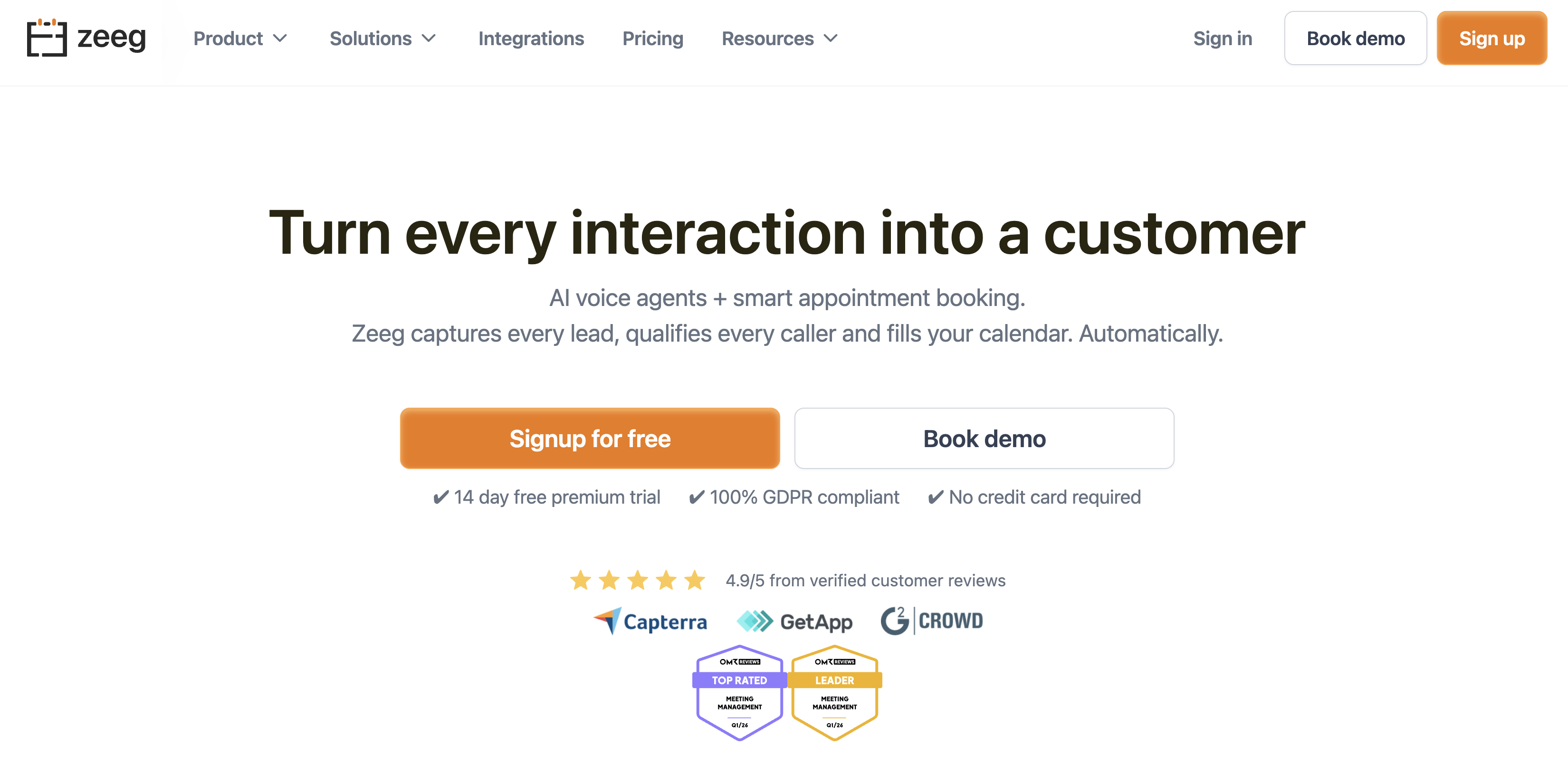
Zeeg is the only platform that natively connects AI voice agents and appointment booking in one system. When a lead calls after hours, Zeeg's AI answers, qualifies, and books the appointment — no human needed, no separate voice tool, no Zapier connector stitching two products together. Best for solopreneurs and professional service teams who need an always-on virtual receptionist, and for sales teams that need inbound qualified and booked automatically before a rep picks up the phone.
Product Overview
Most SMBs face one of two problems. Solopreneurs — doctors, lawyers, tax advisors, coaches — can't answer every call themselves and lose leads after hours. And sales teams waste rep time on repetitive qualification calls that should never reach a human. Zeeg solves both: the AI answers, qualifies, and books the appointment in the same system, with no separate voice tool nor CRM needed. One platform, one data model, one outcome — a booked appointment and an updated contact record.
This is the distinction that matters in this category. Calendly-style tools handle booking but have no voice, while Retell, Vapi, and Bland handle calls but don’t book. Zeeg does both natively — meaning the AI that answers the call is the same system that reads live calendar availability, applies routing rules, and confirms the appointment before hanging up.
GDPR compliance as a competitive advantage
For any team that handles the data of EU residents — whether based in Europe or not — GDPR compliance is a buying filter, not a nice-to-have. US-based voice tools typically require legal review, DPA negotiation, and InfoSec approval before procurement. Zeeg stores all data exclusively on German servers (Open Telekom Cloud, ISO 27001-certified data centres), is GDPR-compliant by default, and provides signed DPAs across paid plans. It passes procurement where US-based tools get stuck in legal review.
Scheduling-native voice automation
The AI phone agent reads live calendar availability across Google Calendar, Apple Calendar, and Microsoft Exchange. It applies buffer rules, routing logic, and overbooking settings defined in Zeeg. Round-robin distribution sends qualified leads evenly across available team members and automatically re-routes when someone is offline. Every booking flows into the Zeeg CRM as a contact record with full interaction history — no manual entry, no data loss between systems.
Pricing
Transparent per-user pricing — no custom enterprise negotiation for standard tiers:
- Starter (Free): Basic scheduling, no AI phone agent.
- Professional ($10/user/month annual): Advanced scheduling and calendar integrations.
- Business ($16/user/month annual): Team scheduling, round-robin distribution, routing, AI phone agent.
- Scale ($30/user/month annual): Full automation and advanced CRM workflows.
- Enterprise (custom): SSO, SCIM, API access, white-labeling, signed DPA, dedicated support.
AI voice agent minutes are billed separately from the plan, starting at €0.07/minute. All paid plans include a 14-day free trial.
Integrations and Telephony
Call forwarding from existing business lines. Native integrations with Google Calendar, Outlook/Exchange, Zoom, Microsoft Teams, Google Meet, HubSpot CRM, Zapier, Stripe, PayPal, Google Analytics, Meta Pixel, and Okta. API and webhooks available on higher tiers.
Deployment and Setup
Cloud-hosted on German infrastructure. No engineering resources required. Self-serve setup with onboarding support — teams are typically live within days, not months.
Tradeoffs
Zeeg's AI voice agents are scheduling-focused, not a general outbound calling platform. Teams that need developer-level control over ASR/TTS pipelines or custom NLU orchestration should evaluate Rasa Voice or Vapi instead. No self-hosted or on-premise deployment option. No native mobile app.
Support
Live chat, email, and contact form. Enterprise tier includes dedicated support. Documentation and onboarding available in English, German, French, Spanish, and Italian.
#4. Nuance (Microsoft): Best AI Voice Agent for Microsoft Ecosystem
Nuance brings the deepest speech recognition heritage in the enterprise voice market. Now part of Microsoft, it integrates tightly with Azure, Dynamics 365, and the broader Microsoft stack. Best for large enterprises already invested in Microsoft infrastructure.
Product Overview
Nuance Mix is the development platform for building voice and digital experiences. Dragon speech recognition technology underpins the ASR layer with decades of acoustic model refinement. Strong biometric authentication via voice prints for caller verification without passwords or PINs.
Pricing
Custom enterprise pricing through Microsoft. Typically bundled into broader Microsoft or Dynamics 365 agreements. No public per-seat or per-minute pricing.
Deployment and Telephony
Azure Cloud deployment. SIP integration with major contact center platforms. Microsoft Teams integration for internal voice use cases.
Setup
Implementation timelines vary. Large-scale deployments typically require months of tuning, particularly for ASR optimization in specialized domains.
Tradeoffs
Legacy platform complexity. The Microsoft acquisition has shifted roadmap priorities toward Azure-native experiences. Organizations not on Microsoft infrastructure face additional integration overhead. The shift from standalone Nuance to Microsoft-integrated Nuance creates uncertainty for existing customers. Strong speech recognition heritage, but the conversational AI layer is less modern than purpose-built platforms.
#5. Parloa: Best AI Voice Agent for European and DACH Markets
Parloa is purpose-built for contact center voice AI with strong European market presence, particularly in Germany, Austria, and Switzerland. Best for mid-to-large European enterprises that prioritize regional support and GDPR-native architecture.
Product Overview
Parloa's platform focuses on contact center automation with a visual flow builder for designing voice experiences. Front-end AI handles conversation management while backend integrations connect to CRM and ticketing systems.
Pricing
Custom enterprise pricing. No public tiers.
Deployment and Telephony
Cloud deployment with European data residency options. Telephony integration with major CCaaS platforms.
Setup
Implementation timelines vary by complexity. The visual builder accelerates initial setup for standard call flows.
Tradeoffs
Smaller scale than Cognigy or Nuance. Less proven at the enterprise scale of thousands of concurrent calls. Primarily DACH-focused, which limits global deployment support. No self-hosted option for organizations with strict on-premise requirements.
#6. Google CCAI / Dialogflow CX: Best AI Voice Agent for Google Cloud Ecosystem
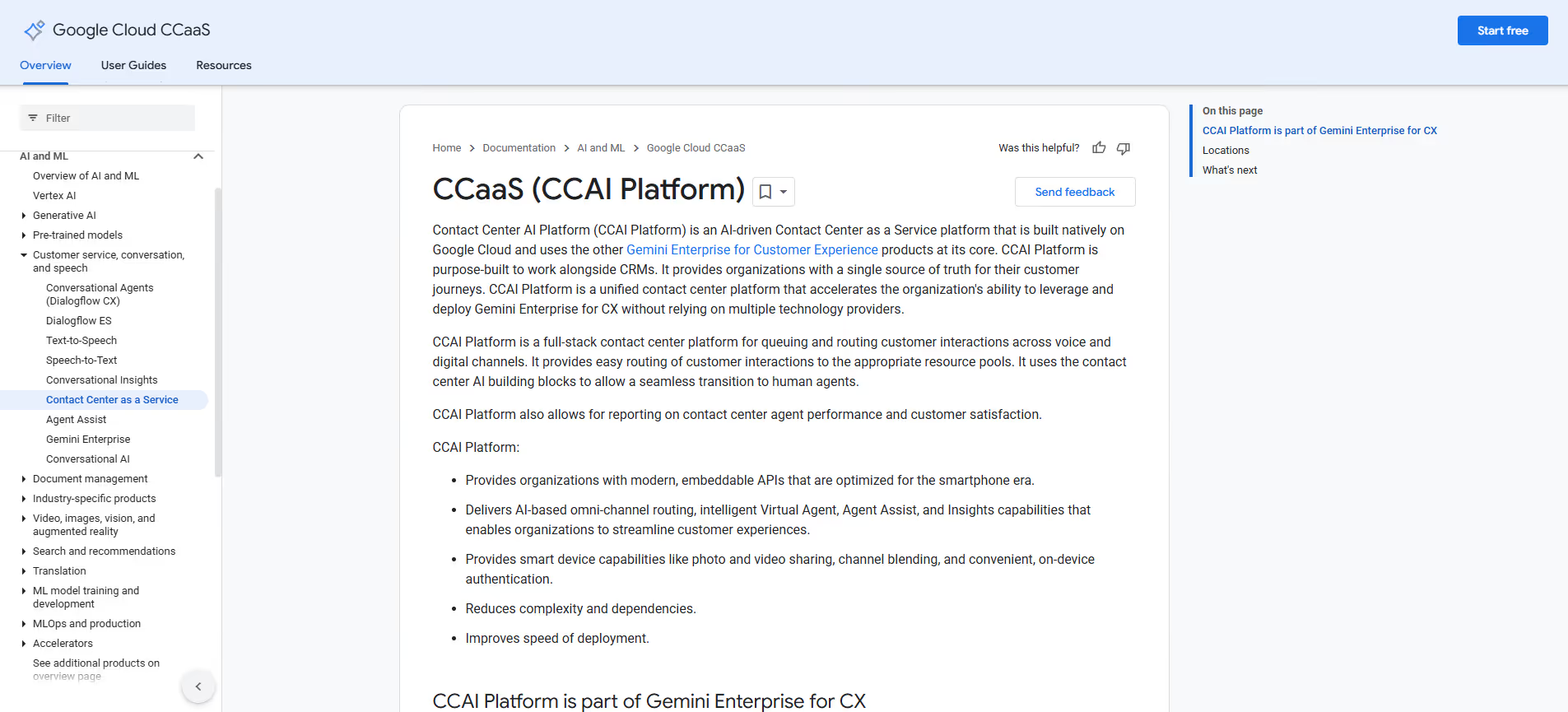
Google Contact Center AI provides modular voice components backed by Google's ASR and TTS infrastructure. Best for enterprises already on Google Cloud that want tight integration with their existing stack.
Product Overview
Dialogflow CX handles virtual agent design with a visual state-machine builder. Agent Assist provides real-time guidance to human agents during live calls. Google's speech APIs deliver strong ASR accuracy and natural TTS across many languages.
Pricing
Usage-based pricing. Dialogflow CX charges per session. Google Speech-to-Text and Text-to-Speech have separate per-minute rates. Costs scale with volume.
Deployment and Telephony
Cloud-only (Google Cloud). No self-hosted option. Partner integrations with Genesys, Avaya, Cisco, and other CCaaS platforms via CCAI Platform.
Setup
Moderate to long implementation timelines. Dialogflow CX requires familiarity with Google Cloud infrastructure. Technical resources needed for advanced configuration.
Tradeoffs
Cloud-only with no self-hosted option. Vendor lock-in to Google Cloud. Less suitable for organizations with strict data sovereignty requirements or multi-cloud strategies. The modular approach means assembling multiple services rather than a single integrated platform. Configuration complexity can be high for non-Google-native teams.
#7. Amazon Lex + Connect: Best AI Voice Agent for AWS Ecosystem
Amazon Lex provides natural language understanding and automatic speech recognition, while Amazon Connect delivers cloud contact center infrastructure. Best for organizations already running on AWS that want tight ecosystem integration.
Product Overview
Lex handles intent recognition and dialogue management. Connect provides telephony, routing, and agent desktop. Amazon Polly adds neural TTS. Together they form a full voice stack inside the AWS ecosystem.
Pricing
Pay-per-use model. Lex charges per speech request. Connect charges per-minute for telephony. Polly charges per character for TTS. Cost-effective at moderate volume if already on AWS.
Deployment and Telephony
Cloud-only (AWS). Native telephony via Amazon Connect with direct inward dialing. SIP trunking for existing phone systems.
Setup
Fast for basic deployments on AWS. Production voice implementations with custom integrations require weeks to months depending on complexity.
Tradeoffs
Cloud-only with AWS lock-in. Basic conversational agent capability compared to purpose-built voice platforms. Dialog management is less sophisticated than Rasa CALM or Cognigy for complex multi-turn voice conversations. Building production-grade voice experiences requires significant custom development beyond the Lex/Connect baseline.
#8. SoundHound: Best AI Voice Agent for Speech-to-Meaning Speed
SoundHound's proprietary speech-to-meaning engine processes spoken language without a traditional ASR-then-NLU pipeline, reducing latency for specific use cases. Strong in automotive, restaurants, and IoT. Best for vertical-specific deployments where speed of understanding is the primary requirement.
Product Overview
The SoundHound Houndify platform uses a proprietary approach that extracts meaning directly from audio rather than converting to text first. This architecture enables fast response times for structured queries.
Pricing
Custom pricing based on deployment type and volume. No public tiers.
Deployment and Telephony
Cloud deployment. Telephony integrations available for contact center use cases.
Setup
Implementation timelines vary by vertical and use case complexity.
Tradeoffs
More vertical-specific (automotive, restaurants, IoT) than enterprise contact center-focused. Less proven in large-scale enterprise support environments. Limited self-hosted options. The Amelia acquisition expanded SoundHound's enterprise footprint, but integration of the two platforms is still evolving.
#9. CCaaS Vendors (Genesys, NICE, Five9): Best for Packaged Voice AI Inside Existing Stacks
If you already run Genesys, NICE CXone, or Five9 for telephony and routing, their built-in AI voice capabilities provide the fastest path to basic voice automation. Best for contact centers committed to one CCaaS vendor that need incremental automation without changing their infrastructure.
Product Overview
Each CCaaS vendor now offers AI-powered voice bots, agent assist, and conversational IVR within their platform. Genesys Cloud has native bot flows with Google CCAI integration. NICE CXone Mpower includes Cognigy-powered conversational AI following the acquisition. Five9 offers IVA Studio with built-in voice automation.
Pricing
Typically bundled into existing CCaaS contracts. AI capabilities may require additional modules or per-minute fees. Total cost depends on your existing agreement.
Deployment and Telephony
Vendor cloud only. Native telephony integration within the CCaaS stack.
Setup
Fastest path to basic automation if you are already on the platform. Weeks for standard IVR replacement. Months for complex multi-turn voice agents.
Tradeoffs
Vendor lock-in: your voice agent experience is tied to one stack. Limited reuse across channels or outside the vendor's ecosystem. Switching costs are high. The agent intelligence is packaged, not owned. You cannot modify core voice processing logic, swap speech providers independently, or deploy outside the vendor's infrastructure. For narrow, well-defined call types this works. For enterprises that need to own and evolve their voice system, CCaaS-packaged voice AI hits a ceiling.
How to Choose the Best AI Voice Agent for Your Enterprise Contact Center
Frame this as an actionable decision. Each step should be specific enough that a contact center leader can execute immediately.
Step 1: Define Your Voice Ownership Model
Three paths exist. Voice AI packaged inside your CCaaS vendor (fast but locked). A sovereign voice platform you own and evolve (Rasa Voice approach). Or a DIY stack stitching together ASR, TTS, NLU, and orchestration.
CCaaS-packaged voice is the fastest path for narrow call types. DIY gives maximum control but requires months of infrastructure buildout. Sovereign platforms like Rasa Voice give you ownership and speed without rebuilding the engine.
Most enterprise teams with regulated data or multi-channel requirements need ownership.
Step 2: Assess Latency and Conversation Quality Requirements
Voice punishes delays in a way text never does. Test end-to-end latency: from caller utterance to agent response. Evaluate turn-taking (can the agent handle interruptions?), recovery (what happens when the caller changes direction mid-sentence?), and emotional handling (does the agent stay calm and clear when the caller is frustrated?).
Demo latency and production latency at scale are different numbers. Ask vendors for production benchmarks, not demo metrics.
Step 3: Verify Data Sovereignty and Compliance Fit
If you are in financial services, healthcare, government, or telco: can you deploy the voice agent in your environment? Does voice data stay on your infrastructure? Can you audit what the agent did and why?
Cloud-only platforms are disqualified for many regulated contact centers. Self-hosted deployment is not optional for organizations where voice data is classified as sensitive.
Step 4: Test Cross-Channel Continuity
Run a real customer journey that starts in one channel and finishes in another. Does the voice agent know what happened in the chat session? Does context carry across without the customer repeating themselves?
This is where most platforms break. Most voice AI treats voice as an isolated channel. Enterprise customers do not interact in isolated channels.
Step 5: Evaluate ASR/TTS Flexibility
Are you locked to one speech provider, or can you choose the best ASR and TTS for your use case? Can you fine-tune speech recognition for your domain (industry jargon, accents, product names)?
Fine-tuning is the difference between a demo that works and production that holds up. Rasa Voice supports built-in integrations with Deepgram, Cartesia, Azure Speech, and Rime, with the ability to build custom ASR/TTS components for other providers.
For domains with heavy jargon, accents, or product names, an accuracy-focused ASR like real-time speech-to-text API can be integrated as a custom component to improve transcription quality before it ever reaches the agent.
Step 6: Run a Production Pilot on a High-Volume Queue
Pick a high-volume, repeatable call type. Track: time-to-first-meaningful-action, call abandonment rate, containment rate, escalation quality (did the human agent receive proper context?), and caller satisfaction.
A pilot on low-volume, easy calls proves nothing. Test where volume is high and call complexity is real.
AI Voice Agent Pricing Models and Costs in 2026
Pricing in the AI voice agent category falls into four models, and each creates different cost curves at scale.
Platform licensing: Annual fee based on conversation volume. Rasa Voice Growth starts at $35,000/year for up to 500,000 conversations. Speech provider costs are separate.
Per-minute / per-call: Usage-based pricing common with Google CCAI, Amazon Lex, and some CCaaS vendors. Predictable at low volume, can spike at scale.
Enterprise custom: Cognigy, Nuance, Parloa, and SoundHound negotiate per-deal. Typical enterprise voice contracts start in the low six figures.
CCaaS bundled: Voice AI packaged into existing contact center contracts. Often requires add-on modules with per-minute surcharges.
Total cost of ownership includes: platform licensing, ASR/TTS provider costs, telephony infrastructure, implementation and onboarding, and internal engineering for customization and maintenance.
Key Features to Look for in an Enterprise AI Voice Agent
Human-Fluent Turn-Taking and Interruption Handling
Enterprise callers interrupt. They change direction mid-sentence. They talk over the agent. A production voice system must handle barge-ins gracefully, detecting true interruptions from background noise and adjusting mid-response. Rasa's Voice Stream channels use partial ASR transcripts to detect when a caller speaks over the agent and stop playback.
Emotional Clarity and Tone Management
A frustrated caller escalating a billing dispute requires a different vocal response than a routine status check. Voice agents need to match tone to context. This means selecting appropriate TTS voices, pacing responses, and avoiding robotic delivery during charged moments.
Voice Streaming and Low-Latency Audio Processing
Voice Stream architecture processes audio directly rather than converting to text, processing, then converting back. This reduces round-trip latency. Rasa Voice targets sub-second latency from end-of-speech to agent response. The difference between 500ms and 2000ms response time is the difference between a natural conversation and a frustrating one.
Sovereign and Self-Hosted Deployment
Regulated industries cannot put customer calls inside a vendor's cloud. Self-hosted deployment means voice data stays in your environment, under your controls. Rasa deploys on-premise or in your private cloud. Most cloud-only platforms are disqualified for financial services, healthcare, government, and telco.
Cross-Channel Continuity (Voice + Chat)
Customers do not operate in single channels. They start in chat, switch to voice, call back days later. The voice agent must know what happened in every previous interaction. Rasa's orchestration and memory layers carry context across channels, sessions, and skills.
Custom ASR/TTS and Fine-Tuning
Default speech models struggle with industry jargon, regional accents, and product names. Choose your own ASR and TTS providers. Fine-tune for your domain. Rasa Voice supports Deepgram, Cartesia, Azure, and Rime out of the box, with a framework for building custom speech integrations.
Orchestration Across Skills and Backend Systems
A voice agent that can only answer questions has limited value. Production voice agents need to look up accounts, process transactions, open tickets, and escalate to humans with full context. Action Server custom actions, MCP server connectivity (beta), and A2A protocol (beta) enable voice agents to execute real business logic.
Observability: Trace What the Voice Agent Did and Why
When a voice call goes wrong, you need to trace the full path. What the caller said. How the ASR transcribed it. What intent the system detected, what action it took, and why. Without this, debugging production voice issues is guesswork.
Clean Human Handoff with Full Context Transfer
When the voice agent escalates, the human agent must receive everything: what the caller asked, what the agent tried, what data was collected, and why the escalation happened. A clean handoff means the caller does not repeat themselves. A bad handoff erases whatever trust the voice agent built.
Best AI Voice Agent for Sovereign / Self-Hosted Deployment
Sovereign voice means phone experiences that run in your environment, under your controls. Not inside a vendor's hosted infrastructure.
For regulated industries, this is not optional. Voice data is sensitive. Compliance is non-negotiable. Cloud-only voice AI is a blocker for financial services teams that must keep call recordings on-premise. It blocks healthcare organizations bound by HIPAA, government agencies with data sovereignty mandates, and telcos handling millions of customer interactions.
Very few AI voice platforms offer self-hosted voice deployment. Most are cloud-only by design.
Rasa Voice deploys on-premise or in your private cloud. You decide where it runs, what it connects to, and how voice data flows. Rasa does not host any customer data, systems, or applications. Cognigy supports on-premise deployment for regulated contact centers. Most other platforms in this guide (Google CCAI, Amazon Lex, Parloa, SoundHound, CCaaS vendors) are cloud-only.
Best AI Voice Agent That Works Across Voice and Chat Channels
Most voice platforms treat voice as an isolated channel. The customer calls, the system responds, the call ends. If the same customer was chatting yesterday, the voice agent has no idea.
Real customer journeys cross channels. A customer opens a billing dispute in chat, then calls back the next day because the issue is not resolved. They should not have to explain the problem from scratch.
Rasa's multi-agent orchestration solves this. Session memory maintains coherence within a single call. Long-term memory carries context across sessions and channels. The same skills, the same business logic, and the same state management work across voice and chat. One agent experience, regardless of surface.
This is where most platforms fail evaluation. Run the test: start a customer journey in chat, then continue in voice. If the voice agent asks the customer to repeat everything, the platform does not support true cross-channel continuity.
Which AI Voice Agent Is Right for Your Business?
CCaaS-packaged voice (Genesys, NICE, Five9): Choose if you have narrow, well-defined call types, are already committed to one vendor stack, and do not plan to own or evolve the voice system independently.
Cloud ecosystem (Google CCAI, Amazon Lex): Choose if you are deeply invested in Google Cloud or AWS, your compliance allows cloud-hosted voice data, and you have the engineering resources to assemble components.
Enterprise platform (Cognigy, Nuance): Choose if you need high-volume contact center scale, have budget for enterprise contracts, and want broad voice automation coverage within an existing analyst-validated platform.
Rasa Voice: Choose if you need sovereign deployment. You operate in a regulated industry. You need voice and chat continuity. You want to choose your own speech providers. And you need voice quality that holds up in production, not just in demos.
FAQs
What is the best AI voice agent platform for customer support?
Rasa Voice, for enterprise teams needing sovereign deployment, cross-channel continuity, and human-fluent conversation quality. Rasa's Voice Stream architecture delivers sub-second latency with built-in barge-in handling and configurable silence detection. Orchestration across skills and backend systems lets voice agents execute real business actions, not just answer questions. For high-volume contact centers, Cognigy is a strong alternative.
What is the best conversational agent for enterprises?
Rasa, for teams that need one agent across voice and chat. Rasa's patented CALM dialogue manager handles natural language understanding while deterministic business rules control every action. Self-hosted deployment keeps data in your environment. For enterprises already on Microsoft infrastructure, Nuance integrates tightly with Azure and Dynamics 365.
How to approach latency when choosing an AI voice agent platform?
Test end-to-end, not component-by-component. Measure from the moment the caller finishes speaking to the moment the agent begins responding. Voice Stream architectures that process audio directly reduce latency versus Voice Ready setups that depend on external transcription. Demo latency and production latency at scale are different numbers. Ask vendors for production benchmarks under real concurrency loads.
What are the main security and compliance questions to ask AI voice agent vendors?
Start with deployment model: can you self-host, or is it cloud-only? Then: where does voice data live? Who has access to recorded calls? What audit trails exist for every agent decision? What encryption is applied to voice data in transit and at rest? Does the platform support PCI DSS for secure data collection via DTMF? Rasa's self-hosted model means voice data never leaves your environment.
How to run a pilot before committing to an AI voice agent tool long term?
Pick a high-volume, repeatable call type. Route real callers, not scripted test scenarios. Track time-to-first-meaningful-action, containment rate, call abandonment rate, escalation quality (did the human agent receive full context?), and caller satisfaction. Run for at least 4 weeks to capture volume patterns. A pilot on low-volume, easy calls proves nothing.
Can AI voice agents replace human agents?
No. Voice agents automate specific, repeatable call types: account lookups, status checks, appointment scheduling, password resets. The goal is getting to the first meaningful action faster and handling the volume work so humans can focus on complex, high-empathy moments. The best implementations augment human teams rather than replace them.
How accurate are AI voice agents?
ASR accuracy varies by domain. General-purpose models achieve 85-95% word error rates on clean audio. Domain-specific fine-tuning improves accuracy for industry vocabulary, accents, and product names. Accuracy in production is different from accuracy in testing because production calls include background noise, crosstalk, and emotional speech. Rasa Voice supports fine-tuning and choice of ASR provider to optimize for your specific domain.
What's the best voice agent for companies that need reducing call abandonment rates?
Faster time-to-first-meaningful-action reduces abandonment. The first moment the caller feels progress is what keeps them on the line. Voice streaming for faster response, orchestration for getting to the right action quickly, and memory for avoiding repetition all contribute. Rasa Voice's sub-second latency and CALM-driven orchestration help callers reach resolution faster.
Which voice agent should I use if I need custom ASR/TTS and telephony integration?
Rasa Voice. Choose your own speech providers rather than being locked to one vendor's stack. Built-in integrations with Deepgram (ASR/TTS), Cartesia (TTS), Azure Speech (ASR/TTS), and Rime (TTS). Build custom ASR/TTS components for providers not included. Telephony via Twilio, Jambonz, AudioCodes, and Genesys Cloud voice channel connectors.
What's the best AI voice agent for contact centers that cannot use cloud-hosted solutions?
Rasa Voice. Self-hosted deployment runs in your environment, on your infrastructure. Voice data stays under your control. Rasa does not host any customer data, systems, or applications. Non-negotiable for financial services, healthcare, government, and telco organizations where cloud-hosted voice data is a compliance blocker.