
Today, most customers are used to calling their financial institution and being greeted by an automated message. It’s actually more out of the ordinary to speak to a human first; you might even think you dialed the wrong number.
A voice agent for banking is an AI agent that handles phone conversations about accounts, payments, cards, fraud, and lending. It understands how customers actually talk, then carries out the request through your banking systems, within rules your risk and compliance teams can read and audit.
Voice agents in the FinServ space can be tricky; they have to be both capable and reliable to be useful. After all, sharing sensitive financial information over the phone is not something to take lightly, and customers will say things in a hundred different ways. The answer to "what is my balance" or "I lost my card" cannot vary at all.
Rasa is the agent building platform for AI product teams building these kinds of agents across voice and chat. This guide covers where voice agents fit in banking customer service, what regulated teams should require before launch, and how to evaluate a platform.
What is a voice agent in banking?
A voice agent in banking is a spoken-language AI agent that completes customer tasks over the phone. It listens, works out what the customer needs, takes action in connected systems, and either finishes the job or hands the call to a person with the context attached.
Three things make it different from what came before:
- Legacy IVR menus make customers navigate "press 1, press 2" trees. A voice agent lets them say what they want.
- Voice agents built only on a large language model sound fluent, but they can improvise. In a regulated setting, improvisation is a risk, not a feature.
- A well-built banking voice agent combines both. A language model handles understanding. Defined logic handles decisions.
Underneath, a voice agent is a set of skills, each handling one job such as checking a balance, freezing a card, or booking a branch appointment. An orchestrator decides what the customer needs and routes the conversation to the right skill.
Where voice agents fit in banking customer service
Banks field high volumes of calls, and many follow familiar patterns. These are the areas where voice agents are in use across voice and digital channels.
The agent should handle the routine and repeatable work well, and the handoff to a person should be fast, with the full conversation context passed along so customers never repeat themselves.
Why regulated banking needs more control
A retailer can tolerate an agent that sometimes rephrases an answer badly. A bank cannot tolerate one that states a wrong fee, skips a required disclosure, or reveals account details before verification.
Financial services buyers consistently weigh three concerns above the rest:
- Compliance. Every answer on a regulated topic has to be correct and defensible.
- Deployment control. Where the agent runs, and who can see the data, matters to risk and security teams.
- Transparency. Teams need to see why the agent did what it did, and show it to an auditor.
These concerns are why many banks look past tools that run entirely on a vendor's hosted infrastructure and toward platforms they can run inside their own environment. Control here is a benefit to the business. It lets teams move faster because risk and compliance can approve what they can inspect.
The hybrid approach: language models for understanding, defined logic for decisions
The most reliable pattern for regulated voice agents splits the work by what each approach does best.
- Language models handle understanding. They interpret intent and the many ways customers phrase the same request, including interruptions, corrections, and accents that trip up rigid systems.
- Defined logic handles decisions. Compliance-sensitive steps, transactional actions, and escalation paths follow explicit rules that behave the same way every time.
Take a lost-card call. The agent understands "I think I left my card in a taxi" without a keyword match. From that point, the steps are fixed: verify the customer, confirm which card, block it, offer a replacement, read the required wording, and log the action. The customer gets a natural conversation. The bank gets a process it can audit.
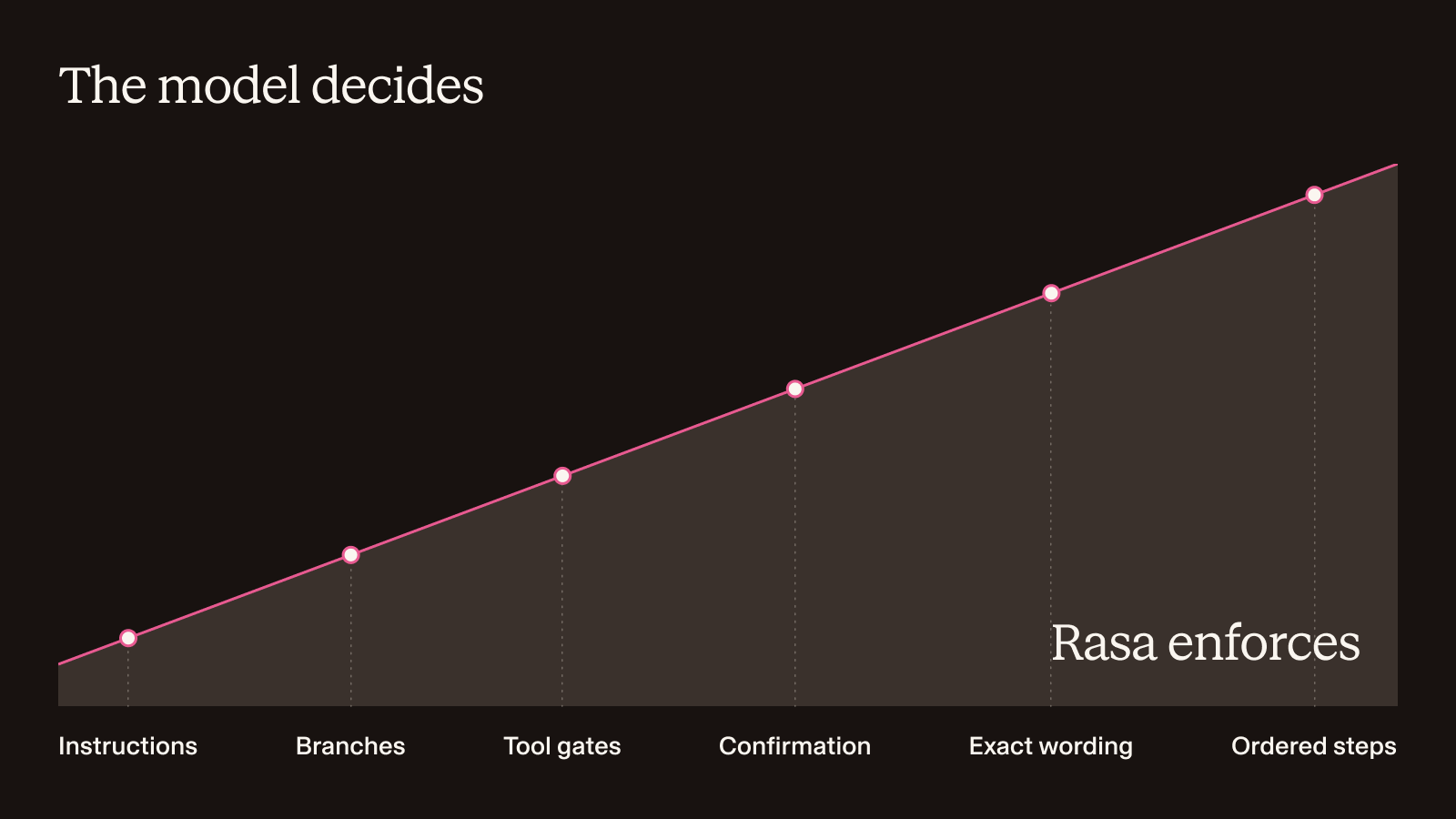
In Rasa, voice and chat agents are built from composable skills, coordinated at runtime by an orchestrator called Mantle. Progressive control lets each skill start as plain instructions and add deterministic guarantees where the business requires them. So, where a mistake is expensive, you can constrain it with tool constraints, skill prerequisites, or ordered blocks.
Security and data privacy for voice agents in banking
Voice carries sensitive data in a way chat often does not: account numbers read aloud, spoken answers to security questions, names and addresses. A voice agent deployment needs to answer these questions up front:
- Where does the data go? Audio, transcripts, and conversation history should stay within an environment the bank controls. Self-hosting or deployment in the bank's own cloud account keeps customer data where existing security policies already apply.
- How is personal data handled? Look for PII handling and redaction in transcripts and logs, not just in the live call.
- What can the agent access? Connect the agent to core banking platforms, CRMs, payment systems, authentication services, and fraud tools through controlled integrations with least-privilege access.
- Who owns the data and the logic? Organizations should own their agent orchestration, business logic, conversation data, and memory. That ownership makes it possible to change hosting or infrastructure later without starting over.
The goal is to fit into the security model a bank already runs, not to ask for exceptions to it.
Voice AI compliance in banking
Requirements differ by country and product, so confirm specifics with your own compliance team. The principles are consistent:
- Predictable answers on regulated topics. Rates, fees, eligibility, and disclosures come from approved content and defined logic, not from open-ended generation.
- A complete audit trail. Every conversation should be traceable at the level of what was said, what the agent decided, and which systems it called.
- Guardrails that act before a response, not after. Rules that block a non-compliant answer from being spoken are more reliable than review after the fact.
- Testing before release. Run simulations against realistic and adversarial calls, and use A/B tests to compare changes. Treat a release like a software release, with versioning, review, and staging.
- Room to change. Products and regulations change. The agent should be easy to update without rebuilding it.
Architecture checklist for a banking voice agent
Use this list when scoping a build or reviewing a vendor.
- Speech layer. Speech-to-text and text-to-speech tuned for your languages, accents, and call-center audio.
- Telephony. Connection to your contact center and phone infrastructure.
- Orchestration. A way to route the conversation between skills and hold the context between turns.
- Skills and flows. Defined tasks for each use case, with explicit steps for regulated actions.
- Integrations. Core banking, CRM, payments, authentication, fraud tools, and knowledge sources, working with the infrastructure you already have.
- Deployment. The option to self-host or deploy in your own cloud environment.
- Guardrails and governance. PII handling, response controls, audit logging, and release controls.
- Testing and insight. Simulations, A/B tests, and conversation analytics.
Rasa’s platform architecture consists of three layers:
- Velocity covers the skills library, visual builder, insights, simulations, and A/B tests.
- Enterprise Readiness covers PII handling, guardrails, audit, telephony, and release operations.
- Capabilities covers models, retrieval, memory, and integrations.
Teams can use this framework when evaluating a voice agent on any platform. Ask: how fast can we build? Can we run it safely? And what can it do?
Voice is one channel, not a separate stack
Customers do not think in channels. They start in the mobile app, call when it gets complicated, and expect the bank to know what happened.
Building voice as a separate system creates a second set of logic to maintain and a second place for compliance to review. A better pattern is to build the agent once and let voice be one of its channels, alongside chat and in-app messaging. The same skills, rules, and integrations then serve every channel. When a fee policy or a disclosure changes, you update it in one place.
This approach also works with the stack you already have. A platform should connect to the tools your teams use today instead of asking you to replace them.
How banks and financial institutions use Rasa
Financial institutions use Rasa to automate high-volume service while keeping control of execution, deployment, and data handling. N26 uses Rasa for regulated banking customer service, deflecting 30% of routine customer service contacts, and nib Group leverages Rasa agents for insurance, leading to a 26% increase in self-service.
The Rasa platform is built for teams that manage agents like software, with versioning, testing, review, staging, and deployment inside their own workflows. Rasa Studio, part of the platform, lets non-technical users, like conversation designers and subject-matter experts, test, review, and refine agent behavior without owning the codebase. Engineering capacity is still part of a successful deployment, particularly for self-hosting, code-based logic, and CI/CD.
How to evaluate a voice agent platform for a bank
Platforms generally fall into a few categories. Each has real strengths.
- Hosted agent services can get a first pilot running quickly, and they take infrastructure off your plate. The tradeoff is less control over where data lives and how decisions are made.
- Point solutions for a single use case can be strong at one job. Banks often outgrow them when they want a second use case or a second channel.
- Building from scratch gives maximum control and the most work. It suits teams with deep engineering resources and a long timeline.
- Agent building platforms give you structure and speed while letting you own the logic, data, and deployment. This is the category Rasa is in.
Questions to ask any vendor:
- Can we run it in our own environment?
- How are regulated answers controlled, and can we show an auditor?
- What does a conversation-level audit trail contain?
- Does it work with our existing systems, and how much integration work is involved?
- How do we test changes before release?
- What will it cost to run over three to five years, including hosting, engineering time, and change management?
Check each answer against the vendor's published documentation and benchmarks instead of the sales deck.
Frequently asked questions
Is voice AI secure enough for banking?
Yes, when it runs inside the security model the bank already uses. That means controlled hosting, PII handling in audio and transcripts, least-privilege access to banking systems, and a full audit trail. Self-hosting or deployment in the bank's own cloud keeps customer data under existing policies.
Can voice agents meet banking compliance requirements, and how do you prevent non-compliant answers?
They can, when regulated steps follow defined logic instead of open-ended generation. Approved content and explicit rules govern rates, fees, and disclosures. Guardrails block a response before it is spoken, and every conversation is logged for audit. Confirm specific requirements with your compliance team.
What banking customer service tasks can a voice agent handle?
Common tasks include account servicing, transaction and payment status, fraud-related interactions such as blocking a card, and lending journeys such as application status and document collection. Complex disputes and credit decisions typically hand off to a person with full context.
Should a bank self-host its voice agent?
Many banks do, because it keeps data in their own environment and satisfies data sovereignty requirements. Self-hosting needs engineering capacity for deployment and operations. Rasa supports self-hosted and own-cloud deployment, and hosted options may suit teams that want to start faster.
How long does it take to launch a voice agent?
It depends on scope, integrations, and approvals. A focused first use case can reach production in weeks, while a broader rollout takes longer. Starting with one high-volume, well-defined task is a common way to prove value. [VERIFY the N26 timeline before citing it here.]
How does voice banking differ from a voice agent a bank builds and owns?
Voice banking often refers to using a voice assistant on a phone or smart speaker to ask about an account. A voice agent a bank builds and owns is part of the bank's own service operation. The bank controls the logic, the data, the hosting, and the experience across channels.
Next steps
If you are scoping a voice agent for a bank, start with one use case, the compliance requirements that apply to it, and the systems it needs to reach. Then check each platform against the checklist above.
To see how Rasa approaches banking voice agents, book a demo or try Rasa Platform with the Developer Edition.