
There's a difference between having an agent platform and running an agent factory. Most enterprises invest in the former without knowing the latter is where value actually compounds.
With an agent platform, every user can build – but they build from scratch for every use case. As a result, there are a lot of AI initiatives across the organization, but the value of each is isolated. Teams spend most of their time rebuilding the same foundational components instead of the skills that actually differentiate them with customers.
At Rasa, we believe the most ambitious enterprises need more. They need an agent factory.
An agent factory is built on a shared foundation of reusable components, integrations, capabilities, and skills that are owned and governed by a central platform team. This layer enables users, both technical and not, to build agents repeatedly and quickly, driving compounding value with every additional use case.
This is what Rasa now delivers.
Today, I’m thrilled to reintroduce the Rasa platform, built to enable AI product teams to turn their agent platform into a high-velocity agent factory.
Why it’s time to invest in an agent factory
I recently spoke to an AI product team leader who described their AI setup to me: "We've got a few people building in Copilot. We stood up our own agent platform. We're doing voice AI separately. I don't know how we get from all of that to anything like centralized governance."
I hear a version of this constantly. Enterprise organizations building AI need two things: 1) federated development, where every team is free to build what it needs, fast, and 2) centralized governance, so they can set standards and manage risk across every use case.
Most agent platforms force a choice. Choose freedom to develop and you get AI fragmentation and compliance risks. Prioritize control and AI innovation stalls behind a central team.
With Rasa, teams get an agent factory that provides both. A central team owns and governs the shared reusable skills, standards, and guardrails. Everyone else – engineers, analysts, product managers, domain experts who know your customers – builds on top of that layer.
This means any member of an AI product team can build with Rasa in the environment they work best: the terminal, an agentic IDE, or their preferred visual interface.
And, because no enterprise is starting their AI development from a blank page in 2026, Rasa’s platform is built to work alongside what you've already invested in, not replace it. You can customize Rasa’s open code with your own components and tools to shape the platform around how you already work.
Introducing Mantle, the engine powering the agent factory
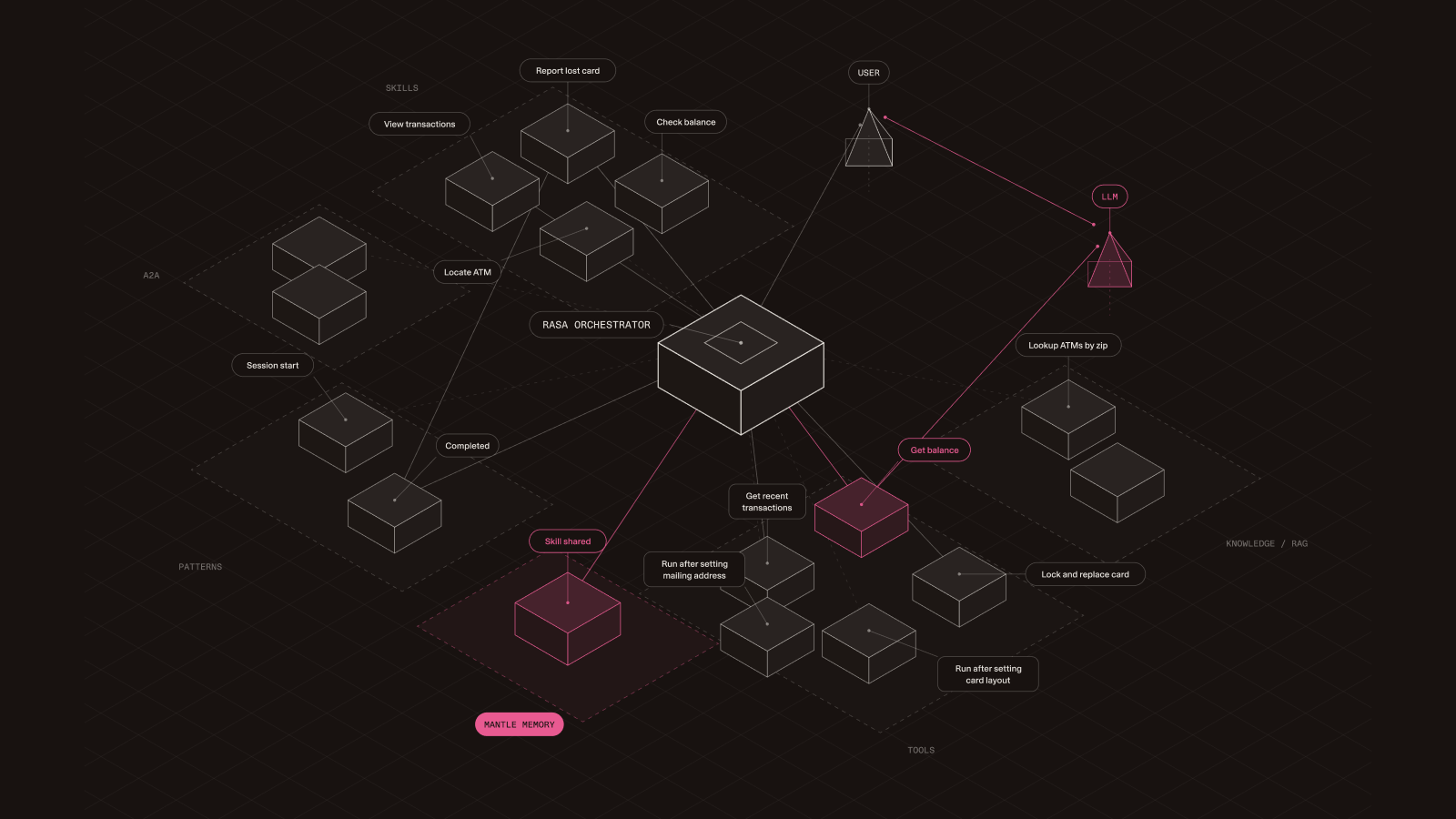
The engine that makes this agent factory possible is Mantle, the new orchestrator at the center of Rasa.
Mantle lets teams of teams build agents rapidly in natural language, evaluate automatically against hundreds of simulated customers, ship changes confidently without breaking what's live, and improve continuously from real conversations.
On September 30 at 11am ET, we'll show this live. You’ll see how builders in different environments collaborate on one shared agent without silos or rework. Tune in here.
Own your agents
I founded Rasa in 2016 and one belief has held the whole way: the best people to build your agents already work for you. The people who know your customers should be building the experiences that serve them, not outsourcing that judgment to a black box.
That's the whole reason to own your platform, and the whole reason we built Mantle.
You can start building with Mantle today. Speak to our team to get started.