Healthcare call centers are drowning. The average health system fields thousands of phone calls daily for appointment scheduling, prescription refills, billing questions, and insurance verification. Staff turnover in administrative and front-desk roles runs 30-40% annually, and average hold times hit 4.4 minutes, with many systems reporting far longer waits during peak periods. Voice is becoming the front door for service again, but with a higher bar than chat. Patients call when they need clarity fast, when the stakes feel real, and when they do not want to explain everything twice. AI voice agents offer a way out: automated, conversational systems that handle routine patient interactions with natural speech instead of rigid phone menus. For healthcare providers struggling with patient access bottlenecks, voice AI agents can serve patients around the clock without adding headcount.
This guide covers what healthcare voice AI actually does, the use cases driving adoption, the top voice agent platforms available in 2026, and how to evaluate and deploy a HIPAA-compliant voice AI solution in a compliance-sensitive environment.
What Are AI Voice Agents in Healthcare?
An AI voice agent for healthcare is a conversational AI system that interacts with patients and staff through spoken language over the phone or other voice channels. Unlike traditional interactive voice response (IVR) systems that force patients through numbered menus and scripted prompts, voice agents use natural language understanding and natural language processing to interpret patient speech in real time and respond with human-like conversations. Some organizations refer to these as a healthcare voice bot, though modern systems go well beyond basic bot functionality.
In a typical interaction, a patient calls their provider's office and says something like: "I need to reschedule my Thursday appointment with Dr. Patel to sometime next week." A voice agent processes that request end-to-end: it identifies the patient, locates the existing appointment, checks Dr. Patel's availability, and confirms a new time slot, all through natural conversation without transferring the call.
The underlying technology stack combines three core components. Automatic speech recognition (ASR) converts patient speech into text that the system can process. Language understanding interprets the meaning behind those words, handling ambiguity, context shifts, and multi-turn medical conversations. Text-to-speech (TTS) generates spoken responses that sound natural rather than robotic, delivering accurate responses through human-like conversations.
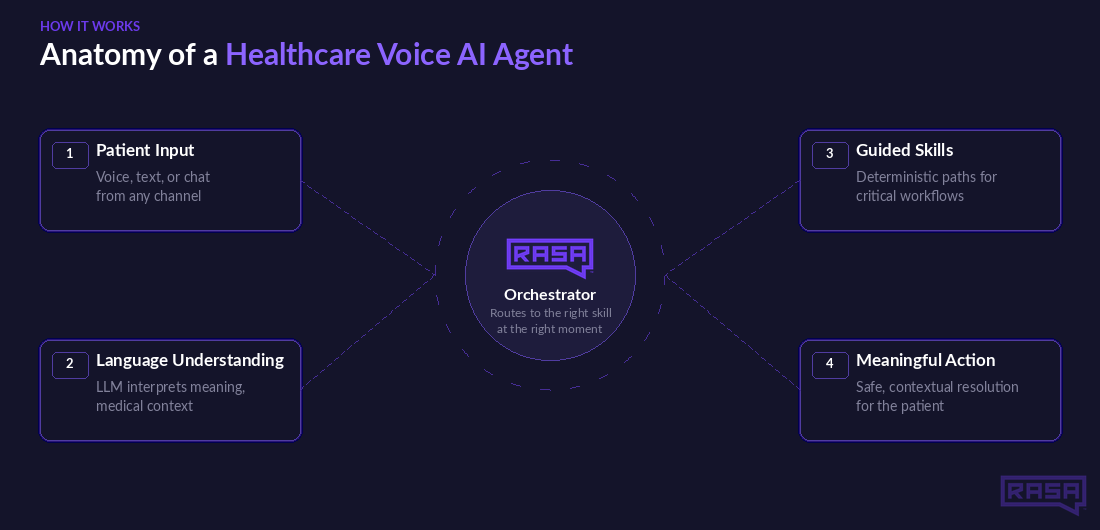
What separates healthcare voice agents from general-purpose virtual assistants is the regulatory and clinical overlay. These systems must handle protected health information (PHI) under HIPAA with enterprise-grade security, integrate seamlessly with electronic health record (EHR) systems like Epic and Cerner, and deliver medical terminology accuracy high enough that a misheard "Lipitor" doesn't become "Lisinopril." Platforms like Rasa address this through a composable agent design that separates what the agent understands from what it's allowed to do. Rasa's Orchestrator coordinates guided skills for critical workflows like scheduling and triage, while LLMs help interpret user requests and generate natural responses. The Orchestrator ensures that only approved workflows and actions are executed, delivering safe, predictable agent behavior without sacrificing conversational quality.
Key Use Cases for AI Voice Agents in Healthcare
Healthcare organizations are deploying voice agents across administrative, clinical, and financial workflows to improve patient engagement and streamline the patient journey. The highest-impact use cases share a common trait: they involve high-volume, repetitive appointment calls and patient inquiries that follow predictable patterns but still require conversational flexibility.
Patient Scheduling and Appointment Management
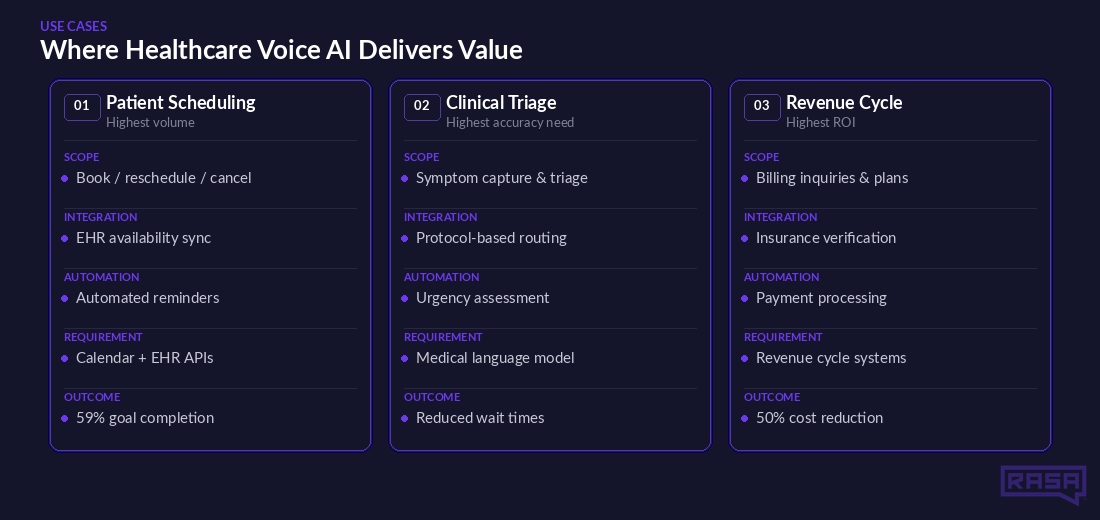
Scheduling is the most common entry point for healthcare voice AI. A single mid-sized health system may process hundreds of thousands of scheduling calls per year, and the majority follow predictable workflows: book, confirm, reschedule, or cancel.
Voice agents handle this by pulling real-time availability from the EHR, verifying patient identity, checking insurance details and eligibility, and confirming the appointment, all in a single call. They also send automated reminders, schedule follow-up appointments, and handle the inevitable calls when patients need to change times. Rasa's healthcare solutions support this full journey, from scheduling through confirmations and reminders, without forcing patients into portal logins or hold queues.
The measurable impact is significant. Leading health systems deploying voice AI for scheduling report significant improvements in call abandonment and wait times, along with gains in operational efficiency. Rasa reports that enterprise deployments achieve goal completion rates around 59% in production assistants, with scheduling automation as a primary driver, since most patient calls follow predictable patterns that guided skills handle end-to-end.
Clinical Triage and Symptom Assessment
Voice calling AI agents for healthcare triage are increasingly used for front-line clinical support, closing care gaps by helping guide patients who call with symptoms and need guidance on next steps. The agent captures symptom patterns, assesses urgency based on clinical protocols, and routes patients appropriately: to an emergency department, an urgent care appointment, a telehealth visit, or a nurse callback for treatment plans.
The critical requirement here is accuracy. A triage agent who misunderstands "chest pain" or fails to flag a patient describing stroke symptoms creates clinical risk. This is where language understanding quality matters most for patient care. Platforms with customizable understanding, like Rasa's hybrid approach that combines guided skills with LLM-driven flexibility, allow healthcare organizations to train agents on domain-specific medical vocabulary rather than relying on general-purpose language models.
Revenue Cycle and Billing Automation
Billing inquiries are the second-highest volume call category for most health systems. Patients call to understand charges, verify what their insurance covers, set up payment plans, or dispute bills. These calls are frustrating for patients and expensive for providers.
Voice agents automate these routine interactions in this workflow. They verify patient identity, pull billing information from the revenue cycle management system, explain charges in plain language, and process payments or route complex disputes to human specialists, supporting revenue protection across the billing cycle. Platforms specializing in administrative healthcare calls report automating millions of calls annually, with some vendors logging over 100 million minutes of healthcare conversations to date.
Top AI Voice Agent Platforms for Healthcare (2026)
The healthcare voice AI market includes both healthcare-specialized platforms and general-purpose agent frameworks adapted for clinical environments. Healthcare leaders and healthcare companies evaluating solutions will find that the right choice depends on your organization's technical capabilities, compliance requirements, and how much control you need over agent behavior in the healthcare industry.
1. Rasa: Best for Custom Enterprise Voice AI
Rasa is an enterprise agent orchestration platform used by organizations that need full control over their voice agent's behavior, patient data, and deployment infrastructure. For healthcare organizations where PHI protection is non-negotiable, Rasa's sovereign deployment model lets you run entirely on-premise or in a private network, with end-to-end encryption eliminating the data sovereignty concerns that come with sending patient conversations to a third-party cloud.
What makes Rasa distinct for healthcare is its three-pillar architecture: Orchestrator, Skills, and Memory. The Orchestrator coordinates what happens next in each conversation, routing between guided skills for critical workflows (like scheduling and triage) and prompt-driven skills for more flexible interactions. Memory maintains conversation state and context across turns, allowing the Orchestrator to make informed decisions about what should happen next. This means a healthcare organization can define exactly which actions are allowed, which require human escalation, and which are blocked entirely. LLMs help interpret user requests and generate natural responses, while the Orchestrator ensures that only approved workflows and actions are executed. Rasa also supports fine-tuning as a first-class way to improve voice accuracy and consistency for your domain—it’s built for teams who treat agent performance as something they actively manage, not something they accept.
Rasa Voice delivers sovereign voice for enterprise service: phone experiences that run in your environment, under your security and data rules, not inside a vendor black box. The platform is built around voice streaming—the Voice Agent can receive and respond with audio directly, which is what unlocks faster response and more natural call behavior. It supports clean turn-taking, barge-in detection, and recoveries when the caller changes direction, so the interaction feels human-fluent rather than robotic.
The platform integrates with ASR and TTS providers of your choice, so there's no vendor lock-in. Seamless EHR integration with systems like Epic and Cerner, plus connections to CRMs and backend tools, is handled through composable skills. Rasa provides ongoing support for enterprise deployments and reports a 50% cost reduction in operational costs across 50+ enterprise deployments and a 59% goal completion rate per conversation.
Pricing: Rasa offers a free developer tier for building and testing assistants, with enterprise pricing for production deployments.
2. Hyro: Best for Health System Call Center Automation
Hyro is a healthcare-focused AI platform built specifically for health system call centers. Its core strength is speed to value, with a no-code platform offering pre-built healthcare conversation flows designed to work out of the box.
Healthcare track record: Hyro counts major health systems among its customers, including Intermountain Health, Montefiore Health System, and Hartford HealthCare. The platform routes routine requests through AI and escalates complex cases to human agents.
Best fit: Health systems that want a managed, healthcare-specialized solution with personalized support and minimal technical configuration.
3. Hippocratic AI: Best for Clinical-Grade Voice Interactions
Hippocratic AI is purpose-built for clinical-grade conversational AI. While most healthcare voice platforms focus on administrative tasks (scheduling, billing, insurance), Hippocratic AI targets interactions where clinical accuracy and patient safety are the primary concerns.
The company focuses on voice AI specifically trained for healthcare scenarios that require medical knowledge, empathy, and strict safety protocols. Their agents are designed for use cases like post-discharge follow-up, chronic disease management check-ins, and pre-visit clinical intake. These are interactions where incorrect information could directly impact patient outcomes.
Best fit: Healthcare organizations prioritizing clinical-grade AI interactions where patient safety and medical accuracy are paramount.
4. Infinitus: Best for Administrative Healthcare Calls
Infinitus focuses on automating administrative calls between providers, payers, and patients. The platform targets payer-provider communication workflows like benefits verification, prior authorization status checks, and claims follow-up calls that typically require staff to sit on hold with insurance companies for extended periods.
Infinitus counts major payers and health systems among its clients, including Humana, CVS Caremark, and Optum Rx.
Best fit: Large health systems and payers with high volumes of administrative calls, especially benefits verification and payer communications.
5. Retell AI: Best for Voice Agent Development Platform
Retell AI is a developer-first voice AI platform built on LLM technology. Unlike the healthcare-specialized platforms above, Retell provides the building blocks for creating custom voice agents for any vertical, including healthcare.
What sets Retell apart is its LLM-native approach. Where traditional IVR uses fixed menus and older voice AI platforms rely on traditional intent-based pipelines, Retell uses LLMs natively for natural conversation handling, edge case management, and multi-turn dialogue.
Best fit: Development teams building custom healthcare voice solutions who want a flexible, LLM-native platform for prototyping.
How to Evaluate AI Voice Agents for Healthcare
Choosing the right voice AI for healthcare requires evaluating factors that don't apply to general-purpose voice agents. Healthcare adds layers of regulatory compliance, system integration complexity, and clinical accuracy requirements around patient data that narrow the field considerably.
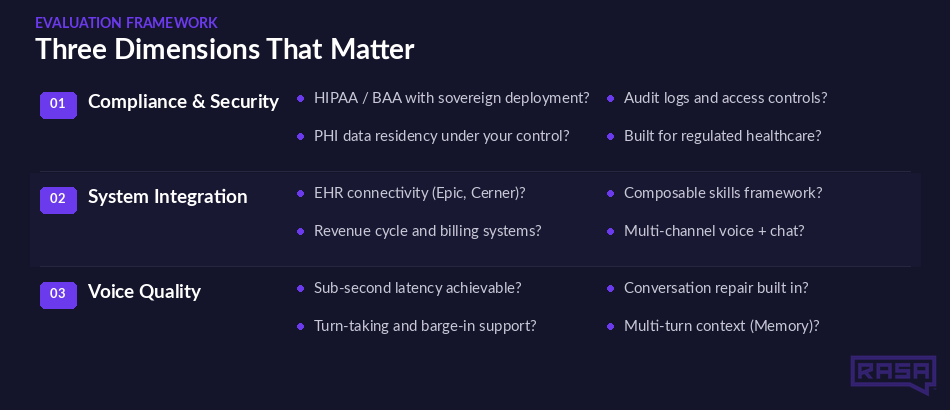
HIPAA compliance is the baseline, not a feature. Any platform handling patient conversations must support Business Associate Agreements (BAAs), encrypt data in transit and at rest, maintain audit logs, and provide access controls. But compliance goes deeper than a checkbox.
Ask these specific questions: Where is voice data processed and stored? Can you deploy on-premise or in your own cloud environment? Who has access to conversation transcripts? How long is data retained, and can you control retention policies?
Platforms like Rasa that support on-premise and private cloud deployment give healthcare organizations full control over where PHI resides. This matters for organizations subject to state-level privacy regulations beyond HIPAA, or for health systems that have already invested in secure infrastructure. Cloud-only platforms require careful evaluation of their data handling, subprocessor agreements, and incident response procedures.
Integration with Healthcare Systems
A voice agent that can't connect to your EHR, scheduling system, or billing platform is just a fancy IVR. Evaluate EHR integration depth, not just integration claims.
Critical integration points include: EHR systems (Epic, Cerner, Meditech) for patient records and scheduling; revenue cycle management systems for billing; identity verification systems for patient authentication; pharmacy systems for prescription workflows; and analytics platforms for monitoring agent performance.
Rasa's composable skills framework allows integration with any system that exposes an API, which provides more flexibility than pre-built connectors that only work with specific EHR versions. For organizations with complex or legacy tech stacks, this flexibility matters.
Voice Quality and Conversational Intelligence
Healthcare conversations require a higher bar for conversational quality than most industries. Patients are often anxious, elderly, or dealing with complex medical situations. The voice agent needs to handle accents, background noise, medical terminology, and emotional context — reducing the need for human intervention on routine patient inquiries while knowing when to escalate.
Key capabilities to evaluate: Voice streaming (the agent can receive and respond with audio directly for faster, more natural responses); turn-taking (the agent knows when to speak and when to listen); barge-in detection (patients can interrupt to correct or clarify); conversation repair (the agent recovers gracefully when it misunderstands); emotional clarity (the agent stays calm, clear, and on-track in emotionally charged moments); and no repetition (the patient never has to restate basics, even after interruptions or channel switches).
Rasa Voice orchestrates the voice pipeline and integrates with ASR and TTS providers to support these capabilities, with features like conversation repair patterns that handle interruptions, topic changes, and user corrections without custom code. Rasa Voice enables teams to reach the first moment of customer relief earlier in the call—not just “answering,” but confirming the right context, taking the next step, and making progress before the patient loses patience.
Best Practices for Deploying Voice AI in Healthcare
Deploying a voice AI agent in a healthcare environment involves more than selecting a platform. Healthcare teams at the organizations that succeed treat deployment as a clinical operations project, not just an IT project.
Start with a pilot program focused on a single, high-volume use case. Appointment scheduling and patient intake are the most common starting points because the workflows are well-defined, the volume is high enough to demonstrate ROI quickly, and the risk of direct patient harm is lower than in clinical decision-making workflows. A focused pilot lets you validate the technology, measure performance, and build organizational confidence before expanding to more complex use cases like medication adherence outreach or chronic care management.
Design for human fallback from day one. Every voice agent deployment needs clear escalation paths. Define which scenarios always route to a human (clinical emergencies, complex billing disputes, patient complaints), which attempt automation first and escalate on failure, and which patient communications are fully automated. Rasa's guided skills make this straightforward because escalation logic is explicitly defined in the agent's skill design, not left to an LLM to decide.
Get patient consent right. Most states require disclosure when a caller is interacting with an AI system. Build this into the conversation flow at the beginning of every call. Make it clear and natural: "Hi, this is the AI assistant for Valley Medical. I can help with scheduling, prescription refills, and billing questions. Would you like to continue, or would you prefer to speak with a staff member?"
Monitor and iterate continuously. Track key metrics from the start: containment rate (percentage of calls resolved without human transfer), average handle time, patient satisfaction scores, and error rates by call type. Use these metrics to identify where the agent struggles and retrain accordingly to support patient recovery outreach, in-person visits coordination, and post-discharge follow-up. Rasa's conversation analytics pipeline tracks skill performance, drop-off points, and success rates across channels.
Plan for multilingual support. Diverse patient populations in most U.S. health systems include significant non-English-speaking communities. Voice agents that only support English leave these patients without automated options. Multilingual capabilities are essential for equitable access. Rasa's multilingual AI capability allows agents to switch languages and maintain context within a single conversation.
Conclusion
Healthcare voice agents have moved past the experimental stage. The platforms available in 2026 can handle real patient conversations for scheduling, triage, billing, and administrative workflows, with the conversational quality and compliance safeguards that healthcare requires.
The right choice depends on what your organization values most. If you need a managed, healthcare-specialized solution with fast deployment, platforms like Hyro and Infinitus deliver pre-built workflows and proven health system track records. If you need full control over your voice agent's behavior, data, and deployment infrastructure, Rasa's agent orchestration platform is built for that. It delivers a sovereign voice for enterprise service—phone experiences that run in your environment, under your security and data rules, not inside a vendor black box. Healthcare organizations can integrate with any EHR system, deploy where their business requires, and use guided skills to ensure the agent only does what it's explicitly designed to do. Rasa gives you a voice agent you can scale with confidence, because it stays human to the caller while staying accountable to the business.
To explore how Rasa's voice AI capabilities work for healthcare, visit the Rasa healthcare page or connect with the team to discuss your use case.
Frequently Asked Questions
What are AI voice agents for healthcare?
AI voice agents for healthcare are AI-powered systems that interact with patients and healthcare staff through natural spoken language, typically over the phone. They replace or augment traditional IVR phone trees by understanding what callers say in their own words and handling tasks like scheduling, billing inquiries, prescription refills, and clinical triage through real-time conversation rather than numbered menu options.
Are AI voice agents HIPAA compliant?
HIPAA compliance depends on the platform and how it's deployed, not on the technology category itself. A voice agent can be HIPAA compliant if it encrypts PHI in transit and at rest, supports BAAs, maintains proper access controls and audit logs, and stores data according to retention policies. Platforms that offer on-premise deployment (like Rasa) provide the highest level of data control because PHI never leaves your infrastructure. Cloud-based platforms can also be compliant but require careful evaluation of their data handling practices.
How much do healthcare AI voice agents cost?
Costs vary significantly by platform and deployment model. Developer-focused platforms like Rasa offer free tiers for getting started, with enterprise pricing for production deployments. Fully managed, healthcare-specialized platforms typically charge per-conversation or per-minute fees, with enterprise contracts for health systems. The ROI case is typically built on reduced call center staffing costs, lower call abandonment rates, and increased appointment completion. Rasa reports a 50% cost reduction in operational expenses across its enterprise deployments, and vendors across the market frequently cite ROI multiples in the range of 3-9X for healthcare implementations.
.png)

.png)
.png)