Single-agent demos are easy. The hard part of agentic AI is what happens after. Once an agent has to call tools, hand off to a second agent, recover from a wrong turn, escalate to a human, and stay coherent across channels, you stop building agents and start building an orchestration layer. That layer is where most production AI systems live or die.
This guide is for ML platform engineers, AI engineering leads, and enterprise architects evaluating AI agent orchestration tools in 2026. We compared ten leading agent orchestration tools, including open-source frameworks that own much of the mindshare in this area and production-grade platforms that ship in regulated environments. The picks span developer SDKs, no-code builders, and full enterprise platforms, and the comparison focuses on what actually matters when AI agents leave the demo and start engaging real customers: multi-agent capabilities, deployment flexibility, observability, MCP support, and total cost of ownership.
What Is AI Agent Orchestration?
AI agent orchestration is the coordination layer that decides which AI agent (or tool) handles each step of a user request, manages handoffs between specialized agents, and tracks state across multi-step workflows. In practice, agent orchestration sits between the user's intent and the tools, models, and downstream systems that fulfill it, deciding what happens next, sharing the right context with the right capability, and keeping the experience consistent over time.
That phrasing matters because most "agent" tooling on the market is a runtime, a builder, or an SDK pointed at a single LLM. Real agent orchestration adds three things on top: coordinating specialized agents, managing supervised handoffs with shared context, and observing the full multi-agent workflow. Without those three, multi-agent systems collapse into a tangle of prompts that nobody can debug.
The reason this category exploded in 2025 and 2026 is the shift toward agentic AI: instead of one big model trying to do everything, teams build a constellation of specialized AI agents (a billing agent, a routing agent, a knowledge agent) and let an orchestration tool decide which one acts next. That decomposition is what makes complex tasks tractable, but it also creates a new operational problem. The orchestration tool is the answer to that problem.
Agent orchestration tools are not workflow automation. Workflow automation assumes the path is known upfront. Agent orchestration assumes the path is decided in motion, with tool use, model reasoning, and state all evaluated as the request unfolds.
How Agent Orchestration Works (Patterns and Architectures)
Three orchestration patterns dominate production AI agent systems in 2026. Most agent orchestration tools support some combination of all three; the differences are in where they default and how cleanly they let you mix patterns.
Sequential orchestration runs a fixed pipeline of agents in order. Agent A produces output, agent B consumes it, and agent C finalizes. This pattern fits well-defined business processes (KYC checks, document review, three-step approvals) where predictability matters more than flexibility.
Hierarchical orchestration, also known as the supervisor pattern, places a router agent at the top of the graph. The supervisor reads the user request, picks a specialized agent, hands off context, and decides whether to escalate, retry, or move on. This is the dominant pattern for customer-facing AI agents because it maps cleanly to triage, resolution, and handoff, and it is the default in Microsoft Agent Framework, OpenAI's Agents SDK, and Rasa's orchestration layer.
Swarm orchestration is the most flexible and the hardest to control. Peer agents share state and pass control to one another based on capabilities, with no fixed hierarchy. Swarm patterns work well for research and long-horizon agentic AI tasks, but most production teams limit them to back-office workloads rather than customer journeys.
Two protocols sit underneath these patterns and are now table stakes. The Model Context Protocol (MCP) standardizes how AI agents discover and invoke tools, and Agent-to-Agent (A2A) protocols standardize how AI agents communicate with other AI agents. Our enterprise guide to AI agent orchestration goes deeper on these patterns and their operational implications.
What to Look for in Agent Orchestration Tools
Listicles love feature checklists. Buyers care about whether the orchestration tool survives contact with real production. These are the seven criteria that separate agent orchestration tools that ship from ones that stall.
Runtime control. Pure prompt-driven orchestration is fine for demos. Production AI agents need a way to mix guided sequences for high-risk steps with prompt-driven reasoning for open-ended ones, with policy checks built in rather than bolted on.
Observability and tracing. When something goes wrong in a multi-agent workflow, you need to know which agent acted, what context it used, and why. Strong agent orchestration tools include tracing, evaluation harnesses, and conversation replay. If you're evaluating frameworks at the SDK level, our best AI agent frameworks post compares the leading options.
Multi-LLM support. Pricing, capability, and policy positions on foundation models shift quarterly. LLM-agnostic tools that let you swap OpenAI, Anthropic, Mistral, Llama, or self-hosted models give you the optionality enterprise teams need.
Deployment flexibility. Cloud-only orchestration tools are fine until your security team blocks them. Banks, telcos, healthcare networks, and government agencies routinely require AI agents to run on their own infrastructure. Look for self-hosted, on-prem, in-VPC, and partner-managed options.
Integration breadth and MCP. Real AI agents touch CRMs, ticketing systems, knowledge bases, and dozens of internal APIs. Native MCP support plus a healthy connector library is the difference between an orchestration tool that integrates in days and one that integrates in months.
Governance. Audit trails, role-based access, data residency controls, and policy enforcement matter the moment AI agents touch revenue or regulated processes.
Total cost of ownership. Free tier, pay-as-you-go, per-seat, and enterprise contracts all hide different costs. Match the pricing model to how your AI agents will actually run.
The 10 Best AI Agent Orchestration Tools in 2026
Here are the ten AI agent orchestration tools enterprise teams should evaluate in 2026. We include orchestration frameworks, managed runtimes, automation platforms, and enterprise orchestration platforms because buyers often compare them in the same evaluation, even though they sit at different layers of the stack. If you're shopping for a complete platform rather than just an orchestration layer, our best AI agent platform post compares the broader category.
1. Rasa
Rasa is our enterprise agent orchestration platform for customer-facing and employee-facing AI agents. We built Rasa for teams that need to own the agent system end to end and turn what works into a durable capability that holds up across years, not quarters. We were named a Strong Performer in The Forrester Wave: Conversational AI Platforms For Customer Service, Q2 2026, with a top score on the "Resource Orchestration & Application Execution" criterion, and we power production AI agents for customers like N26, ERGO, and nib Group. Deutsche Telekom reports that an agent built on Rasa "can process around 50% of service desk inquiries independently," reducing the need for human agents by approximately 30%.
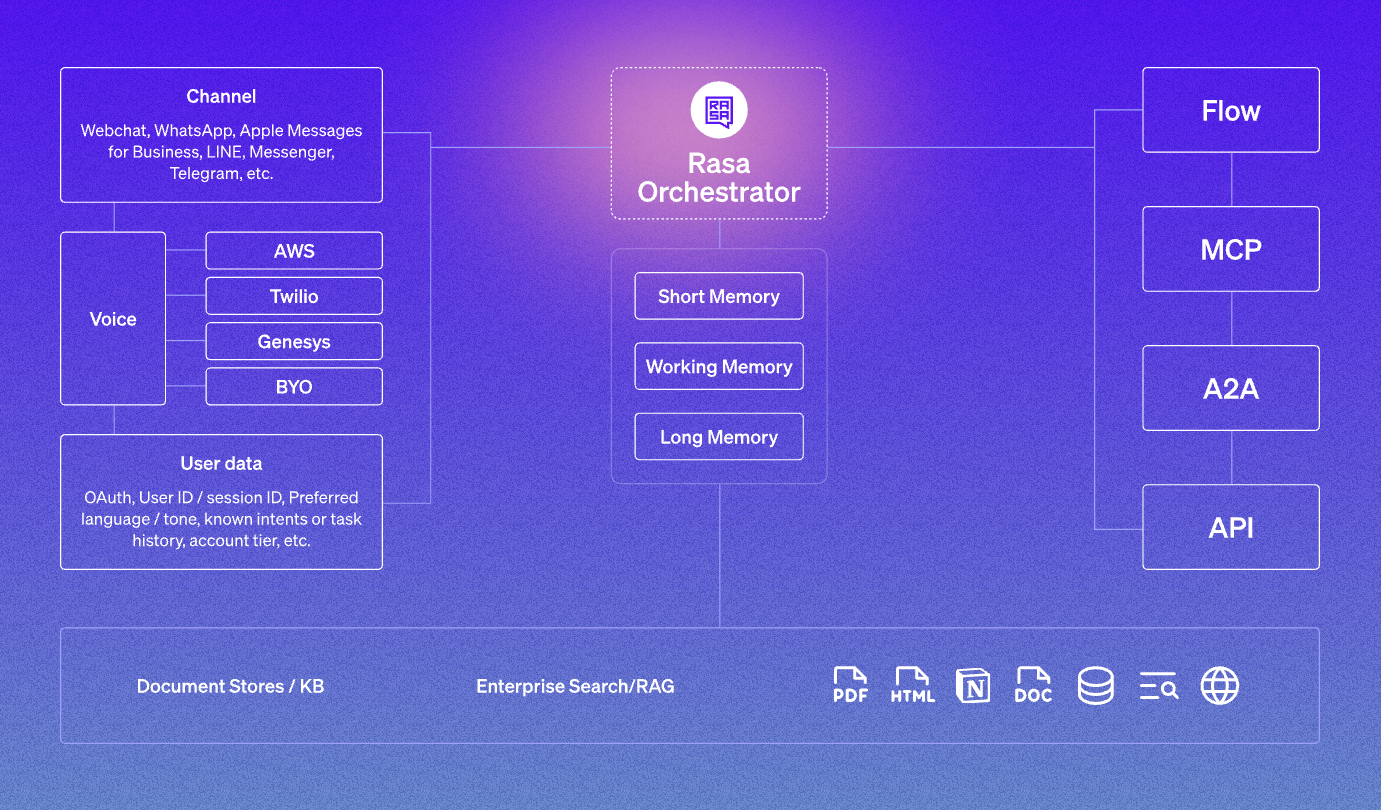
Our orchestration layer combines guided skills for high-risk paths with prompt-driven skills for open-ended ones. It runs in two modes: one is runtime orchestration, where we own the conversation loop end-to-end, and the other is multi-runtime orchestration, where we coordinate across other agents and vendor systems via MCP and A2A.
Strengths: Self-hosted, on-prem, VPC, or partner-managed deployment (one of the strongest deployment-flexibility stories in this category); LLM-agnostic; voice as a first-class channel in the same orchestration model, not a bolt-on runtime; MCP and A2A support; composable skills and intentionally managed continuity across sessions, channels, and handoffs.
Limitations: Steeper learning curve than no-code orchestration tools; priced for enterprise buyers (SMB teams may find Rasa heavier than they need).
Best for: Banks, insurers, telcos, healthcare providers, and government agencies running customer-facing or employee-facing multi-agent systems at scale.
Pricing: Free plan via our Developer Edition with one bot per company and up to 1,000 external conversations per month. Enterprise contracts on request.
2. LangGraph + LangSmith
LangGraph is the developer-first stack for stateful, long-running AI agents, paired with LangSmith for deployment, tracing, and evaluation. LangGraph is a low-level orchestration framework for graph-based agent workflows; LangSmith adds observability and a managed runtime (now called LangSmith Deployment).
Strengths: Best-in-class developer experience for stateful agent runtimes; strong tracing and evaluation via LangSmith; cloud and self-hosted deployment, including a free Self-Hosted Lite tier.
Limitations: Optimized for engineers; voice, channels, and CRM glue are bring-your-own.
Best for: Engineering teams already on LangChain who want a managed orchestration runtime for stateful production agents.
Pricing: Free Developer plan; Plus plan adds cloud deployment; paid plans scale to Enterprise.
3. CrewAI
CrewAI is a leading open-source multi-agent orchestration framework, paired with CrewAI AMP for running agents in production. Its core abstraction (a "crew" of specialized AI agents collaborating on complex tasks) shaped how many teams think about multi-agent collaboration.
Strengths: Mature OSS framework with a large community; strong fit for agentic AI use cases needing multiple specialized agents in parallel; code-first control over agent behavior.
Limitations: AMP is newer than the framework, so production tooling is evolving quickly; not designed primarily for customer-facing voice or omnichannel CX.
Best for: Engineering teams building multi-agent systems and back-office agentic AI workflows in code.
Pricing: Free OSS plus a free tier on AMP, with paid plans for AMP monitoring and collaboration.
4. Microsoft Agent Framework + Azure AI Foundry
Microsoft Agent Framework reached 1.0 GA in April 2026, consolidating Semantic Kernel and AutoGen into a single production-ready SDK and runtime for .NET and Python. Microsoft positions Agent Framework as the SDK that can target Azure AI Foundry Agent Service as one managed runtime among several backends. AutoGen is in maintenance mode, and Microsoft now points new projects at Agent Framework via published migration guides.
Strengths: Deep Azure and Microsoft 365 integration; hybrid deployment (OSS SDK runs anywhere, managed runtime on Azure); long-term support commitment.
Limitations: Best when other Azure or Microsoft 365 services are already in the mix; younger than its predecessors when measured against production scar tissue.
Best for: Microsoft-anchored enterprise teams.
Pricing: SDK is free; Azure AI Foundry consumes Azure pricing.
5. OpenAI Agents SDK
OpenAI Agents SDK is a lightweight, provider-agnostic framework for building multi-agent workflows. It supports OpenAI's Responses and Chat Completions APIs alongside 100+ other LLM providers, with built-in tracing, function tools with automatic schema generation, and a Sessions memory layer. The earlier "Swarm" project is deprecated and flagged as educational only; Agents SDK is the production path.
Strengths: Provider-agnostic across major LLMs; built-in tracing, sessions, and tool-call validation; strong fit for teams using OpenAI's evaluation and fine-tuning suite.
Limitations: Some newer features land Python-first; enterprise governance, channels, and runtime infrastructure are bring-your-own.
Best for: Engineering teams that want a fast OSS path to multi-agent orchestration with native OpenAI integration.
Pricing: SDK is free; LLM API costs are separate.
6. LlamaIndex Agents
LlamaIndex Agents are built around AgentWorkflow, a multi-agent orchestration primitive that handles state, tool calling, and handoffs. The framework is strongest for document-heavy and RAG-centric AI agents, with deep ties to LlamaCloud parsing and OCR.
Strengths: Best-in-class document and RAG agent ergonomics; AgentWorkflow handles multi-step orchestration with handoffs; native MCP support.
Limitations: Document and RAG-centric; production deployment via LlamaCloud and llamactl is newer and still maturing.
Best for: Teams whose AI agents are anchored in documents, knowledge bases, and retrieval workflows.
Pricing: The OSS framework is free; LlamaCloud is usage-based and sold via sales.
7. n8n
n8n is a fair-code workflow automation platform with native AI agent capabilities, support for multiple AI agents in one workflow, and 500+ integrations. Its Microsoft Agent 365 integration lets agents act inside Microsoft 365 work contexts with company identity.
Strengths: Strong fit for workflow-driven agents connecting many internal systems; free, self-hostable Community Edition; visual workflow builder approachable for technical PMs.
Limitations: Less polish on customer-facing voice and chat; enterprise observability still maturing.
Best for: Teams that want AI agents plus workflow automation as one layer on top of an existing automation platform.
Pricing: Free self-hosted core, plus paid plans for cloud and enterprise features.
8. Make
Make.com offers AI agent orchestration as a first-class citizen inside its visual Scenario Builder, with 3,000+ apps and a Reasoning Panel that gives a real-time view of how the agent thinks, the tool calls it makes, and how it reaches its conclusion.
Strengths: Generous connector library and approachable no-code builder; Reasoning Panel adds observability that most no-code orchestration tools lack; fast time to first working multi-step agent.
Limitations: SaaS only; less granular than code-first frameworks for complex logic and custom guardrails.
Best for: Operations and automation teams that need AI agents inside a no-code automation platform.
Pricing: Tiered SaaS (Free, Core, Pro, Teams, Enterprise). Confirm current pricing on Make's site.
9. Vellum
Vellum is an LLM ops platform with first-class agent-orchestration features: a no-code workflow builder, prompt versioning, RAG tools, and integrated evaluation and observability.
Strengths: Strong evaluation and observability out of the box; Workflows builder spans no-code and code-first development; VPC deployment available on Enterprise.
Limitations: Proprietary, not open source; higher tiers required for SSO, RBAC, and VPC.
Best for: Product engineering teams that want LLM ops, agent orchestration, and evaluation in one tool.
Pricing: Free tier, paid Pro tier, and Enterprise pricing via Vellum sales.
10. Sema4.ai
Sema4.ai is the enterprise automation platform built on top of Robocorp, with the SAFE framework, a Studio plus "Sai" assistant for building agents in natural language with MCP, and a Semantic Layer that lets agents query Postgres, Snowflake, and Redshift in plain English without writing SQL.
Strengths: Enterprise governance with SOC 2 and ISO 27001 for the Control Room; two deployment editions (Enterprise self-managed, Team Edition runs natively on Snowflake); Semantic Layer GA at the Gartner Data and Analytics Summit 2026.
Limitations: Heavier setup than developer SDKs; pricing is sales-led with no published tiers.
Best for: Enterprise teams orchestrating agentic AI across structured data, RPA-style automation, and complex workflows.
Pricing: Contact sales.
Where Rasa Fits in the Orchestration Landscape
Most agent orchestration tools land at one of two extremes. SDK-level tools (LangGraph, CrewAI, OpenAI Agents SDK, Microsoft Agent Framework) give engineers maximum control but expect them to assemble the runtime, observability, and deployment themselves. Cloud-only platforms move fast but lock you into one vendor's runtime and channel set.
Our lane is narrower and more honest. Rasa is the production-grade orchestration platform for teams that need to ship customer-facing and employee-facing agent systems into regulated environments and operate them for years. We support guided skills for high-risk steps and prompt-driven skills for open-ended ones, so a single orchestration model can combine probabilistic reasoning with policy-bound execution. We deploy self-hosted, on-prem, in VPC, or partner-managed, with native MCP and A2A support and voice as a first-class channel in the same orchestration model.
For pure developer SDK use cases, LangGraph or CrewAI may be a faster way to get started. Our lane is enterprise production. When the agent has to handle a refund, a regulated claim, or a mid-journey topic change in front of a real customer, the structural choices we made (composable skills, managed continuity across sessions and channels, sovereign voice, guided-where-it-matters control) are what hold up.
AI Agent Orchestration Use Cases
Concrete deployments make the orchestration story click. Four patterns recur across our customer base and the broader 2026 market.
Customer service deflection. A triage agent classifies the request, hands it off to a specialized resolution agent (billing, account, technical), and escalates cleanly to a human if confidence drops. Deutsche Telekom processes around 50% of service desk inquiries independently in this way, with a 30% reduction in the need for human agents.
Banking and KYC. A KYC verification agent runs identity checks, hands off to a transaction agent for the actual operation, and routes through a compliance check before returning to the customer. Guided skills on the high-risk steps and prompt-driven skills on the conversational wrapper let banks ship AI agents into regulated journeys without giving up audit trails.
Telecom diagnostics and provisioning. A diagnostic agent reads device telemetry, hands off to a provisioning agent for the change, and notifies the customer. Voice is usually the front door here, which is why agent orchestration tools that treat voice as an afterthought struggle in telecom.
Back-office automation and GTM. Sales-support, finance close, and IT helpdesk agents increasingly run as multi-agent workflows that blend RPA, LLM reasoning, and structured data access. This is where platforms like Sema4.ai and Microsoft Agent Framework focus.
Choosing the Right Agent Orchestration Tool
Choosing an orchestration tool is really three decisions stacked on top of each other: guided versus prompt-driven flow control, framework or SDK versus full platform, and cloud-managed versus self-hosted deployment. Get those three right and the rest of the feature checklist usually sorts itself out.
If you want a production-grade orchestration platform you can deploy where your business requires, mix guided and prompt-driven skills, and operate for years rather than rent for quarters, book a demo with us or start with our free Developer Edition. The fastest way to know whether an agent orchestration tool is right for your team is to put it next to your hardest customer journey and watch what happens.
Frequently Asked Questions
What are the best AI agent orchestration tools?
The best AI agent orchestration tools depend on whether you want an SDK, a no-code builder, or a full enterprise platform. For production-grade enterprise orchestration, Rasa, Microsoft Agent Framework + Azure AI Foundry, and Sema4.ai are the strongest. For developer-first SDKs, LangGraph + LangSmith, CrewAI, and OpenAI Agents SDK lead the category. For no-code orchestration, Make and n8n are the most credible. For document-heavy AI agents, LlamaIndex Agents is purpose-built.
What is AI agent orchestration?
AI agent orchestration is the coordination layer that decides which AI agent or tool handles each step of a request, manages handoffs between specialized agents, and tracks state across multi-step workflows. Strong agent orchestration tools include a runtime, a router or supervisor pattern, observability, and tool-use protocols like MCP and A2A.
How is agent orchestration different from workflow automation?
Workflow automation assumes the path is known upfront. Agent orchestration assumes the path is decided in motion: the orchestration tool evaluates context, picks the next agent or tool, and routes accordingly, often blending guided sequences for known steps with prompt-driven reasoning for the unknown ones.
Do I need a multi-agent system or a single agent with tools?
Start with a single agent and tools. Move to a multi-agent system when one of three things is true: the system has clearly distinct domains that benefit from specialized agents, the prompt-engineering surface area for one mega-agent has become unmanageable, or governance requires that different teams own different agents.
.png)

.png)
.png)