
Building AI agents used to require months of engineering effort, custom pipelines, and deep technical knowledge. That barrier is disappearing. A new generation of low-code AI agent platforms lets teams design, test, and deploy AI agents through visual interfaces, pre-built components, and declarative AI workflows. Non-technical users who once depended on engineering queues can now prototype conversational agents alongside technical teams. Development timelines that used to stretch across months now compress into weeks. This guide breaks down what low-code AI agents are, compares the leading agent platforms for 2026, and walks through the evaluation criteria that matter most for enterprise teams.
What Are Low-Code AI Agents?
Low-code AI agent platforms help teams build reliable AI agents that interpret user requests, coordinate workflows, and take approved actions across business systems, all while minimizing writing code through visual editors, pre-built modules, and declarative configuration. Unlike traditional chatbots that follow rigid, pre-scripted conversation trees, these agents reason about context, call external tools, and complete real transactions like processing an insurance claim, rescheduling a delivery, or escalating a support ticket with full context attached.
The "low code" distinction matters because it determines who can build these systems and how fast. A low-code chatbot platform typically offers a drag-and-drop editor, pre-built templates, and scripting capabilities for customization. A low-code AI agent builder extends that foundation with LLM orchestration, tool-use frameworks, and agentic workflow design, meaning the agent does not just respond to questions but takes actions across integrated systems. This makes building AI agents accessible to business analysts, automation leads, and non-technical teams who understand the business logic but may not have programming skills.
Here is the practical difference between a chatbot and an agent: a chatbot answers "What's my order status?" by looking up a record. An AI agent handles "My package didn't arrive, and I need a replacement shipped to a different address" by verifying the order, checking inventory, initiating a return, updating the shipping address, and confirming the new delivery window. That multi-step reasoning and action-taking capability is what separates agents from chatbots, and low-code platforms now make it accessible to teams without deep ML engineering expertise or advanced coding skills.
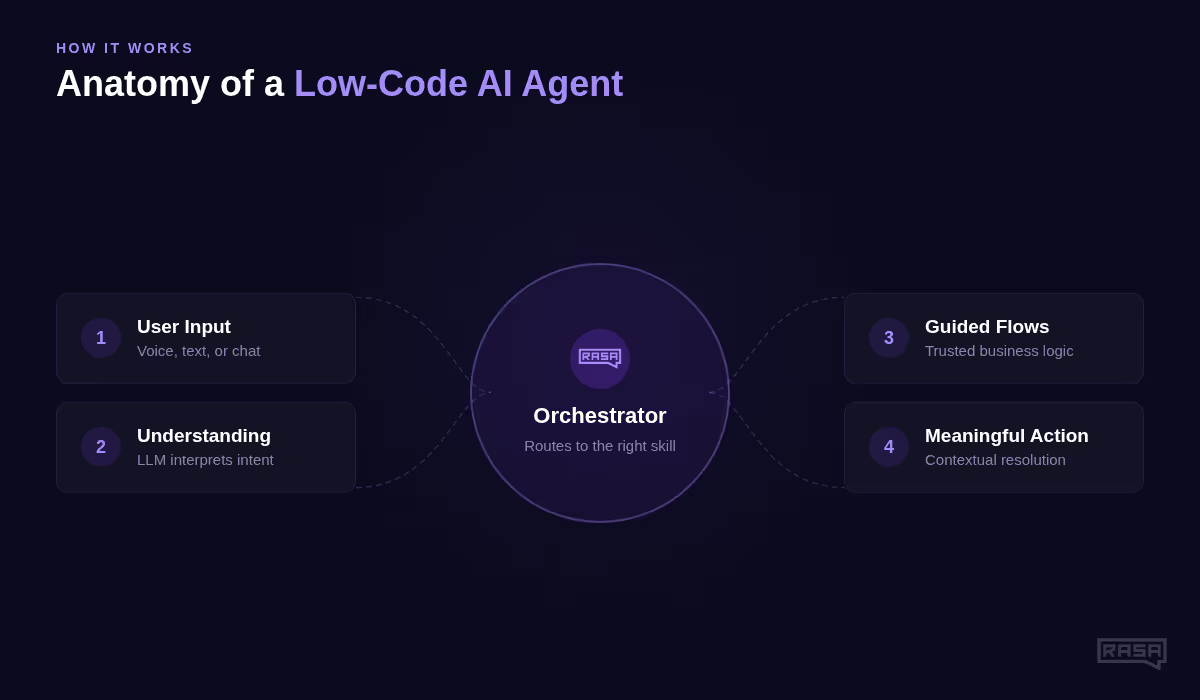
Rasa's architecture illustrates this distinction clearly. The platform uses the Orchestrator to orchestrate conversations, combining reusable skills that encode business logic with memory that maintains context across interactions. LLMs are applied selectively for interpretation and response generation, while skills and orchestration control what the agent is allowed to do. This means teams can build custom AI agents that handle complex, multi-turn conversations with controlled, predictable behavior rather than unconstrained LLM responses.
Why Low-Code AI Agent Platforms Are Growing
Three forces are driving enterprise adoption of low-code AI agent development.
1. The AI talent gap is real. Demand for engineers who can build production-grade AI systems far outpaces supply. Low-code AI agent platforms let product managers, business analysts, and citizen developers prototype and iterate on agent designs without waiting in an engineering queue. Non-technical users gain the visual tools to build and manage AI agents directly, while technical teams shift their focus from building conversation flows to solving harder problems like system integration, data security, and performance optimization.
2. Time-to-deployment defines competitive advantage. Enterprises that take six months to ship an AI agent lose ground to competitors that ship in six weeks. Visual builder interfaces and pre-built components compress the build cycle. Rasa Studio, for example, provides starter packs with pre-built skills, responses, and integrations so teams start from working examples rather than blank files. The result is faster iteration cycles without sacrificing the control engineering teams need to deploy AI agents confidently.
3. Production costs demand efficiency. Running every user interaction through a large language model gets expensive at scale. Platforms that apply AI models selectively while flows and orchestration handle business logic can reduce token consumption and improve reliability simultaneously. Rasa applies this principle directly: LLMs are used selectively for interpretation and response generation, while the orchestration layer coordinates the right flow at the right moment, keeping agents fast and cost-efficient across millions of conversations.
Best Low-Code AI Agent Platforms for 2026
The platforms below span open-source visual builders, cloud-native enterprise tools, and frameworks with low-code interfaces backed by full pro-code flexibility. Each serves a different audience and use case, from drag-and-drop interface simplicity to advanced automation requiring custom code.
1. Rasa: Best for Enterprise-Grade AI Agents
Rasa is the developer platform for enterprise AI agents. It gives technical teams the framework to build agents that don’t just respond—they resolve. The platform combines a pro-code framework for full customization depth with Rasa Studio for visual prototyping and team collaboration, giving engineering teams code-first control with a visual layer for cross-functional input.
What sets Rasa apart is how it delivers the control of building in-house, the speed of buying off-the-shelf, and the governance required to operate at enterprise scale.
Teams build reusable flows that encode what the business knows and requires. The Orchestrator coordinates those skills across channels and existing tools, and manages memory to keep the experience coherent over time. Guided skills handle high-stakes interactions like processing financial transactions or healthcare inquiries with guardrails, error handling, and policy checks, while prompt-driven skills handle the long tail where flexibility is valuable.
Key capabilities:
- On-premise deployment for data sovereignty and sensitive data protection (critical in banking, healthcare, and government)
- Multi-LLM routing to balance latency and cost across AI models
- Built-in conversation repair that handles topic shifts and user backtracking without custom code
- Support for MCP and emerging A2A protocols for multi-agent orchestration
- Voice agents with turn-taking and timeout behaviors built in
- Agent memory that carries context across sessions, channels, and handoffs
- Enterprise-grade security with audit logs and role-based access controls
- API access for connecting to data sources and external tools
Pricing: Rasa offers a free Developer Edition for individual builders, with Enterprise plans for organizations scaling to production that need enterprise-grade governance, dedicated support, and advanced deployment options. See current pricing and plans for details.
Best for: regulated enterprises with technical teams in-house (financial services, healthcare, telco, insurance) building customer-facing or employee-facing AI agents at scale, where compliance, security architecture, and ownership matter.
2. Langflow: Best for Open-Source Visual AI Agent Building
Langflow is a low-code agent builder for creating agentic applications and RAG systems. The platform positions itself with the tagline "Stop fighting your tools" and provides a visual flow-based interface for connecting LLMs, vector databases, and AI tools without requiring deep technical skills.
Key capabilities: visual drag-and-drop agent design, support for multiple LLM providers, vector database integrations for RAG pipelines, MCP server support for tool integration, and a pre-built component library. Langflow has an active community and regular release cadence.
Pricing: Open-source and free to self-host. Langflow offers a managed cloud option with paid tiers starting at a free tier for experimentation, scaling up based on usage.
Best for: developers who want a visual interface for prototyping AI agents and RAG workflows without vendor lock-in.
3. Google Vertex AI Agent Builder: Best for Google Cloud Ecosystem
Google's Vertex AI Agent Builder provides an enterprise agent platform for building, scaling, and governing AI agents within the Google Cloud ecosystem. The Agent Development Kit (ADK) lets teams build production-ready agents in Python with deterministic guardrails and orchestration controls, though it requires programming skills for advanced configurations.
Key capabilities: multi-agent workflow design and multi-agent collaboration, enterprise data integration with BigQuery and Firestore, fully managed runtime deployment, agent evaluation tools for quality assessment, and support for multiple frameworks including LangChain, LangGraph, and CrewAI.
Pricing: Usage-based pricing tied to Google Cloud consumption. No standalone free tier for the agent builder; costs scale with API calls, compute, and data processed.
Best for: organizations already invested in Google Cloud that want managed agent infrastructure with built-in enterprise-grade governance.
4. Dify: Best for Open-Source RAG and Agent Pipelines
Dify is an open-source low-code platform for building production-ready agentic workflows with RAG pipelines, integrations, and observability. It takes an all-in-one approach, combining agent design, knowledge retrieval from multiple data sources, and monitoring in a single platform.
Key capabilities: agentic workflow builder with conditional logic, RAG pipeline support, built-in observability and monitoring, a marketplace for pre-built custom workflows and workflow tools, and both cloud and self-hosted deployment options.
Pricing: Open-source and free to self-host. Dify's cloud offering includes a free tier with limited usage, with paid plans for higher volumes and team collaboration features.
Best for: product teams that want open-source flexibility with built-in RAG and monitoring in a single tool.
5. n8n: Best for Workflow Automation with AI Agents
n8n is a workflow automation platform that has expanded into AI agent capabilities. It is one of the most popular open-source low-code tools available for advanced automation, now adding AI agent nodes alongside a broad library of integration connectors to manage AI agents within existing automation pipelines.
Key capabilities: visual workflow builder, AI agent node integration, extensive pre-built integrations for connecting to existing tools and enterprise systems, conditional logic and complex logic branching, human-in-the-loop workflows, and strong IT Ops, Security Ops, and DevOps support for custom workflows.
Pricing: Open-source and free to self-host. n8n Cloud paid plans start at a Starter tier with scalable pricing based on workflow executions and team size, with Pro and Enterprise tiers for teams needing more capacity and features.
Best for: IT and operations teams that need to embed AI agent capabilities within existing workflow automation pipelines.
6. Microsoft Copilot Studio: Best for Microsoft 365 Integration
Microsoft Copilot Studio enables non-technical users and technical teams alike to build AI-driven custom agents and workflows within the Microsoft ecosystem. It integrates directly with Microsoft 365, SharePoint, Teams, and the broader Power Platform, making it the natural choice for organizations standardized on Microsoft infrastructure.
Key capabilities: agent and workflow creation with a drag-and-drop interface, SharePoint as a knowledge source, MCP server integration, child agent support for complex multi-agent workflows, Python code execution for custom logic, and topic management for structured conversations.
Pricing: Microsoft Copilot Studio is available as a standalone product and as part of Microsoft 365 Copilot licenses. Paid plans start at per-user or per-message pricing depending on volume, with enterprise agreements available.
Best for: organizations deeply integrated with Microsoft 365 that want agents pulling from SharePoint, Teams, and Copilot without leaving the Microsoft ecosystem.
7. Flowise: Best for LangChain-Based Visual Building
Flowise is an open-source visual builder for creating agentic systems. The platform provides modular building blocks based on the LangChain framework, making it accessible for developers familiar with that ecosystem who want visual building capabilities without a steep learning curve.
Key capabilities: visual agent builder with drag-and-drop interface, modular components based on LangChain, custom node creation for extending functionality, pre-built agent templates, and both cloud and self-hosted deployment options.
Pricing: Open-source and free to self-host. Flowise offers a cloud-hosted option with paid tiers for managed infrastructure and support.
Best for: developers building on LangChain who want a visual interface for composing agent workflows.
Notable Mention: Relevance AI
Relevance AI is an agent platform primarily focused on building AI agents for sales, support, and operations teams. It provides a no-code visual builder for creating AI workflows and managing agents, with pre-built templates for common business use cases.
Key capabilities: no-code AI agent building, pre-built workflow templates, integration with CRM and support tools, and team collaboration features. Relevance AI targets business users who want to deploy AI agents quickly without coding skills.
Pricing: Relevance AI offers a free tier for experimentation. Paid plans start at a Team tier, scaling based on agent runs and features.
Best for: business teams that want to deploy AI agents for sales and support workflows quickly without technical skills.
How to Evaluate Low-Code AI Agent Platforms
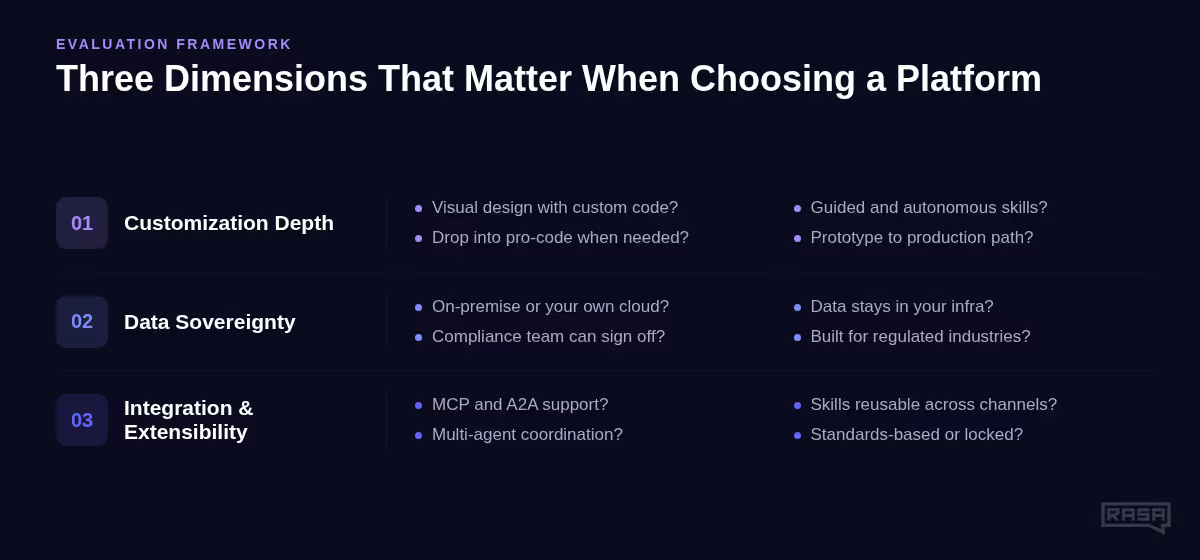
Choosing the right agent platform depends on three dimensions that most comparison articles overlook: the depth of customization your use case demands, where your sensitive data lives, and how many systems your agent needs to connect with.
No-Code vs. Low-Code vs. Code-First
These labels describe a spectrum, not discrete categories. No-code AI agents (pure drag-and-drop, zero scripting) work for FAQ bots and simple routing but hit limitations with complex tasks. Low-code platforms add scripting, custom logic, and API access for agents handling real business processes and complex workflows. Code-first frameworks provide unlimited flexibility but require significant programming skills and engineering investment, often with a steep learning curve.
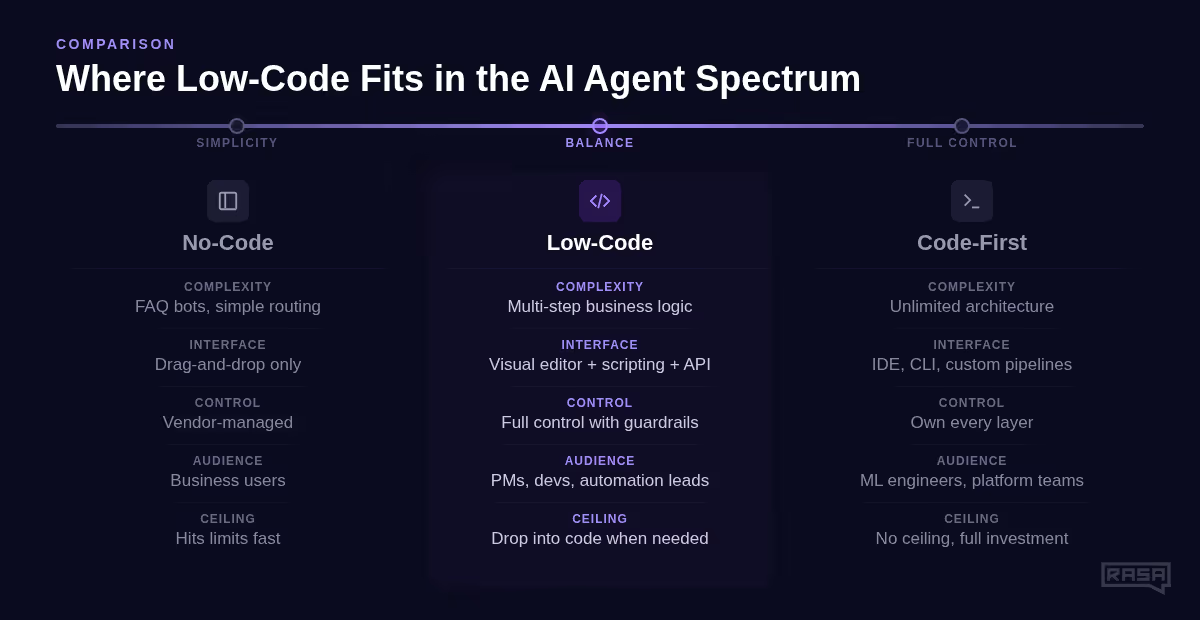
The question is not which approach is "better" but where your use case sits on the complexity curve. A customer support agent who answers shipping questions sits at the no-code end. An agent that processes insurance claims, validates documents, and triggers payments across three backend systems needs low-code or code-first capabilities. Single-agent systems may work for simple use cases, but multi-agent collaboration becomes essential as workflows span multiple domains.
Rasa spans this spectrum intentionally. The Rasa framework provides full pro-code access for defining skills, actions, and integrations, while Rasa Studio provides the visual interface for prototyping, testing, and team collaboration for teams that need custom actions, pipeline modifications, or deep integration work. Teams can start in Studio and drop into code when complexity demands it, without switching platforms or losing version control over their agent configurations.
Deployment and Data Sovereignty
For enterprises in regulated industries, the deployment model is often the deciding factor. Cloud-only platforms (Google Vertex AI, Microsoft Copilot Studio) offer convenience but require sensitive data to leave your infrastructure. Self-hosted options (Langflow, Dify, Flowise, n8n) give you control but shift operational burden to your team.
Rasa offers all three: on-premise, your cloud, or fully managed. On-prem isn’t an add-on—it’s the default, designed for regulated industries from the start. This is why financial institutions and healthcare organizations choose Rasa. Patient data and financial records stay within your security perimeter with enterprise-grade security, and your compliance team signs off on the deployment architecture rather than the vendor's cloud security posture.
Integration and Extensibility
An agent that cannot connect to your CRM, ERP, or ticketing system is a demo, not a product. Evaluate platforms based on native integrations, API access, and support for emerging standards like MCP (Model Context Protocol) and A2A (Agent-to-Agent) for multi-agent orchestration.
n8n leads in raw connector count with an extensive integration library. Rasa supports MCP and emerging A2A-based orchestration patterns for connecting agents to external tools and other agents. The orchestration layer coordinates these integrations so the agent can invoke the right flow at the right moment, rather than depending on pre-built connectors that may not cover your specific stack.
Low Code AI Agents vs. Traditional AI Development
The trade-off between low code and traditional development is not speed vs. quality. It is speed vs. initial control, with the right low-code platform eliminating that trade-off entirely.
Traditional AI agent development gives you maximum control from day one. You choose the AI models, build the pipeline, design the dialogue management, and write every integration. The cost is time: six to twelve months before the agent takes its first meaningful action in production, a dedicated ML engineering team, and ongoing maintenance of custom infrastructure. It also requires programming skills that limit who on the team can contribute.
Low-code AI agent development compresses the build cycle by providing pre-built components, visual tools, and managed infrastructure. This makes production-ready agents accessible to non-technical teams and business analysts without dedicated ML engineers. The risk with purely low-code platforms is hitting a ceiling: when your agent needs custom business logic, complex logic branches, or error handling that the visual editor cannot express, some platforms leave you stuck with workarounds.
The hybrid approach eliminates this trade-off. Platforms like Rasa that combine no-code Studio interfaces with full pro-code frameworks give teams the speed of visual design for standard patterns and the depth of custom code for complex logic. You build reusable skills for the patterns that repeat, then extend with custom code for complex validations or deep system integration. Those skills become composable building blocks
that teams can reuse across channels, custom agents, and use cases.
This matters as enterprises move from chatbots to reliable agents. Conversational agents handle simple, scripted interactions where no-code visual design is sufficient. AI agents handle complex, multi-step workflows where the orchestration layer needs to coordinate skills, carry context through memory, and maintain a continuous experience across channels and sessions. A platform that only offers one mode forces you to choose between speed and capability. The best agent builder supports both, letting teams move between visual building and writing code as complexity demands without AI-generated code guessing at your business rules.
Conclusion
Low-code AI agent platforms are reshaping how enterprises build reliable AI systems, making it possible for cross-functional teams to design, test, and deploy AI agents without deep ML engineering expertise. The right choice depends on your deployment requirements, the complexity of your workflows, and whether you need open-source flexibility or managed cloud convenience.
For enterprises that need to own and operate an agent system, not just ship a demo, Rasa lets teams package trusted capability into reusable skills, coordinate them through orchestration, and carry continuity through managed memory.
The result is custom AI agents that get to the first meaningful action faster and stay reliable as complexity grows. Explore the Rasa documentation to start building.
Frequently Asked Questions
Are There Free Low-Code AI Agent Platforms?
Yes. Several platforms offer free tiers or fully open-source self-hosted options. Langflow, Dify, Flowise, and n8n are all open-source with free self-hosted deployments. Rasa's open-source framework has over 25 million downloads and offers a free Developer Edition. Google Vertex AI Agent Builder and Microsoft Copilot Studio are proprietary with usage-based or enterprise licensing. Most platforms also offer paid plans for teams that need managed infrastructure, support, and collaboration features.
What Is the Difference Between Low-Code and No-Code AI Agents?
No-code platforms require zero programming skills and rely entirely on drag-and-drop interfaces. They work well for simple FAQ bots and basic routing, but lack flexibility for advanced automation. Low-code platforms add scripting capabilities, custom logic, and API integrations, enabling agents that handle real business processes with complex workflows. The key difference is ceiling: no-code AI agents hit limitations when you need custom business logic or error handling, while low-code platforms let you extend with code when the visual interface is not enough.
How Do Low-Code AI Agent Platforms Handle Data Security?
Enterprise-grade platforms offer multiple layers of data security. Self-hosted and on-premise deployment options keep sensitive data within your infrastructure. Features like audit logs, role-based access controls, and encryption at rest and in transit protect data throughout the agent lifecycle. Rasa's deployment flexibility means regulated industries can maintain full control over where data lives and how it flows, meeting compliance requirements without compromising on agent capability.
Do I Need Technical Skills to Build AI Agents?
It depends on the platform and use case. No-code platforms like Relevance AI let business users build simple agents with zero coding skills through a drag-and-drop interface. Rasa Studio provides a no-code interface that non-technical users can work with for standard patterns, while the pro-code framework gives developers deeper flexibility for custom logic or complex workflows. Code-first frameworks require technical knowledge from the start. For most enterprise use cases, a platform that spans no-code and pro-code gives the best balance: business analysts design the agent experience visually, and developers extend it with custom code where needed.
.png)
.png)
.png)