
6 Best Voice AI For Customer Service In 2026
Your support lines are flooded, wait times are climbing, and the IVR is making it worse, not better. The best voice AI for customer service in 2026 doesn't route callers through menus; it understands what they need, acts on your backend systems mid-call, and resolves the request end to end, escalating to a human with full context only when it should.
Getting the choice wrong has operational consequences: low containment that deflects only easy calls, latency that tanks CSAT, per-minute pricing that balloons with volume, and, in regulated industries, a compliance review that kills the project after the pilot. This guide compares six platforms against those realities.
We evaluated each platform on containment, voice experience, deployment control, governance, integration depth, cost predictability, and multi-channel continuity, weighted for what enterprise contact centres actually need.
Best Voice AI for Customer Service in 2026: Quick Comparison Table
How We Evaluated These Voice AI Platforms
We analyzed aggregated user reviews from G2, Capterra, and Gartner Peer Insights, verified current pricing against vendor pages and independent 2026 cost breakdowns, and reviewed public documentation for telephony integration, deployment options, and governance capability. Where independent latency benchmarks exist, we used those over vendor claims.
We weighted the evaluation for enterprise customer service buyers, particularly in regulated, high-call-volume industries (financial services, telecom, healthcare, government), where deployment control, auditability, and data sovereignty decide shortlists before features do.
We prioritized production readiness over demo quality. A platform that dazzles on a scripted call but degrades at P95 latency under load, or caps out on your hardest call type, costs more than it saves. The top AI voice agents for customer service 2026 buyers should shortlist are the ones that hold up on real traffic.
Our Scoring Methodology
Each platform was scored across seven weighted dimensions reflecting what determines success in production customer service:
6 Best AI Voice Agents for Customer Service in 2026
Rasa: Best Voice AI for Customer Service Overall
Retell AI: Best for Inbound Support & Call Deflection
PolyAI: Best Managed Voice AI for Enterprise Contact Centres
Bland AI: Best for High-Volume Outbound
Synthflow: Best for No-Code / Fast Deployment
Vapi: Best for Developer Control & Custom Builds
1. Rasa: Best Voice AI for Customer Service Overall
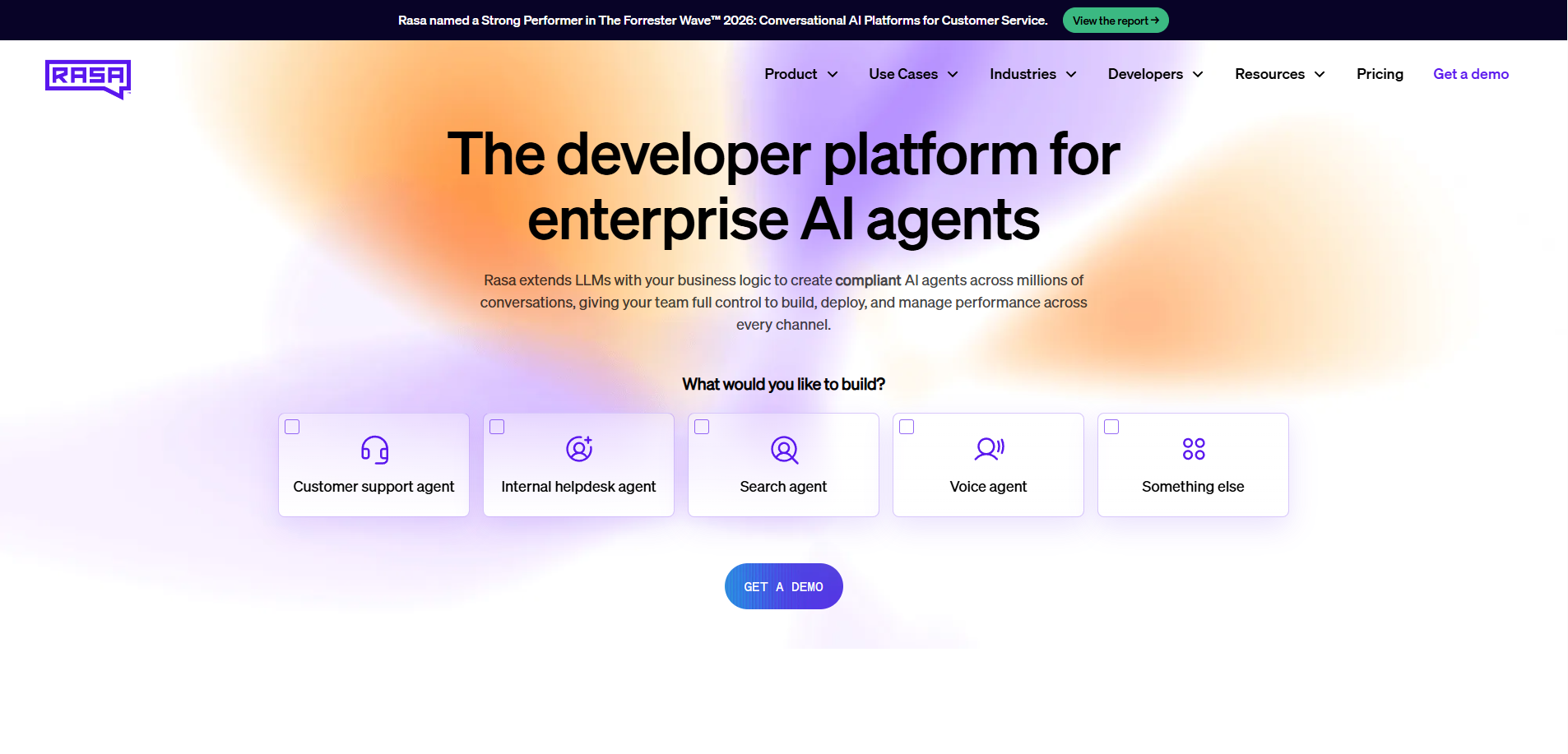
Rasa is the enterprise platform for building and operating voice AI for customer service that the company owns, not rents. Three pillars make that real: a conversational engine that orchestrates multi-turn, multi-system conversations; Rasa Voice, sovereign, human-fluent voice for enterprise contact centres with sub-second latency and barge-in handled natively; and CALM, which integrates LLMs inside enterprise guardrails, so the model interprets what callers want while your deterministic business logic decides what happens.
Best for: contact centre and CX leaders at enterprises in regulated, high-call-volume industries who need voice and chat from one governed platform, deployed in their own environment. Honest framing up front: Retell, PolyAI, or Synthflow will get a narrow cloud use case live faster. Rasa's differentiation is ownership, self-hosting, voice-plus-chat depth, and governance that compounds as scope grows.
Product Overview
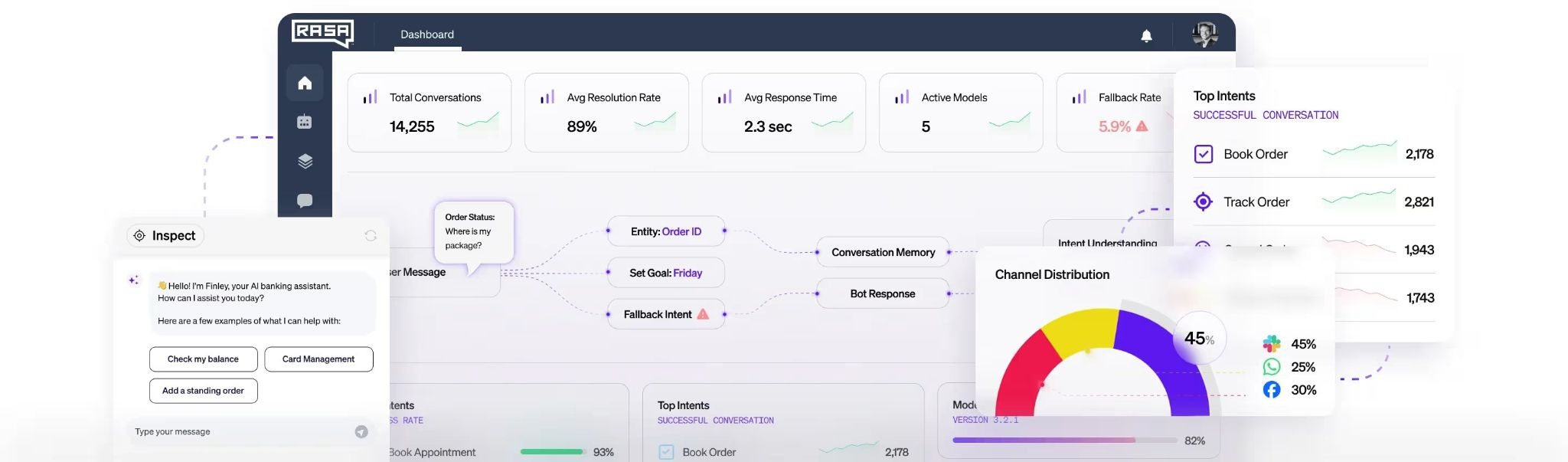
Calls break when they span systems. The typical failure mode: a caller wants to dispute a charge, which needs identity verification, account lookup, and a case created in the CRM, and the voice bot punts to a human at step two. Rasa orchestrates multi-turn conversations across tools, CRMs, and backend systems mid-call, with CALM keeping the LLM inside business guardrails: the model never invents the process, it routes the caller through the one you defined.
Voice and chat behave like different companies. Most stacks run an IVR on the phone and a separate bot on the site, with different logic, integrations, and analytics. Rasa runs the same conversational logic, policies, and integrations across voice and chat, so a customer who starts in chat can call in and continue without repeating themselves.
Regulated support needs governance, not promises. Rasa deploys self-hosted, in your private cloud, or fully air-gapped; Rasa does not host any customer data, systems, or applications. Every AI response is auditable, and policy enforcement lives in deterministic flows rather than prompt hopes, which is what security reviews in banking, healthcare, and government need to see.
Pricing
Developer Edition (free): full platform access, one bot per company, up to 1,000 external conversations per month (100 for internal agents), community support via the Rasa Forum. Enterprise (custom): premium support, dedicated customer success manager, advanced security features, and custom onboarding, priced on annual conversation volume rather than per user, per seat, or per minute. That model is the point for contact centres: costs scale with conversations served, predictably, instead of ballooning per minute at peak.
Integrations & Extensibility
Telephony and contact centre: Voice Stream connectors for Twilio Media Streams, Jambonz, AudioCodes, and Genesys Cloud AudioConnector, plus Voice Ready options where transcription is handled externally. Speech: pluggable ASR (Deepgram, Azure) and TTS (Cartesia, Deepgram, Azure, Rime), so you choose the voice stack rather than inherit one. Business systems: CRM integrations including Salesforce and Zendesk, an Action Server for custom backend actions in code, and MCP server integration (beta) for tool ecosystems. The difference from configuration-only platforms: teams can extend Rasa at the engine level, replacing or customizing modules, not just configuring what the vendor pre-built.
Deployment & Setup
Self-hosted in your own environment, on your infrastructure, under your security model; private cloud and fully air-gapped deployments are supported, and managed cloud deployment is also available. Expect production timelines in weeks, not days: N26 went from concept to production in four weeks, Swisscom took a full customer-facing voice rebuild live in 20. On-prem and hybrid capability is the differentiator for regulated industries where call audio cannot leave the environment.
Tradeoffs
Rasa requires a builder mindset. You need Python developers, telephony infrastructure knowledge, and conversational AI architecture familiarity; reviews consistently praise the control and flexibility while noting the learning curve. If we scored time-to-first-call, Rasa would sit mid-pack: it's more platform than you need for a simple out-of-the-box bot. The trade is full ownership of a system that doesn't hit a ceiling in month nine.
Support
Enterprise tier includes premium support with a dedicated customer success manager and implementation partner support for telephony integration. Developer Edition users get community support via the Rasa Forum, documentation at rasa.com/docs, and structured learning resources at learning.rasa.com.
Mini Case Study
Swisscom, Switzerland's leading telco, rebuilt its customer service agent on Rasa and went from prototype to production in 20 weeks, doubling automation rates and cutting operational costs by 50%, with voice latency under two seconds even with LLMs in the loop. Read the full Swisscom case study.
Get Started With Rasa
2. Retell AI: Best for Inbound Support & Call Deflection

Retell AI is the fastest managed path to a production inbound agent, and the most-reviewed platform in the category: 4.8/5 on G2 across 1,400+ reviews as of early 2026. Independent benchmarks put its median latency around 600 milliseconds out of the box, and its visual builder is genuinely usable by non-developers.
Product Overview
A managed voice AI platform covering inbound support, appointment booking, and call deflection, with a bundled speech stack, warm transfer support, and a usable no-code builder alongside its API. Compliance support including self-serve BAAs is available on standard paid tiers.
Pricing
Pay-as-you-go from $0.07 per minute with no platform fee; premium voices and models push real per-minute costs toward the top of its published $0.07 to $0.31 range. At 40,000 minutes per month, independent 2026 breakdowns put all-in costs around $2,800 per month.
Deployment & Integrations
Vendor cloud only; no self-hosted option, which is the line regulated buyers should check first. Telephony via Twilio and SIP, CRM and calendar integrations native or via API.
Setup
Days to a working inbound agent for teams without deep voice engineering; among the fastest in this list.
Tradeoffs
Reviews praise latency, ease of use, and natural conversation flow. The limits: a bundled stack means less component control, per-minute economics compound at high volume, and call audio is processed in Retell's cloud. Strong choice for inbound deflection at moderate volume without sovereignty requirements.
3. PolyAI: Best Managed Voice AI for Enterprise Contact Centres
PolyAI is the white-glove option: a voice-first, fully managed service where PolyAI builds, integrates, and tunes the assistant for you. Its voice quality is consistently ranked among the best in the category, and it's deployed by large enterprises in banking, insurance, hospitality, and telecom.
Product Overview
Customer-led voice assistants with strong multi-turn stability, interruption handling, and 45+ languages, delivered as a managed deployment with vendor-led optimization. Reviewers on Gartner Peer Insights rate it around 4.7/5, though the total public review pool is small, which is typical for enterprise-only vendors.
Pricing
Custom enterprise contracts only; no published pricing, free tier, or self-serve signup. Independent 2026 analyses place typical contracts at roughly $150,000+ per year with per-minute usage on top. The contract bundles monitoring, maintenance, and 24/7 support with an uptime SLA.
Deployment & Integrations
Vendor-managed cloud deployment with CCaaS and telephony integration handled by PolyAI's team during rollout, including major contact centre platforms and CRM connections.
Setup
Roughly six weeks from kickoff to live in typical engagements, run by PolyAI's delivery team rather than yours.
Tradeoffs
The managed model is the strength and the constraint: excellent outcomes with minimal internal lift, but changes route through account teams, self-serve control is limited, and the six-figure floor excludes mid-market buyers. Best for enterprises that want outcomes delivered rather than a platform to build on.
4. Bland AI: Best for High-Volume Outbound
Bland AI is purpose-built for outbound at scale: reminders, notifications, surveys, and campaigns running 1,000+ concurrent calls, with managed telephony that handles compliance plumbing like A2P 10DLC and STIR/SHAKEN registration.
Product Overview
The platform centres on Pathways, a visual node-graph builder for deterministic call flows, backed by a bundled model stack and simple APIs for launching campaigns from contact lists.
Pricing
Flat rate near $0.09 per minute with the stack bundled in and usage-based billing at entry tiers; verify current rates directly, as pricing has shifted since late 2025 and outbound fee structures vary by plan.
Deployment & Integrations
Vendor cloud only, with managed telephony included and native CRM integrations for lead routing.
Setup
Days for a scripted outbound campaign; longer for complex Pathways.
Tradeoffs
G2 reviews are mixed: outbound simplicity and predictable pricing earn praise, while inbound maturity, latency (independent tests measure roughly 700 to 900 milliseconds), and support responsiveness draw criticism. You're also locked to Bland's model stack. Right tool for outbound campaigns; not the pick for inbound customer service.
5. Synthflow: Best for No-Code / Fast Deployment

Synthflow is the leading no-code option: a visual drag-and-drop builder with 20+ templates, 200+ integrations, 50+ languages, and white-label capability that's made it a favourite of agencies and lean teams. It rates 4.5/5 on G2.
Product Overview
A self-serve platform for building voice agents without engineering: templates for appointment booking, FAQ deflection, and lead qualification, with bundled models and voices, plus SMS and WhatsApp channels alongside voice.
Pricing
Self-serve plans from roughly $29 per month with usage rates from about $0.08 to $0.13 per minute; effective all-in rates often land higher once voice engine and model choices are added, so model your real rate before committing.
Deployment & Integrations
Vendor cloud with owned telephony infrastructure; 200+ native integrations aimed at SMB and mid-market stacks.
Setup
The fastest in this list: a working agent in hours to days, no developer required.
Tradeoffs
Reviews praise accessibility and speed; the trade-offs are per-minute costs above developer platforms, latency benchmarks behind Retell and Vapi, and less depth for complex enterprise integration and governance. Ideal for small teams and agencies; a stretch for a regulated enterprise contact centre.
6. Vapi: Best for Developer Control & Custom Builds

Vapi is the developer's pick: API-first, bring-your-own-keys, with support for any LLM, voice provider, and telephony carrier. Engineering teams that want to assemble a custom voice stack, and tune every component, choose it for exactly that flexibility.
Product Overview
A voice orchestration layer rather than a finished product: you supply model, speech, and telephony choices, Vapi coordinates the real-time loop. Tuned configurations reach 500 to 700 milliseconds median latency in independent 2026 tests.
Pricing
Roughly $0.05 per minute platform fee with STT, LLM, TTS, and telephony passed through at provider rates; real all-in costs typically land between $0.10 and $0.30 per minute. HIPAA support sits behind an enterprise add-on reported around $1,000 per month.
Deployment & Integrations
Vendor cloud; integrations are whatever you wire up, with 40+ native app connections and webhooks for the rest.
Setup
Days to weeks depending on stack complexity; this is an engineering project by design.
Tradeoffs
Maximum flexibility, maximum assembly: you own tuning, maintenance, and billing that spans several providers, and public review volume is thin compared to Retell. Right for developer-led teams building something specific; wrong for teams that want a product.
How to Choose the Best Voice AI for Customer Support
Work these seven steps in order and you'll arrive at a shortlist you can defend to leadership, security, and finance.
Step 1: Define Your Deployment Model First
This is the non-negotiable filter. If data sovereignty requirements, compliance mandates, or security policy require the platform to run in your environment, eliminate cloud-only vendors before comparing a single feature. Of the six platforms here, that filter leaves one standing; apply it first and save weeks.
Step 2: Map Your Call Types and Complexity
FAQ deflection and simple status calls are solved problems. Pressure-test each vendor against your hardest call: identity verification, multi-step resolution, mid-call system lookups, a caller changing their mind halfway through. The demo path proves nothing; your worst call type proves everything.
Step 3: Test Voice Quality, Latency, and Interruption Handling
Voice is unforgiving. Measure real latency at your expected concurrency (sub-800 milliseconds feels natural; ask for P95, not the median), test barge-in and interruption recovery, and run it on your callers' accents and real line conditions, not studio audio.
Step 4: Evaluate Multi-Channel and Human Handover
Ask two questions. Does the same logic and integration layer drive voice and chat, or are they separate builds? And when the agent hands over to a human, does the agent receive the transcript, verified identity, and attempted steps, so the caller never repeats themselves? Cold transfers undo every CSAT gain the automation earned.
Step 5: Assess LLM Governance and Control
Every vendor claims LLM capability. The differentiator is governance: can you define what the AI can and cannot say, enforce business policies deterministically, constrain scope per call type, and produce an audit trail for every AI response in a regulated call? Test with off-policy prompts and watch what happens.
Step 6: Test Integrations Against Your Real Stack
Ask for a live integration demo with your actual CRM, telephony, and authentication systems, and ask the uncomfortable question: what happens when the integration fails mid-call? Also establish where custom logic lives, in a vendor UI you configure or at the code level you control; that determines your ceiling.
Step 7: Run a Production Pilot and Evaluate TCO
Pilot one high-stakes call type end to end on live traffic for two weeks. Track containment, CSAT, escalation quality, and cost predictability, then compare true total cost: licence, per-minute charges, telephony, speech services, implementation, and the switching cost you'll pay if you hit the platform's ceiling in year two.
Voice AI Customer Service Pricing Models and Costs in 2026
Five models dominate. Per-minute (Retell, Bland, Vapi, Synthflow): $0.05 to $0.31 per minute all-in, simple to start, and the model that balloons at volume; 500,000 minutes a year at $0.15 is $75,000 in usage alone, before telephony. Per-session or per-resolution: charged per handled or resolved conversation, better aligned to outcomes, watch the definition of 'resolved.' Per-seat: common in CCaaS bundles, priced like agent licences. Managed enterprise contracts (PolyAI): six-figure annual agreements bundling delivery and support. Flat enterprise licence by conversation volume (Rasa): predictable annual cost that doesn't spike with call duration or peak traffic.
The questions buyers actually ask in sales calls: 'Is it per user, per conversation, or flat fee?' and 'What does a license include?' Get both answered in writing, then model total cost, licence plus telephony plus STT/LLM/TTS plus implementation, at your realistic year-two volume, not your pilot volume. Per-minute pricing that looks cheap at 10,000 minutes rarely survives contact with 100,000.
Questions to Ask Before Buying AI Voice Bots for Customer Service
- Can it run in our environment? Self-hosted, private cloud, or air-gapped deployment is binary: the vendor supports it or the project dies in security review. Ask first.
- Where are call audio and transcripts processed, stored, and for how long? Get the data-flow diagram in writing, including subprocessors and jurisdictions. A vendor who can't produce one has answered the question.
- What's the measured latency at our concurrency? Demand P95 figures under load, not median figures from a quiet demo line, and verify interruption handling on real calls.
- What's your actual containment on calls like ours, and what travels on handover? Ask for containment rates on comparable call types and confirm the human receives transcript, identity, and context.
- How deep do integrations go, and what happens when one fails mid-call? Native connectors versus API glue matters less than failure behavior: retry, graceful message, or dead air.
- What locks us in? Model lock-in, proprietary flow formats, and vendor-cloud data all raise switching costs. Ask what leaves with you if you leave.
- What happens when we outgrow it? New channels, new languages, harder call types, custom logic: is the ceiling configurable, or is it a migration?
- What's the true total cost at year-two volume? Licence, usage, telephony, speech services, implementation, and optimization; per-minute rates are the floor, never the bill.
Voice AI Integrations: What to Verify Before Buying
Integration is where voice AI deployments fail, because the agent must act on live systems mid-call, under a latency budget, while a human waits on the line. A knowledge-base answer bot survives a slow API; a voice agent doesn't.
The critical handoffs to verify: telephony and CCaaS (SIP trunks, Twilio Media Streams, AudioCodes, Genesys Cloud, Jambonz), CRM and ticketing (Salesforce, Zendesk), identity and authentication (verification flows, one-time codes, DTMF keypad input for PINs so sensitive digits bypass transcription), speech services (whether you can choose ASR and TTS providers like Deepgram, Azure, Cartesia, and Rime, or inherit the vendor's), and the human handover path into your agent desktop with full context attached.
Two tests separate marketing from production readiness: a live demo against your actual stack rather than the vendor's sandbox, and a deliberate mid-call integration failure to see whether the agent recovers, escalates gracefully, or leaves the caller in silence.
Key Features to Look for in AI Voice Agents for Customer Service
- Natural-language understanding and intent handling. The agent must handle real phrasing ('I can't get into my account' equals 'reset my password'), topic changes, and corrections; keyword matching collapses on live calls.
- LLM integration with governance controls. LLM fluency with deterministic business logic in control, CALM or equivalent, so the model understands callers but cannot improvise your processes. This is the top voice AI tech for customer service automation in regulated settings.
- Low latency and natural turn-taking. Sub-800 millisecond responses, barge-in support, and graceful recovery when callers interrupt; anything slower reads as broken and drives zero-outs to agents.
- Voice and chat from a single platform. One set of logic, integrations, and analytics across channels, so customers move between them without repeating themselves and your team maintains one system instead of three.
- Self-hosted and on-premises deployment. For regulated industries, where call audio is processed is the first gate; platforms without a self-hosted option fail it before the feature comparison starts.
- Telephony and contact-centre integration. Native SIP, CCaaS, and CRM connectors, because the agent is only useful inside your existing call infrastructure, not beside it.
- Warm human handover with full conversation context. Transcript, verified identity, and attempted steps travel with the caller; context transfer is the single biggest CSAT lever in the escalation path.
- Observability and analytics. Containment tracking, full transcripts, per-decision audit trails, and dashboards your operations team actually uses to tune flows week over week.
What Is the Best Voice AI for Regulated Customer Service?
For banking, healthcare, and government contact centres, the evaluation inverts: deployment model and governance come first, features second. The requirements are consistent across regulators and internal security teams: the platform runs in your environment (self-hosted, private cloud, or air-gapped), call audio and transcripts never leave your control, every AI decision carries an audit trail, and business policies are enforced deterministically rather than requested via prompt.
Against those requirements, Rasa is the strongest fit in this list: it's the only platform here with self-hosted and air-gapped deployment, it doesn't host customer data, and CALM's separation of understanding from execution gives compliance teams an architecture to approve rather than a promise to trust. N26 runs its banking assistant on Rasa inside its own secure cloud; Groupe IMA automates roadside assistance voice for roughly 30 million drivers on the same platform. PolyAI serves regulated enterprises through its managed model where vendor-cloud processing is acceptable; the per-minute cloud platforms are generally ruled out at the deployment gate.
What Is the Best Voice AI for Enterprise Voice and Chat Support?
Buyers regularly ask: what AI customer service agents work with voice? Fewer than the marketing suggests. Most of this market is voice-only (Retell, Bland, Vapi, PolyAI) or chat-first with voice bolted on, which leaves enterprises running two systems with two sets of logic, integrations, and analytics, and customers repeating themselves between them.
A true customer service platform with voice AI runs both channels from one conversational core. Rasa is built exactly this way: the same flows, policies, integrations, and analytics drive voice and chat, so an agent built once serves both, and a customer who starts in chat can call in and continue mid-task. Deutsche Telekom's Frag Magenta runs on this architecture across chat, web, and voice, with more than 10 million customer issues resolved. If multi-channel consistency is a 2026 priority, this is the requirement that shortens the shortlist fastest.
Understanding the AI Behind Voice Customer Service
The questions below come up in nearly every enterprise sales conversation about voice AI customer support, and they deserve straight answers. The framing that matters: AI as a structured tool within defined guardrails, not an unconstrained agent.
How is the LLM controlled and validated for customer-facing calls? In governed architectures, the LLM interprets what the caller wants and proposes next steps, while deterministic business logic decides what executes. Validation happens through regression test sets, off-policy prompt testing, and per-release evaluation, the same discipline as any production system.
Can business teams define what the AI can and cannot say? Yes, on platforms built for it: response libraries, policy-enforced flows, and scoped topics put the boundaries in configuration and code, not in hope. Ask each vendor to demonstrate a hard boundary being enforced on a live call.
How does the platform handle accents, non-native speakers, and diverse callers? Primarily through the ASR layer, which is why pluggable speech providers matter: you can test Deepgram, Azure, and alternatives against your real caller population and pick what performs. Always test on your callers' accents and line conditions, never studio samples.
What audit trail exists for AI-handled calls? In regulated deployments, every response should be reconstructable: transcript, model interpretation, the flow and step that executed, and the systems touched. If a vendor can't show a per-call decision log, regulated conversations don't belong on the platform.
What does the AI actually do versus what humans decide? The AI transcribes, interprets intent, runs defined workflows, and drafts responses. Humans define the workflows, set the policies, review the audit trails, and take over live when judgment or empathy is required. The division of labor is a design decision, and it should be yours.
Is Rasa Voice Worth the Cost?
Honest answer: it depends which of three paths you're on. A cloud point tool (Retell, Synthflow) makes sense when scope is narrow, volume is moderate, sovereignty isn't a requirement, and speed matters most; you'll be live in days and the economics work until volume or scope grows. A DIY stack assembled from STT, LLM, and TTS vendors makes sense with unlimited engineering appetite and a genuinely custom requirement; you get maximum control and own every operational problem forever.
Rasa makes sense on the third path: voice AI as a long-term customer service system. Ownership and self-hosting for regulated data, voice and chat from one platform, governance that survives audits, and conversation-volume licensing that stays predictable at scale. The deployments bear it out: Swisscom cut operational costs 50%, Deutsche Telekom resolves millions of issues across channels, and Groupe IMA runs voice for 30 million drivers. Rasa is for teams building that system, not for teams that need a bot live by next Friday.
Which Voice AI for Customer Service Is Right for Your Business?
Match the platform to your operating reality. Retell for fast inbound deflection at moderate volume; PolyAI for white-glove managed delivery with a six-figure budget; Bland for outbound campaigns; Synthflow for no-code speed; Vapi for developer-led custom builds. And Rasa when the requirement is the full system: an ai voice agent for customer service you own, running voice and chat from one governed platform, deployed where your data lives.
Whichever direction you lean, run the seven-step evaluation above on live traffic before signing, and if you're weighing building components yourself, our guide on how to build an ai voice agent covers the stack you'd be taking on. Ready to test the ownership path? Book a Rasa demo and bring your hardest call type.
Frequently Asked Questions
How does voice AI work in customer service?
Voice AI transcribes the caller's speech in real time, interprets intent with a language model, executes the request through backend integrations (account lookups, bookings, updates), and responds in a natural synthesized voice, all in under a second per turn. Complex or sensitive calls hand over to humans with full context.
What is the best self-hosted AI voice agent for customer service?
Rasa is the leading self-hosted option: the platform deploys in your own environment, private cloud, or fully air-gapped, and Rasa does not host any customer data, systems, or applications. That makes it the default shortlist entry for banking, healthcare, and government contact centres with data sovereignty requirements.
Which voice AI gives the most control over how the AI behaves on calls?
Rasa, through CALM: the LLM interprets what callers want while deterministic flows you define control what happens, so the AI cannot improvise outside your business logic. You can constrain scope, enforce policies, and audit every response. Developer platforms like Vapi offer component control; CALM adds behavioral control.
What's the difference between an IVR and voice AI?
An IVR routes callers through fixed menus ('press 1 for billing') and resolves almost nothing. Voice AI understands natural speech, holds multi-turn conversations, acts on backend systems mid-call, and resolves requests end to end. Operationally: IVRs deflect and frustrate; voice AI contains and resolves.
How much do top voice AI tools for customer service cost?
As of mid-2026: per-minute platforms run $0.05 to $0.31 all-in (Retell from $0.07, Bland near $0.09, Vapi $0.10 to $0.30 with pass-throughs), Synthflow starts around $29 monthly, PolyAI contracts reportedly start near $150,000 yearly, and Rasa licenses by annual conversation volume with a free Developer Edition.
What are the best voice-native customer service tools?
The best ai voice assistants for customer service by category: Rasa for enterprise ownership and voice-plus-chat, Retell AI for managed inbound, PolyAI for white-glove enterprise delivery, Bland AI for outbound, Synthflow for no-code, and Vapi for custom developer builds. Voice-native matters: bolted-on voice shows in latency and interruption handling.
What's the best voice AI for banking and financial services?
Banking shortlists start at the deployment gate: call audio and customer data must stay under the bank's control, with audit trails on every AI decision. Rasa leads there via self-hosted and air-gapped deployment; N26 runs its assistant on Rasa in its own secure cloud. PolyAI serves banks accepting managed vendor-cloud delivery.
How do you evaluate leading companies in voice AI customer service?
Score the leading companies in voice AI customer service on seven dimensions: containment on your hardest call types, P95 latency under load, deployment and data control, governance and auditability, telephony and CRM integration depth, cost predictability at year-two volume, and voice-chat continuity. Then pilot the top two on live traffic.
Can voice AI handle both voice and chat from one platform?
Only genuinely multi-channel platforms can. Most voice AI tools are voice-only, forcing a second system for chat with duplicate logic and integrations. Rasa runs both from one conversational core, the architecture behind Deutsche Telekom's Frag Magenta, so customers move between channels without repeating themselves.
What is the best no-code voice AI for customer service?
Synthflow leads the no-code category: a visual drag-and-drop builder, 20+ templates, and self-serve plans from about $29 per month get a working ai voice assistant for customer service live in hours. Retell's builder is the strongest no-code option among the developer-grade platforms.
Does voice AI improve or hurt CSAT?
It depends entirely on execution. Done well, CSAT holds or improves: Rasa deployments average 4.4 CSAT alongside 59% goal completion, and Albert Heijn raised quality scores 37% while preventing more contacts. Done badly (high latency, low containment, cold transfers), it hurts. Latency and handover quality are the levers.
How does voice AI hand over to a human agent?
Good platforms do warm handovers: the human agent receives the full transcript, the caller's verified identity, and what the AI already attempted, so the caller never repeats themselves. Verify this in every evaluation, because cold transfers, where the agent gets nothing, undo the CSAT gains automation earned.