
Botpress is a strong prototyping tool. Its visual flow builder and LLM-agnostic architecture get teams to a working demo fast.
But enterprise teams can hit limits when they need customer-controlled deployment, governed release workflows, deeper auditability, voice as part of a broader service operation, and predictable scaling across high message volume.
If you are searching for Botpress alternatives, you are likely looking for a platform that fits a more demanding production environment.
This guide evaluates 10 alternatives across governance architecture, deployment flexibility, voice capability, and production reliability for enterprise teams that have outgrown what Botpress can deliver.
What Are the Alternatives to Botpress Chatbot Platform? Competitor Comparison and Ratings Chart
10 Best Alternatives to Botpress Software for 2026
Alternatives for Enterprise AI Agent Ownership
#1. Rasa: Best Botpress Alternative for Enterprise Governance and Self-Hosted Deployment
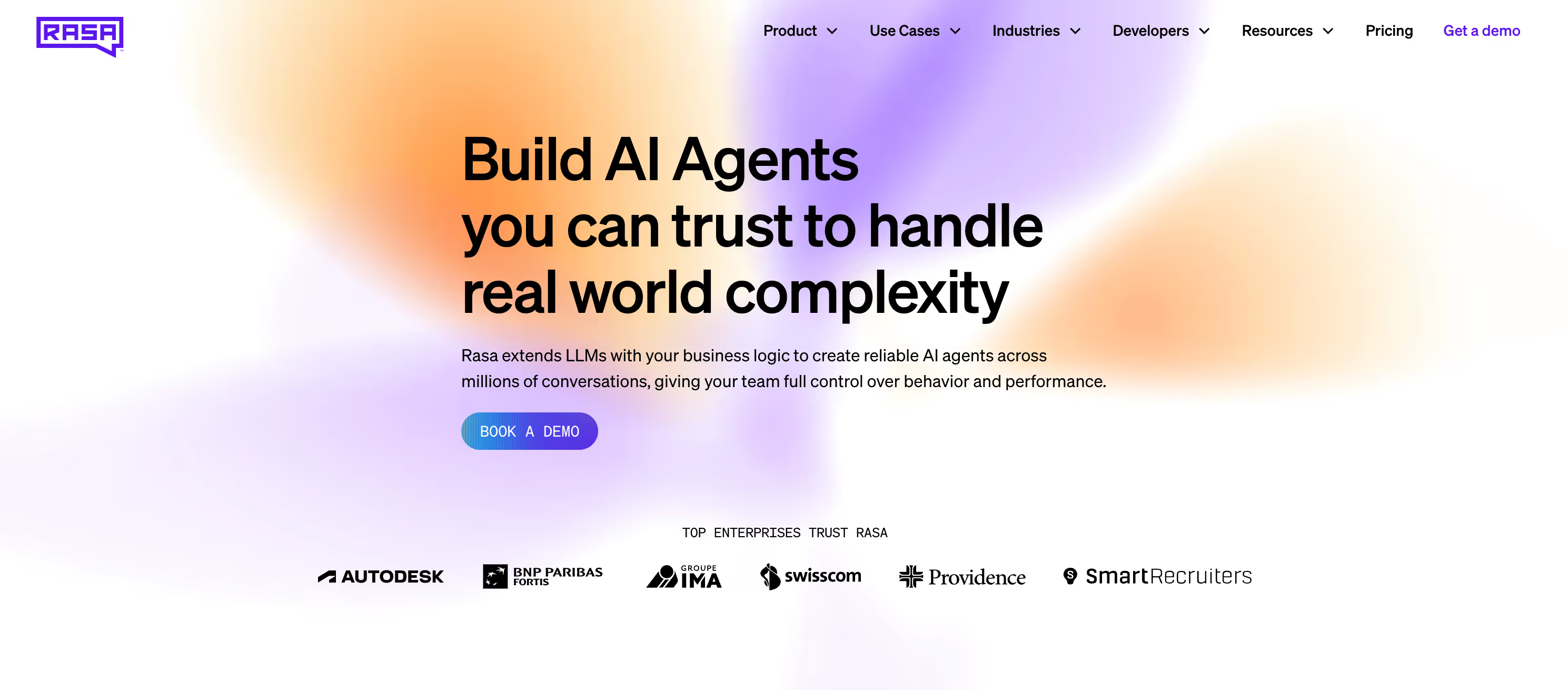
The Rasa platform is the developer platform for enterprise AI agents.
Deutsche Telekom, Autodesk, Swisscom, and Groupe IMA use it to build, orchestrate, and own AI agents across voice and digital channels.
Best for enterprise engineering teams (1,000+ employees) in regulated industries that need self-hosted deployment, architectural governance over agent behavior, and native voice capability.
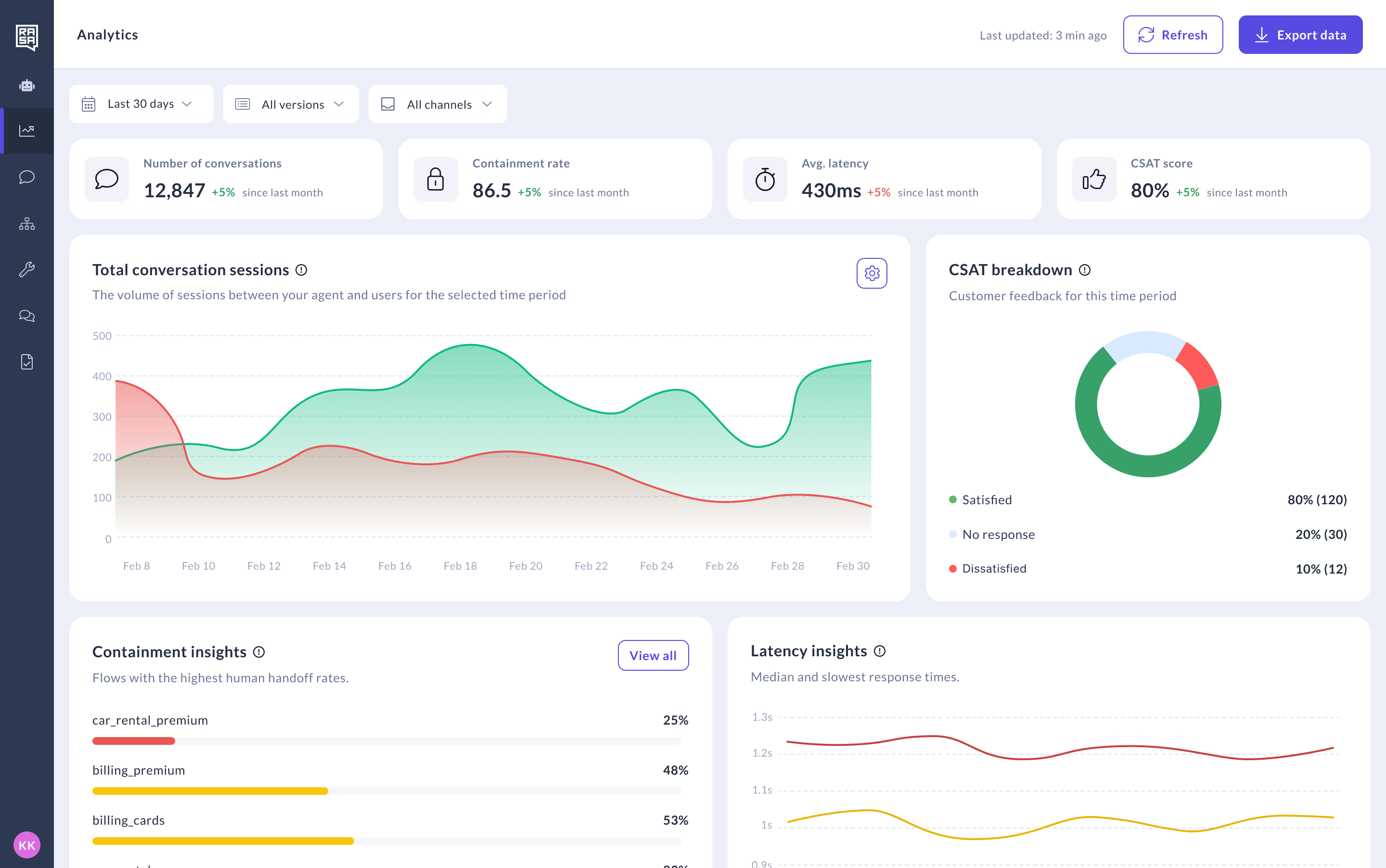
Product Overview
Botpress gets you to a prototype fast. Rasa gets you to production safely. The difference is the Orchestrator, a patented dialogue management layer that gives teams control over how agents reason, orchestrate, and operate reliably at scale.
The Rasa Platform includes the Framework, Orchestrator, and Studio. The Framework gives developers a code-first way to build agents, connect backend systems, manage versions, and deploy through existing engineering workflows. The Orchestrator manages conversation state, routes between skills, and supports both flexible agent behavior and stricter controls where required. Studio gives teams a workspace to test, review, and improve agent behavior.
Rasa supports self-hosted, private-cloud, and air-gapped deployment. That matters for teams that need control over customer data, logs, model access, audit records, and infrastructure.
Rasa also supports voice through channel connectors and speech-provider integrations, including Twilio, AudioCodes, Genesys Cloud, and Jambonz. It is strongest when voice is part of a broader enterprise agent platform, rather than a standalone phone-agent project.
Pricing
Developer Edition (Free): Full access to Rasa. One bot per company, up to 1,000 external conversations/month (100 for internal agents). Community support via the Rasa Forum.
Enterprise (Custom): Premium support, dedicated CSM, advanced security features, custom onboarding, Rasa Studio for refining design and review. Contact Rasa for a quote.
Pricing is based on annual conversation volume, not per-user or per-seat.
Integrations
Rasa connects to enterprise systems through custom actions, APIs, MCP-style integrations, channel connectors, and deployment infrastructure that teams control.
Setup
Self-hosted in your environment from day one. Rasa provides onboarding support and dedicated implementation specialists on the Enterprise tier.
Swisscom went from prototype to production in 20 weeks, doubling automation rates and cutting costs by 50%.
Pros and Cons
Pros:
- Self-hosted, private-cloud, and air-gapped deployment options.
- Code-first framework for teams that need to own and extend the system.
- Orchestrator for managing state, skills, handoffs, and controlled workflows.
- Studio for testing, review, and non-developer collaboration.
- Voice and digital channels in one operating model.
- Model, speech provider, and infrastructure choice.
- Annual conversation-volume licensing.
Cons:
- Requires engineering resources or an implementation partner.
- Steeper learning curve than no-code chatbot builders.
- Not the best fit for teams that want a fully managed vendor-built agent.
Tradeoffs
Choose Rasa if your team needs to deploy in its own environment, connect to internal systems, manage governed workflows, support voice and digital channels, and keep long-term control over how the agent is built, tested, released, and improved.
Support
Enterprise customers receive premium support, onboarding, and implementation guidance.
Developer Edition users can access community support through the Rasa Forum, documentation, and learning resources.
Mini Case Study
Swisscom rebuilt its customer service agent Sam using Rasa's CALM framework. Prototype to production in 20 weeks. Doubled automation rates. Cut operational costs by 50%. Development was 1.6x faster with zero-shot language understanding.
→ Read the Autodesk case study
See How Rasa Handles Enterprise Agent Orchestration
#2. Voiceflow: Best Botpress Alternative for AI Agent Prototyping
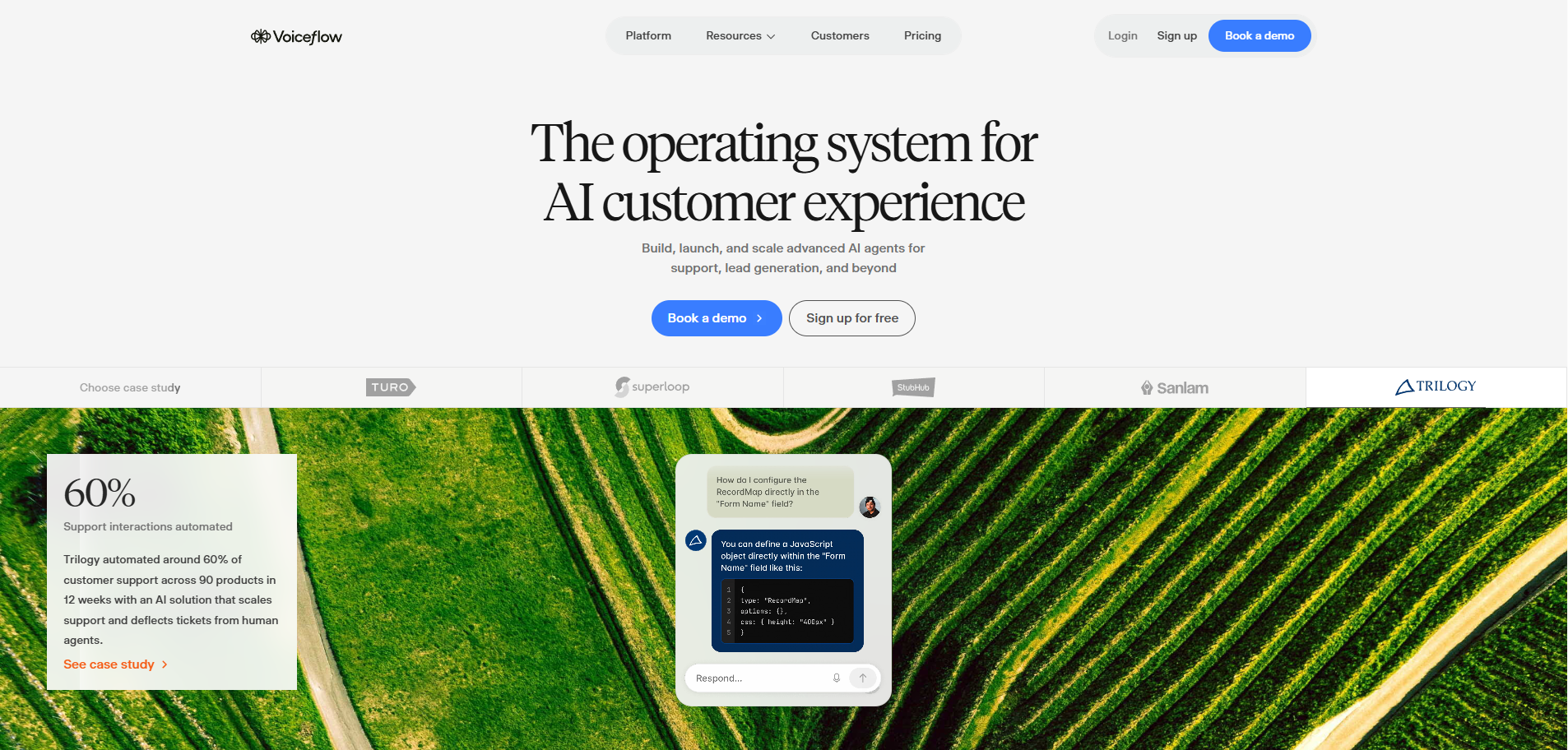
Best for CX, product, and agency teams that want a visual workspace to design, test, and deploy chat or voice agents quickly.
Product Overview
Voiceflow gives teams a visual canvas for building AI agents with workflows, playbooks, knowledge sources, API calls, and collaboration tools. It is especially useful when conversation designers, product managers, and CX teams need to map and test agent behavior without starting in code.
Voiceflow supports both chat and voice agents, with usage billed through a credit system. Credits are consumed by actions such as chat messages, LLM calls, phone calls, and text-to-speech usage. Enterprise plans can include advanced security, compliance features, custom credit allotments, and private-cloud hosting.
Pros and Cons
Pros:
- Strong visual builder for designing and testing agent flows.
- Good fit for prototypes, agencies, and CX teams that need a shared design workspace.
- Supports chat and voice agents.
- Includes knowledge base, API, analytics, simulation, and collaboration features.
- Enterprise plans support larger team, security, and deployment requirements.
Cons:
- Credit-based usage can be harder to forecast as agent volume grows.
- Additional editor seats and add-ons can increase cost for larger teams.
- Less suited for teams that want the agent platform to live as part of their own codebase and release process.
- Private-cloud hosting appears to be Enterprise-only, not a standard self-serve deployment option.
Pricing
Free plan (limited). Plus $60/editor/month. Enterprise custom. Additional editors $50/month each. Credit-based usage billing.
Setup
Hours for basic agent prototyping. Weeks for production deployment with integrations.
Tradeoffs
Voiceflow is stronger than Botpress for teams that want a polished collaborative design environment for AI agent prototyping and CX experimentation.
Rasa is the better fit when the agent needs to run in the enterprise’s own environment, connect deeply into backend systems, follow governed release workflows, and support voice plus digital channels as part of a broader service operation.
#3. Dialogflow CX: Best Botpress Alternative for Google Cloud Teams

Best for teams already committed to Google Cloud that want a visual flow builder, Google-native integrations, and contact center telephony options.
Product Overview
Dialogflow CX, now part of Google Cloud’s Conversational Agents direction, combines flow-based agent design with newer generative features such as playbooks, data stores, generators, and generative fallback. It supports text and audio input, synthetic speech output, prebuilt flow components, webhooks, test cases, versions, environments, analytics, audit logging, and telephony integrations.
For teams standardized on Google Cloud, Dialogflow CX is a strong option. It fits well when the agent is expected to live inside the GCP ecosystem, use Google Cloud services, and connect into Google’s contact center tooling.
Pros and Cons
Pros:
- Strong fit for Google Cloud teams.
- Visual flow builder for structured conversation design.
- Supports both flow-based and generative agent patterns.
- Telephony options include Dialogflow CX Phone Gateway, AudioCodes, Avaya, Twilio, Voximplant, and SIP trunk integration.
- Includes testing, versions, environments, analytics, conversation history, audit logging, and BigQuery export options.
Cons:
- Best suited to teams that are comfortable building inside Google Cloud.
- Pricing can become harder to model when text requests, voice seconds, generative features, data stores, and Google Cloud usage are all involved.
- Less natural fit for teams that want the agent platform to live in their own codebase, infrastructure, and release workflow.
Pricing
Pay-as-you-go. Free tier for text. CX pricing is based on sessions and audio minutes.
Setup
Hours for basic bots. Weeks for complex multi-turn deployments with telephony.
Tradeoffs
Dialogflow CX is a good Botpress alternative for Google Cloud teams that want structured conversation design, managed cloud infrastructure, and contact center integration.
Rasa is the better fit when the team needs customer-controlled deployment, deeper code-level ownership, model and provider choice, governed release workflows, and voice plus digital channels as part of an enterprise-owned agent platform.
Alternatives for Customer Support and E-Commerce
#4. Intercom Fin: Best Botpress Alternative for Customer Support Resolution
Best for SaaS and digital-first support teams that want a managed AI agent inside Intercom’s customer service platform.
Product Overview
Fin is Intercom’s AI agent for customer service. It can handle support conversations across Intercom Messenger, email, WhatsApp, phone, SMS, Slack, Facebook Messenger, and Instagram. It uses company support content, help center articles, past conversations, and connected sources to answer questions, complete workflows, and hand off to human agents when needed.
Fin works best for teams that already use Intercom, or want an AI agent tightly connected to a helpdesk, inbox, reporting, and human support workflows.
Pros and Cons
Pros:
- AI agent, helpdesk, inbox, reporting, and human handoff in one platform.
- Strong fit for high-volume SaaS and digital support teams.
- Supports chat, email, WhatsApp, phone, SMS, Slack, and social channels.
- Fin Copilot supports human agents inside the support workflow.
- Outcome-based pricing aligns cost with resolved support work.
Cons:
- Outcome-based pricing can be harder to forecast at high support volume.
- Best fit when the support operation is built around Intercom.
- Public materials do not describe a customer self-hosted deployment option.
- Less suited for teams that need code-level ownership, customer-controlled infrastructure, or an agent platform that sits across multiple enterprise systems outside the helpdesk.
Pricing
$0.99/resolution. Requires Intercom seat plan: Essential ($29/seat/mo), Advanced ($99/seat/mo), Expert ($132/seat/mo).
Setup
Under one hour for basic deployment. 1-2 weeks for full production with custom training.
Tradeoffs
Fin is a strong Botpress alternative for support teams that want a managed AI agent inside a full customer service platform.
Rasa is the better fit when the team needs customer-controlled deployment, deeper backend integration, governed release workflows, voice and digital channels in one operating model, and long-term ownership of the agent architecture.
#5. Gorgias: Best Botpress Alternative for E-Commerce Support
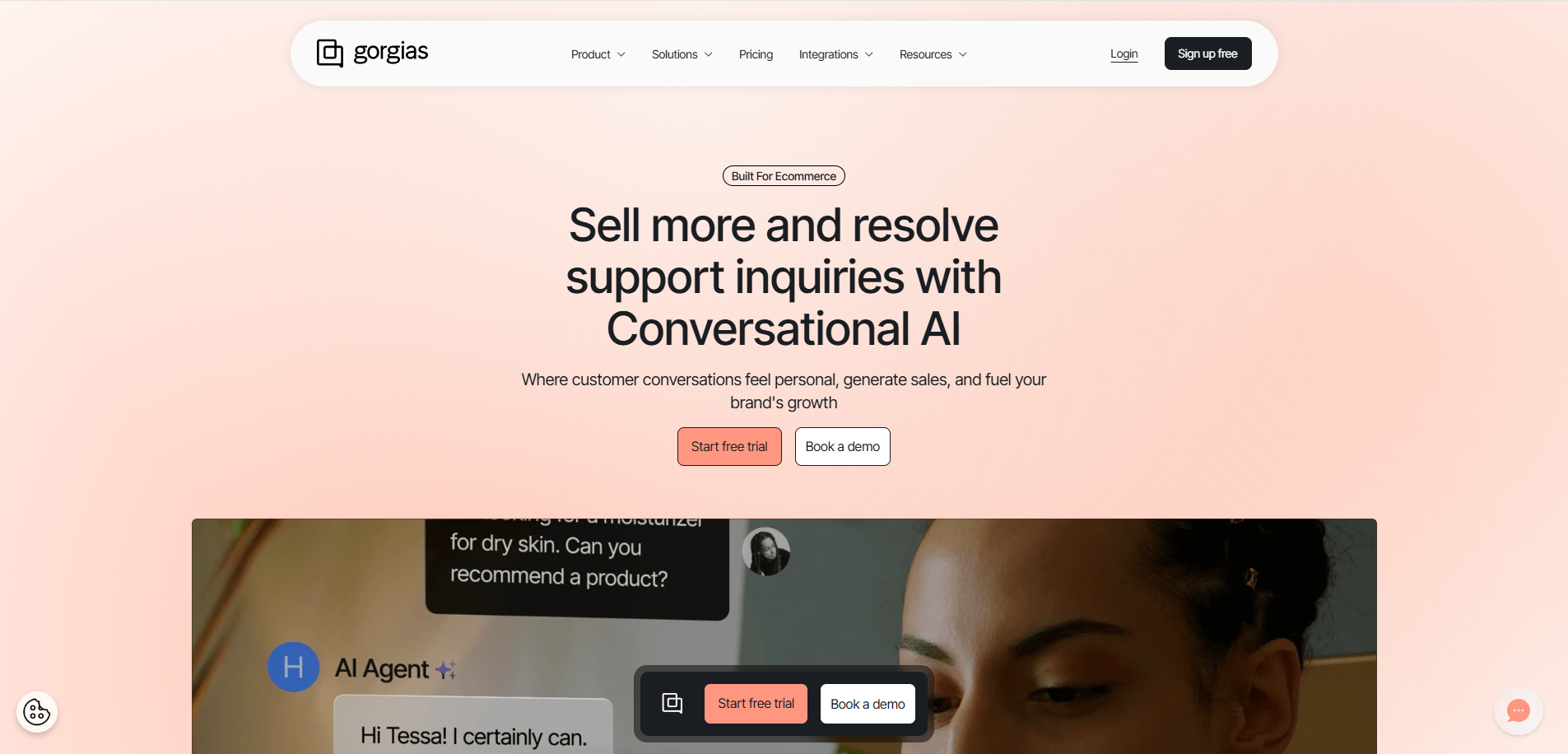
Best for Shopify, BigCommerce, and WooCommerce merchants needing AI tightly integrated with order management.
Product Overview
Gorgias is built around ecommerce support. Agents can manage customer conversations across email, live chat, social, WhatsApp, SMS, and voice add-ons, while pulling in order, customer, loyalty, returns, subscription, and product data from ecommerce systems.
Its AI Agent is designed for common commerce workflows: answering pre- and post-sale questions, tracking orders, handling returns and refunds, editing orders and subscriptions, recommending products, and offering discounts. AI Agent is available on email and chat.
Pros and Cons
Pros:
- Strong Shopify and ecommerce ecosystem fit.
- 150+ integrations, including tools like Klaviyo, Recharge, Loop Returns, and Yotpo.
- AI Agent can resolve common ecommerce support tasks without a human agent.
- Revenue statistics help connect support interactions to sales.
- Good fit for brands that want support automation close to order and customer data.
Cons:
- Narrower fit outside ecommerce.
- Pricing is based on helpdesk ticket volume, with separate AI Agent usage.
- AI Agent pricing adds cost for automated interactions.
- Voice is an add-on, not a dedicated voice-agent platform.
- Public materials do not describe a customer self-hosted deployment option.
Pricing
Starter $300/month (50 tickets). Pro, Advanced, and Enterprise tiers up to $5,000/month.
Setup
Days for Shopify stores. Weeks for multi-store configurations.
Tradeoffs
Gorgias is a good fit when the support problem is mainly ecommerce: order status, returns, refunds, product questions, discounts, and post-purchase support.
It is not trying to be a general enterprise agent platform. For banks, insurers, telecoms, healthcare teams, or enterprises that need customer-controlled deployment, custom backend workflows, release governance, audit records, and voice plus digital channels across many service journeys, Rasa is the stronger comparison point.
#6. Tidio: Best Botpress Alternative for SMB Live Chat and AI
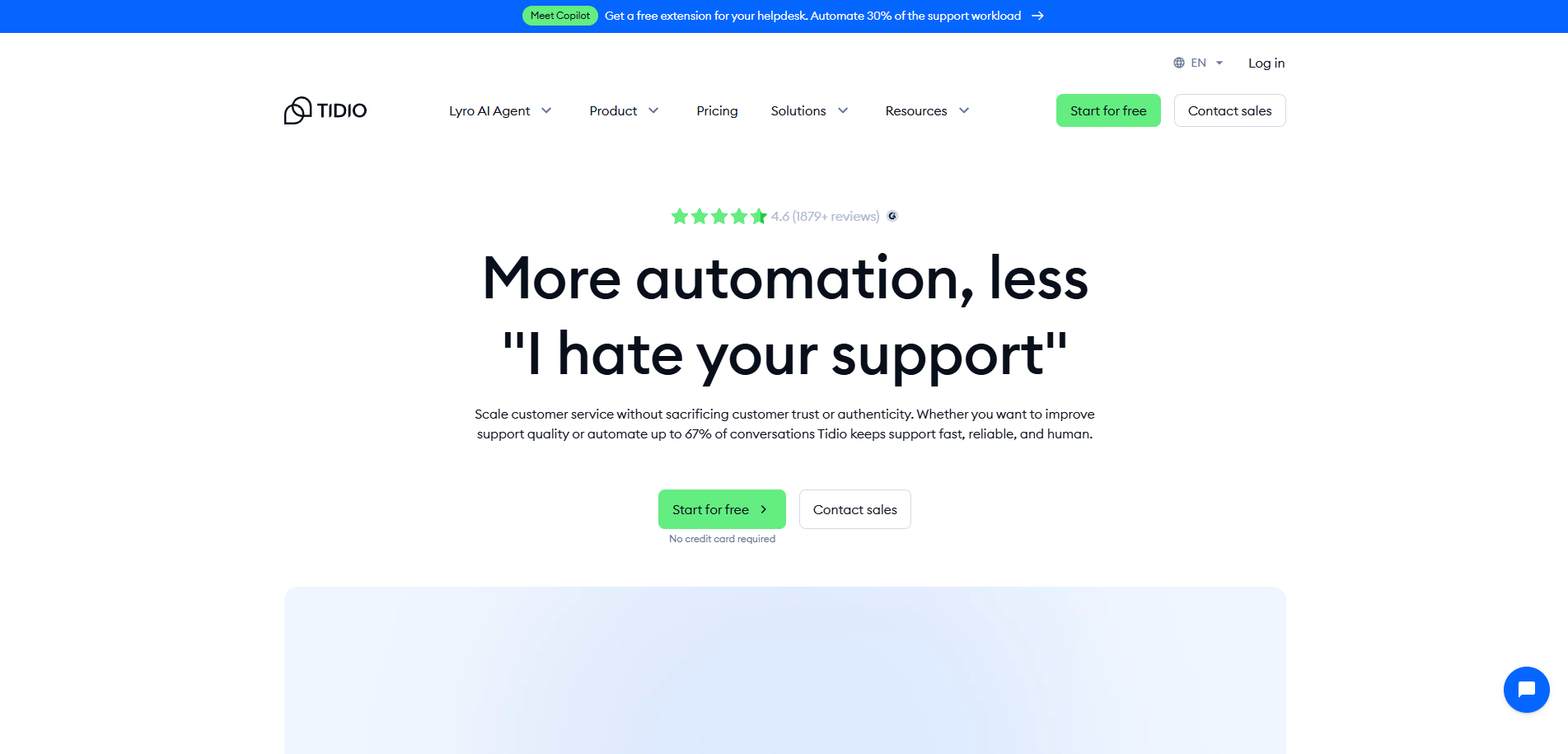
Best for small businesses that want live chat, ticketing, and AI support automation without a large implementation project.
Product Overview
Tidio combines live chat, helpdesk ticketing, rule-based flows, and Lyro AI Agent. Lyro answers from approved knowledge sources, can ask follow-up questions, and can hand off to a human agent or create a ticket.
Tidio fits ecommerce and SMB support teams that need quick website chat automation. It has dedicated Shopify and WooCommerce support, plus broader website and API-based setup.
Pros and Cons
Pros:
- Fast setup for website chat and ecommerce support.
- Free plan and low entry price.
- Lyro can answer from help content, solved chats, imported knowledge, and product data.
- Shopify and WooCommerce integrations support product recommendations.
- Human handoff and ticket creation are built into the support workflow.
Cons:
- Built for SMB support teams, not complex enterprise agent operations.
- Public materials do not describe a customer self-hosted deployment option.
- Lyro usage is limited by monthly conversation allowances.
- Voice is not the core product.
- Advanced plans and AI usage can raise total cost as the team scales.
Pricing
Free (50 conversations/month). Starter $29/month. Growth $59/month. Plus from $749/month.
Setup
Minutes. Single code snippet embeds the chat widget.
Tradeoffs
Tidio is a good entry-level choice when the goal is to add live chat and AI answers to a website or online store. It is less relevant for enterprise teams that need governed service journeys across internal systems, release workflows, audit records, and voice plus digital channels.
Alternatives for Social Media and Marketing
#7. ManyChat: Best Botpress Alternative for Social Media Marketing
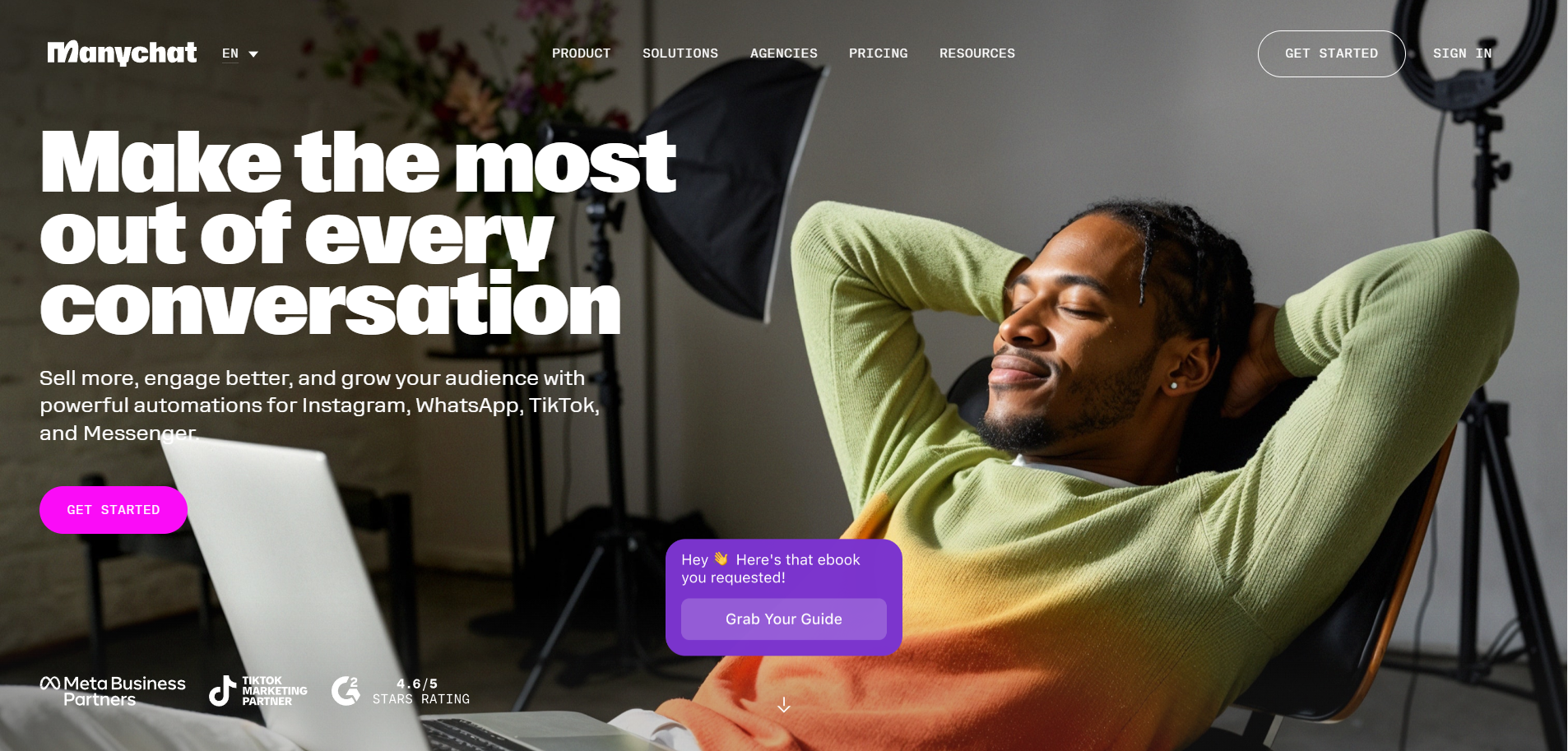
Best for creators, ecommerce brands, and small businesses that use social DMs as a lead generation or sales channel.
Product Overview
Manychat is built for social messaging automation. It supports Instagram, WhatsApp, TikTok, Messenger, SMS, and email. Teams use it to trigger conversations from comments, story replies, ads, QR codes, and direct messages.
Its visual flow builder is useful for lead capture, product promotions, appointment booking, giveaways, and simple customer follow-up. Manychat also includes AI features for replies, FAQs, intents, and flow creation, but its core strength remains social media marketing automation rather than enterprise conversational AI.
Pros and Cons
Pros:
- Strong fit for Instagram, WhatsApp, TikTok, and Messenger automation.
- Visual builder for social DM funnels.
- Useful triggers for comments, story replies, ads, links, and QR codes.
- Good for creators, ecommerce brands, agencies, and performance marketers.
- AI features can assist with replies, FAQs, and flow creation.
Cons:
- Built around marketing automation more than complex support resolution.
- Pricing scales with active contacts, so viral campaigns can raise cost.
- Not a voice-agent platform.
- Public materials do not describe a customer self-hosted deployment option.
- Limited fit for regulated enterprise workflows.
Pricing
Free (limited). Pro $15/month. Elite $99/month. Enterprise custom.
Setup
Minutes. First automation live in under 10 minutes.
Tradeoffs
Manychat is a strong choice when the goal is to turn social engagement into DM-based funnels. It is less useful when the buyer needs a production agent that handles complex service journeys, backend actions, audit records, controlled releases, and deployment inside the customer’s own environment.
Specialized Alternatives
#8. Chatbase: Best Botpress Alternative for Simple RAG Chatbots
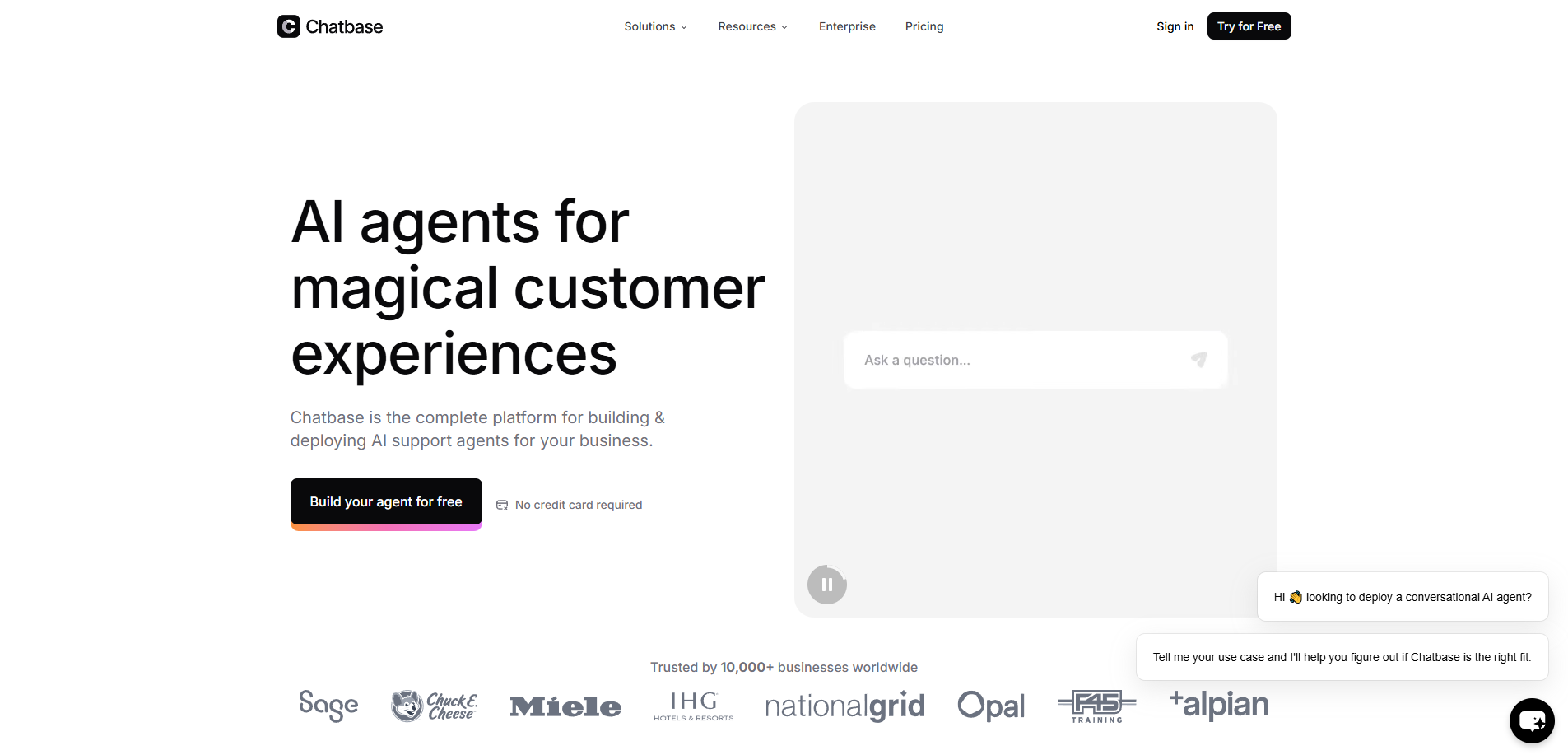
Best for small teams that want to turn website content, documents, and help center material into an AI agent quickly.
Product Overview
Chatbase lets teams create AI agents from sources such as websites, files, text, Notion, Zendesk, Intercom, HubSpot, Salesforce, Freshdesk, Slack, WhatsApp, Messenger, Instagram, and WordPress. It supports multiple model families, including OpenAI, Anthropic, Gemini, DeepSeek, Meta, and others.
Chatbase is useful when the main job is answering questions from approved content. Higher plans also add AI Actions, Help Desk, API access, personalization, voice, and telephony.
Pros and Cons
Pros:
- Fast setup from documents, URLs, and connected sources.
- No flow builder required for simple support or lead-capture agents.
- Broad model support.
- Integrations for common support, CRM, and messaging tools.
- Voice and telephony available on higher plans.
Cons:
- Best suited for content-grounded Q&A, not complex service journeys.
- Workflow control is lighter than platforms built around governed business processes.
- Training size, message credits, seats, AI Actions, and voice usage vary by plan.
- Public materials do not describe a customer self-hosted deployment option.
- Enterprise controls such as SSO, audit logs, custom roles, SLAs, and CSM support sit on the Enterprise plan.
Pricing
Free (limited). Hobby $19/month. Standard $99/month. Pro $399/month.
Setup
Minutes. Upload content and deploy.
Tradeoffs
Chatbase is a strong fit for fast knowledge-base agents. It is less suited when the agent needs to coordinate many backend actions, follow controlled business steps, support enterprise release workflows, and run inside the customer’s own infrastructure.
#9. Kore.ai: Best Botpress Alternative for Enterprise Workflow Automation
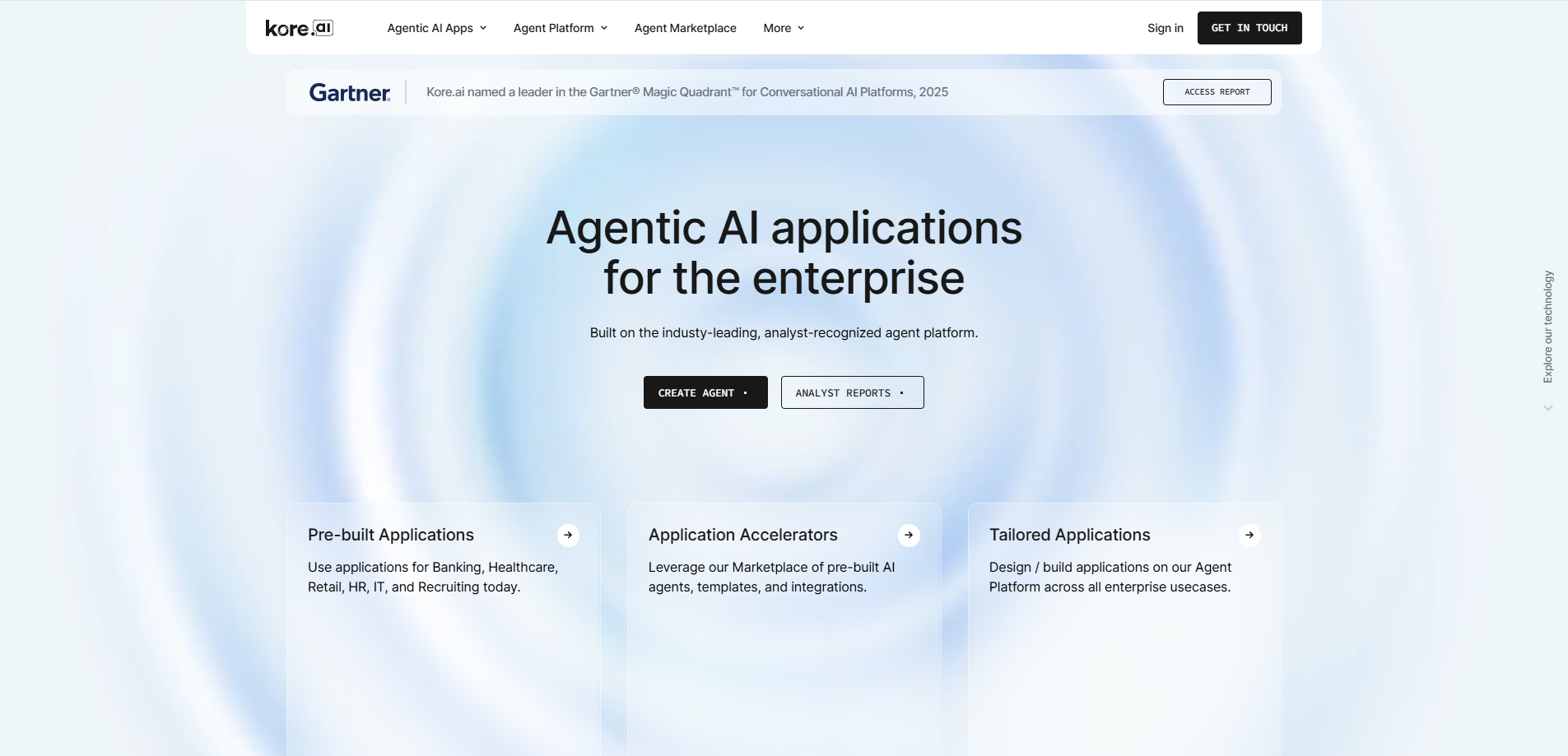
Best for large enterprises that want a broad AI agent platform with prebuilt industry solutions, low-code tooling, contact center support, and enterprise governance.
Product Overview
Kore.ai is an enterprise AI agent platform for service, work, and process automation. It supports chat, voice, email, social channels, contact center use cases, and agent assist.
The platform includes low-code agent building, multi-agent orchestration, memory stores, guardrails, analytics, evaluation tools, and prebuilt industry agents.
Pros and Cons
Pros:
- Broad enterprise platform across service, work, and process automation.
- Prebuilt agents and templates for industries like banking, healthcare, retail, HR, and IT.
- Contact center capabilities through SmartAssist and Agent Assist.
Cons:
- Large product surface can create a learning curve.
- Enterprise setup can require significant configuration and services work.
- Pricing depends on product, plan, usage, add-ons, and enterprise terms.
- Less code-first for teams that want the agent project to live directly in their own engineering workflow.
Pricing
Custom enterprise pricing. Contact Kore.ai for a quote.
Setup
Weeks for pre-built agents. Months for custom enterprise deployments.
Tradeoffs
Kore.ai is a serious enterprise option when a company wants a large, packaged platform with many built-in modules.
Rasa is the cleaner fit for technical teams that want deeper ownership of the agent architecture, deployment environment, codebase, release process, and model/provider choices.
#10. Retell AI: Best Botpress Alternative for Developer Voice Agents
Best for developer-led teams building AI phone agents for inbound and outbound calls.
Product Overview
Retell AI is a voice-first platform for building phone agents. It supports inbound and outbound calls, custom telephony through SIP, webhooks, API access, call analytics, transcripts, simulation testing, and concurrent calling.
Retell also offers AI Chat Agents, but its core strength is still real-time voice automation. It fits teams that want to build phone agents quickly without assembling their own STT, LLM, TTS, telephony, and call analytics stack.
Pros and Cons
Pros:
- Strong fit for low-latency phone agents.
- Supports inbound and outbound voice use cases.
- Custom telephony through SIP.
- API access, webhooks, call transcripts, analytics, and simulations.
- Pay-as-you-go pricing for developer-led teams.
Cons:
- Voice-first, so it is not the best fit for broad omnichannel service operations.
- Enterprise governance depends heavily on how the team designs prompts, tools, tests, handoffs, and backend controls.
- Less suited for teams that need a single platform across voice, chat, internal systems, and governed release workflows.
Pricing
Pay-per-minute. Pricing varies by provider and call volume.
Setup
Hours for API integration. Minutes for demo calls.
Tradeoffs
Retell is a better fit than Botpress when the main job is phone automation. It gives developers a faster path to real-time voice agents than building the whole speech and telephony stack from scratch.
Rasa is the better fit when voice is one channel inside a larger enterprise agent program. That matters when the same service logic needs to work across voice and digital channels, connect to internal systems, follow governed release workflows, and run in the customer’s own environment.
Why Choose Botpress Alternatives
Self-Hosted Deployment for Regulated Data
Botpress has sunset Botpress v12 and all self-hosted versions. New development now happens in Botpress Cloud.
That matters for teams in banking, healthcare, insurance, and government. They often need customer data, logs, prompts, model calls, and audit records to stay inside their own infrastructure.
Rasa supports self-hosted, private-cloud, and air-gapped deployment. For regulated teams, that means the agent can run closer to the systems, data, and security controls the business already owns.
Governance Over Agent Behavior
A production agent needs more than a prompt and a knowledge base. It needs clear rules for what actions are allowed, when backend tools can be called, how handoffs work, what must be tested before release, and which events are available for review.
Rasa’s Orchestrator gives teams a structured way to manage skills, state, handoffs, memory, and controlled workflows. That is important when the agent handles account changes, payments, claims, appointments, identity, or regulated service journeys.
Native Voice Capability
Voice is not just another channel. It adds latency, interruption handling, speech recognition, text-to-speech, telephony routing, and fallback requirements.
Rasa supports voice through channel connectors and speech-provider integrations, including Twilio, AudioCodes, Genesys Cloud, and Jambonz. It is a better fit when voice needs to share logic, context, and governance with digital channels.
More predictable Scaling
Botpress uses plan fees, message and event limits, add-ons, and AI Spend. Botpress also notes that there is currently no reliable way to forecast AI Spend.
Rasa Enterprise uses annual conversation-volume licensing. That gives enterprise buyers a clearer way to model usage as automation scales.
How to Choose the Right Alternative to Botpress
Start with the job the agent needs to do
The right alternative depends on the use case.
If you need a simple website FAQ agent, look at Chatbase or Tidio. If you need social DM automation, Manychat is a better fit. If you need ecommerce support tied to Shopify orders and returns, Gorgias is more relevant. If you need a managed support agent inside a helpdesk, Intercom Fin is the closer match. If you need phone automation, Retell AI or Dialogflow CX may fit better. If you need an enterprise agent platform across systems, teams, and regulated workflows, compare Rasa and Kore.ai more closely.
Decide where the agent must run
Deployment is one of the fastest ways to narrow the list.
Some teams are fine with hosted SaaS. Others need private cloud, self-hosted, or air-gapped deployment because of data residency, security review, audit requirements, or internal infrastructure rules.
Botpress has sunset its self-hosted versions, so new Botpress development runs on Botpress Cloud. Rasa supports customer-controlled deployment, including self-hosted and private-cloud environments. Kore.ai also supports enterprise deployment options.
Check how deep the agent needs to integrate
A content bot can answer from documents. A service agent often needs to do more.
If the agent must check eligibility, update an account, process a refund, change a plan, create a claim, route a ticket, or trigger an internal workflow, look closely at the platform’s integration model. Check APIs, webhooks, custom actions, MCP support, authentication, error handling, and how tool calls are logged.
Evaluate control and review workflows
For low-risk questions, prompt behavior and knowledge grounding may be enough.
For regulated or high-value journeys, you need stronger controls. Look for tool permissions, required steps, exact response options, approval gates, test cases, versioning, release review, human handoff, conversation traces, and audit-friendly logs.
Separate voice demos from voice operations
Voice support can mean many things.
A voice API helps you build phone agents. A contact center platform helps with telephony and agent handoff. An enterprise agent platform should let voice and digital channels share logic, context, integrations, and governance.
Retell AI is strong for developer-led phone agents. Dialogflow CX is a strong fit for Google Cloud voice deployments. Rasa is a stronger fit when voice is one channel in a broader enterprise service operation.
Model the production cost, not the entry price
Do not compare only the starting plan.
Model messages, events, AI spend, seats, outcomes, phone minutes, voice credits, add-ons, support, hosting, and implementation work. Botpress pricing includes plan fees, usage limits, add-ons, and AI Spend. Intercom charges for Fin outcomes. Voiceflow and Chatbase use credit models. Rasa Enterprise uses annual conversation-volume licensing.
Run a pilot with a real service journey
Do not pilot the easiest FAQ.
Use a journey with backend actions, handoff, missing information, corrections, interruptions, policy constraints, and reporting needs. Track resolution quality, escalation quality, latency, cost per useful outcome, failure diagnosis, and how quickly the team can improve the agent after testing.
Key Features to Look for When Exploring the Top Botpress Alternatives
Deployment model
Start with where the agent must run. Regulated teams may need self-hosted, private-cloud, or air-gapped deployment so customer data, logs, prompts, model calls, and audit records stay under their own controls.
Integration depth
A serious service agent needs to do more than answer from a knowledge base. Check how the platform connects to backend systems, APIs, CRMs, contact center tools, identity systems, payment systems, and internal workflows.
Workflow control
Look for controls that match the risk of the task. Low-risk answers can be flexible. Account changes, claims, refunds, payments, and regulated disclosures need required steps, approvals, exact response options, tool permissions, and tested handoffs.
Voice and digital channel support
Voice support should be evaluated carefully. Some tools offer phone agents. Others offer voice through contact center integrations. For enterprise service operations, the stronger question is whether voice and digital channels can share logic, context, and governance.
Team workflow
The platform should fit how the team actually ships software. Look for versioning, testing, review, controlled releases, role-based collaboration, and a clear path for developers, product owners, conversation designers, and subject-matter experts to contribute.
Observability and auditability
Production teams need to see what happened. Look for conversation traces, event history, tool calls, handoff records, test results, latency, cost signals, and logs that support debugging and compliance review.
Pricing model
Compare how costs scale. Message limits, AI spend, credits, seats, outcomes, phone minutes, and add-ons can all change the real cost. For enterprise deployments, model 12- and 24-month volume before choosing a platform.
Cost Comparison: Botpress vs. Competitors
Which of the Alternatives to Botpress Is Right for Your Business?
- Need enterprise governance + self-hosted + voice: Rasa. The only alternative with architectural governance over agent behavior, native voice, and on-premises deployment.
- Need agent prototyping with visual builder: Voiceflow. Best drag-and-drop flow design for conversation prototyping.
- Need simple RAG chatbot fast: Chatbase. Upload content, deploy in minutes.
- Need customer support resolution: Intercom Fin. Highest autonomous resolution rate.
- Need ecommerce support: Gorgias. Deepest Shopify integration.
- Need SMB live chat: Tidio. Fastest to deploy, free plan available.
- Need social media marketing: ManyChat. Best DM automation.
- Need Google Cloud native: Dialogflow CX. Strong NLU, telephony via CCAI.
- Need enterprise workflow automation: Kore.ai. Pre-built industry agents, on-prem option.
- Need developer voice API: Retell AI. Low-latency phone agents.
FAQs
What are the main reasons teams look for Botpress alternatives?
Teams usually look elsewhere when they need more control over deployment, cost, governance, voice operations, or long-term production ownership.
Botpress is strong for building and launching agents in a hosted visual environment. The gap appears when the agent needs to run inside the company’s own infrastructure, connect deeply into internal systems, follow strict release controls, or support regulated service journeys.
Is Botpress open source?
Botpress started with open-source and self-hosted versions, but Botpress v12 and all self-hosted versions have been sunset. New Botpress development now happens on Botpress Cloud.
Teams looking for a self-hosted enterprise agent platform should evaluate Rasa. Teams looking for a lightweight open-source framework may need to compare developer frameworks separately.
Is Botpress free to use?
Botpress has a free Pay-as-you-go plan with 500 incoming messages and events per month, plus a monthly AI credit. Paid plans add higher usage limits, support, collaboration, analytics, and enterprise controls.
Rasa offers a free Developer Edition for one bot per company, with up to 1,000 external conversations per month or 100 internal conversations per month.
Can Botpress be self-hosted?
Not for new deployments. Botpress says v12 and all self-hosted versions are no longer available for download, purchase, or new deployments. Existing v12 customers remain supported.
Rasa supports self-hosted and private-cloud deployment. Kore.ai also offers enterprise deployment options beyond standard public cloud.
Does Botpress support voice?
Botpress has a Twilio integration that can support SMS and phone-based interactions. That is different from a platform designed to operate voice and digital channels as one governed enterprise service system.
Rasa supports voice through channel connectors and speech-provider integrations, including Twilio, AudioCodes, Genesys Cloud, and Jambonz. Retell AI is a stronger fit for developer-led phone agents. Dialogflow CX is a strong fit for Google Cloud voice deployments.
Is Botpress better than no-code chatbot platforms?
Botpress is usually more flexible than simple no-code FAQ tools like Chatbase or Tidio. It gives builders a visual studio, workflows, knowledge bases, LLM features, APIs, and integrations.
For enterprise production, the question changes. Teams need deployment control, backend integration, release governance, observability, and auditability. That is where Rasa is a stronger fit.
Does Botpress integrate with social media?
Yes. Botpress supports channels such as WhatsApp, Instagram, Messenger, and Slack.
For dedicated social marketing automation, Manychat is usually the better fit. It is built around Instagram DMs, WhatsApp campaigns, comment triggers, lead funnels, and creator or ecommerce growth workflows.
Are there fully hosted alternatives to Botpress?
Yes. Intercom Fin, Tidio, Manychat, Chatbase, Gorgias, Voiceflow, Retell AI, and Dialogflow CX are hosted options.
That is useful when the team wants speed and minimal infrastructure work. It is less useful when security, compliance, or data residency requires customer-controlled deployment.
Which Botpress alternative is best for non-developers?
Manychat is best for social DM automation. Chatbase is best for simple knowledge-base agents. Tidio is best for SMB website chat. Voiceflow is strong for collaborative agent design and prototyping.
For larger enterprises, Kore.ai offers low-code tooling and prebuilt industry agents. Rasa is more technical, but Studio helps non-developers review, test, and improve agent behavior alongside engineering teams.
Which Botpress alternative is best for ecommerce businesses?
Gorgias is the strongest fit for Shopify-focused ecommerce support. It connects support automation to orders, returns, refunds, subscriptions, product data, and revenue reporting.
Tidio is a better fit for smaller stores that want affordable live chat and AI answers without a large support platform.
How does Rasa compare to Botpress?
Botpress is a hosted platform with a visual builder, knowledge bases, workflows, LLM features, and integrations. It is a good fit for teams that want to build quickly in Botpress Cloud.
Rasa is a developer platform for enterprise AI agents. It is a better fit when teams need customer-controlled deployment, backend integrations, governed workflows, voice and digital channels in one operating model, and a release process that fits their engineering team.
Choose Botpress for fast hosted building. Choose Rasa when the agent becomes part of your own software and service operation.
Is technical knowledge required to use Botpress alternatives?
It depends on the platform.
Manychat, Chatbase, and Tidio are the easiest for non-technical teams. Voiceflow and Botpress work well for builders who are comfortable with visual workflows and integrations. Intercom Fin and Gorgias are easier when the team already uses those support platforms.
Rasa, Dialogflow CX, Kore.ai, and Retell AI usually require technical resources for production use, especially when the agent needs backend actions, voice setup, testing, security review, and ongoing improvement.