
Sierra is a high-profile enterprise AI agent company co-founded by Bret Taylor and Clay Bavor. It positions Sierra Agent OS as a platform for building, optimizing, personalizing, and scaling AI agents for customer experience across channels.
The pitch is compelling. The reality is more nuanced.
Sierra is strongest for enterprises that want a managed customer experience agent operating model. Agent OS includes products for agent building, memory, insights, channels, and human-agent support workflows. But Sierra does not publish a standard price list, and its public materials emphasize outcome-based pricing rather than customer-run infrastructure. For teams that need the agent platform to fit their own architecture, deployment model, engineering workflow, and release process, that operating model deserves closer evaluation.
If you’re evaluating Sierra AI alternatives, this guide compares 10 platforms across operating models, deployment flexibility, governance, voice and digital channels, engineering fit, and pricing model.
What Alternatives to Sierra AI Are There? Competitor Comparison and Ratings Chart
11 Best Alternatives to Sierra AI Agents for Enterprise Conversational AI in 2026
Enterprise and Omnichannel AI
#1. Rasa: Best Sierra AI Alternative for Enterprise Ownership and Self-Hosted Deployment
Rasa is the developer platform for enterprise AI agents.
Where Sierra is strongest for teams that want a managed CX agent operating model, Rasa is built for technical enterprise teams that want the agent platform to fit their own architecture, deployment model, engineering workflow, security process, and release process.
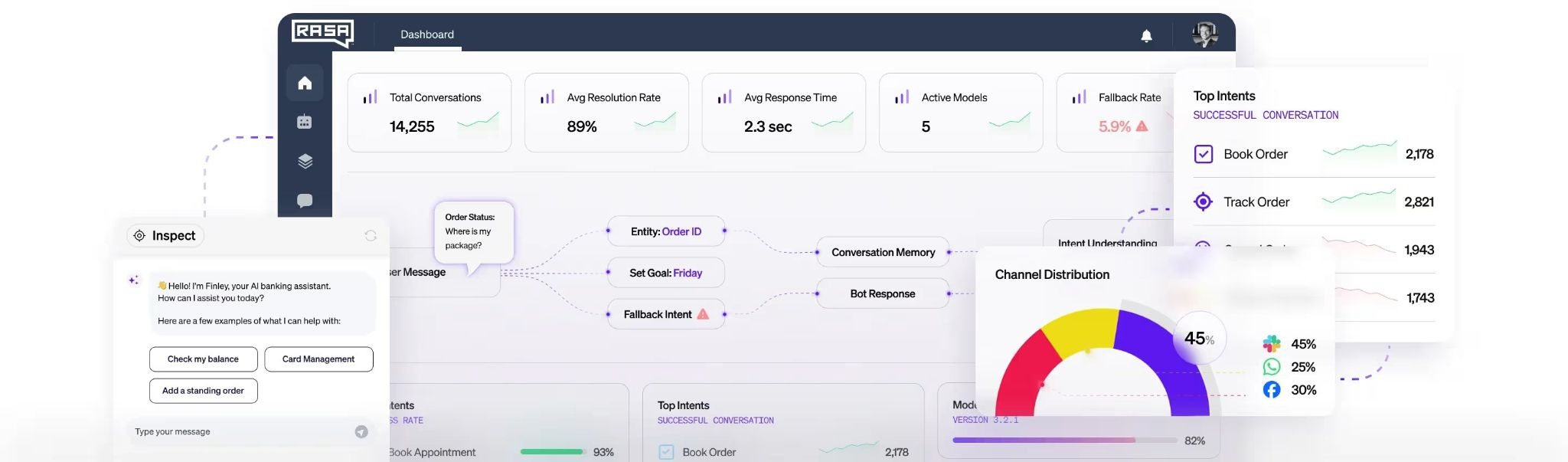
The Rasa Platform brings together the Framework, Orchestrator, and Studio so teams can build, run, review, and improve agents across voice and digital channels.
Best for technical enterprise teams in regulated industries that need self-hosted, private-cloud, or air-gapped deployment, model and provider choice, auditable agent behavior, and the ability to add stricter controls where the use case requires it.
Product Overview
Sierra and Rasa approach enterprise agents from different operating models. Sierra Agent OS is a managed CX agent platform with Agent Studio, Ghostwriter, Agent Data Platform, Insights, Channels, and Live Assist. It is a strong fit when a company wants a vendor-managed customer service agent layer.
Rasa is built for teams that want the agent platform to become part of their own software and service operation. The patented Orchestrator manages conversation state and agent behavior across skills, tools, and channels, while the Framework gives engineering teams code-level ownership of integrations, tests, versioning, and releases. Studio gives teams a place to review conversations, manage responses, and improve agent behavior without moving every change through engineering.
That difference matters in regulated and complex enterprise environments. Rasa lets teams use flexible agent behavior where natural conversation matters, then add stricter controls where required: approvals, policy checks, required steps, backend actions, handoffs, or exact wording.
Pricing
Developer Edition (Free): Free Rasa license for local or production use. One bot per company, up to 1,000 external conversations/month or 100 internal conversations/month, with community support via the Rasa Forum.
Enterprise (Custom): Full access to the Rasa Platform, premium support, enterprise security features, and support for large-scale deployment.
Rasa pricing is based on annual conversation volume, not per-seat licensing.
Integrations
Rasa connects to backend systems through custom actions, APIs, MCP server integrations, and channel connectors. Teams can integrate with CRMs, ERPs, ticketing systems, contact center platforms, knowledge systems, and internal services while keeping logic and release management in their own engineering workflow.
Setup
Rasa can be deployed self-hosted, in private cloud, or air-gapped when required. Enterprise customers get onboarding, implementation guidance, best-practice reviews, and support aligning Rasa with their architecture, deployment model, integrations, and release process.
Swisscom went from prototype to production in 20 weeks, doubling automation rates and cutting costs by 50%.
Pros and Cons
Pros:
- Customer-controlled deployment: self-hosted, private-cloud, and air-gapped options.
- Technical ownership: codebase, version control, CI/CD, tests, review, and controlled releases.
- Patented Orchestrator: manages conversation state, skills, memory, tools, and channel behavior.
- Flexible where useful, stricter where required: approvals, policy checks, required steps, handoffs, backend actions, and exact wording.
- Voice and digital channels in one operating model.
- Model and provider choice across LLM and speech providers.
- Observable and auditable: event-based tracker and inspectable dialogue state.
Cons:
- Requires engineering resources or an implementation partner.
- Less turnkey than a managed CX agent vendor.
- Not the right fit for teams that want a vendor to fully operate the agent for them.
Tradeoffs
Sierra is a better fit when the buyer wants a managed CX agent layer and is comfortable working inside Sierra’s operating model.
Rasa is a better fit when the buyer wants the agent platform to fit their own architecture, deployment model, integrations, security process, and release workflows.
Support
Rasa Enterprise includes premium support, customer success, implementation guidance, and best-practice recommendations. Developers also have access to documentation, learning resources, and the Rasa Forum.
Mini Case Study
Deutsche Telekom deployed Rasa's Orchestrator for internal IT support across 10,000+ employees in German and English. 50% of service desk inquiries are resolved autonomously. 30% reduction in agent workload. Non-technical IT experts use Rasa Studio to design conversation flows.
See How Rasa Compares to Sierra's Managed Approach
#2. Quiq: Best Sierra AI Alternative for Transparent Agentic AI Across Voice and Digital
Best for enterprise brands that need transparent, agentic AI across voice and digital channels, without losing control of the customer experience.
Product Overview
Quiq is an enterprise conversational AI platform focused on what it calls “reliable resolution” rather than basic chatbot automation. The platform combines AI agents, AI assistants for human agents, workflow automation, and conversation analytics into one customer journey platform. It supports voice, SMS, chat, WhatsApp, and other digital channels while maintaining context between AI and human handoffs.
One of Quiq’s biggest differentiators is transparency. Unlike many newer AI vendors that operate like black boxes, Quiq emphasizes visible AI reasoning, verification guardrails, and deep workflow customization. The platform is also model agnostic, allowing enterprises to use different LLMs instead of locking into a single provider.
Quiq is particularly strong for large retail, travel, hospitality, and consumer service brands handling high conversation volume and complex workflows. Customers include Spirit Airlines, Panasonic, Accor Hotels, Roku, Brinks Home, and Urban Outfitters.
Pros and Cons
Pros:
- Transparent AI reasoning and observability.
- Strong omnichannel and asynchronous messaging support.
- Seamless AI to human escalation with shared context.
Cons:
- Enterprise focused pricing.
- Implementation can take several weeks for large deployments.
- More complex than lightweight chatbot platforms.
Pricing
Custom enterprise pricing based on conversation volume, AI usage, and deployment scope. Proof of concept deployments typically start around $40,000 to $75,000 annually. Full enterprise deployments scale into six or seven figures depending on usage and features.
Setup
Proof of concept deployments generally take 6 to 8 weeks. Full enterprise rollouts typically range from 3 to 4 months depending on integrations, workflows, and channels.
Tradeoffs
Quiq is a strong fit for enterprises that want more control, visibility, and customization than most AI customer service platforms provide. It works especially well for brands handling complex workflows across multiple channels, where context continuity and AI governance matter.
That said, it is not the simplest option for smaller teams looking for a plug and play chatbot. Quiq is built for large scale customer experience operations with deeper implementation requirements and enterprise workflows.
#3. Kore.ai: Best Sierra AI Alternative for Enterprise Omnichannel Workflow Automation
Best for large enterprises that want a broad AI agent platform across customer service, employee support, HR, IT, and process automation.
Product Overview
Kore.ai offers an enterprise AI agent platform for building, orchestrating, governing, and optimizing agents across teams, systems, and channels. It supports customer service, employee service, contact center, HR, IT, recruiting, and process automation use cases, with pre-built agents, enterprise integrations, analytics, guardrails, and multi-agent orchestration.
Pros and Cons
Pros:
- Broad platform coverage across customer-facing and employee-facing use cases.
- Strong enterprise governance, analytics, and observability story.
- Pre-built agents and marketplace assets can speed up common use cases.
Cons:
- Integration configs can be messy (Capterra).
- Enterprise pricing is opaque.
- Learning curve on advanced features.
Pricing
Custom enterprise pricing. Contact Kore.ai for a quote.
Setup
Weeks for pre-built agents. Months for custom enterprise deployments.
Tradeoffs
Kore.ai is a strong fit for enterprises that want a broad, packaged AI agent platform across many business functions. Rasa is a stronger fit when technical teams want the agent platform to become part of their own software operation, with deeper fit into their architecture, deployment model, engineering workflow, and release process.
#4. Salesforce Agentforce: Best Sierra AI Alternative for CRM-Native Contact Centers
Best for enterprises already standardized on Salesforce that want AI agents, CRM data, voice, digital channels, and service workflows inside the Salesforce platform.
Product Overview
Salesforce Agentforce brings AI agents into the Salesforce ecosystem. For contact centers, Agentforce Contact Center combines AI agents, CRM context, voice, digital channels, routing, workflows, and human-agent handoff inside the Salesforce platform. Salesforce Voice and Service Cloud Voice options also support telephony through partner telephony or Amazon Connect, depending on the edition and architecture.
Pros and Cons
Pros:
- Deepest CRM context of any platform.
- Native telephony via Service Cloud Voice.
- Regional data residency through Hyperforce.
Cons:
- Best fit requires deep Salesforce commitment.
- Licensing spans multiple Salesforce products and usage models.
- TCO can be hard to model across Agentforce conversations, Service Cloud seats, Voice, Data Cloud, integrations, and implementation work.
Pricing
$2/conversation for Agentforce. Service Cloud from $25/user/month. Enterprise tiers are significantly higher.
Setup
Weeks to months. Requires Salesforce admin expertise.
Tradeoffs
Salesforce is the strongest fit when the buyer wants AI agents inside an existing Salesforce service operation. Rasa is a stronger fit when the enterprise wants the agent platform to sit inside its own architecture, connect across systems beyond one CRM, and run through its own deployment, security, and release process.
Voice and Conversational AI
#5. Ada: Best Sierra AI Alternative for No-Code AI Automation at Scale
Best for CX teams that want no-code AI agent deployment with automated resolution across chat and messaging channels.
Product Overview
Ada provides an AI customer service platform for automated resolution across digital and voice channels. Its platform includes no-code AI coaching, knowledge-based answers, Playbooks for multi-step processes, integrations with systems like Salesforce, Zendesk, Twilio, and Contentful, and analytics for CSAT, automated resolution, and improvement opportunities.
Pros and Cons
Pros:
- No-code AI agent coaching for CX teams.
- Supports messaging, email, voice, and social channels.
- Playbooks support multi-step support processes.
- Over 50-language translation.
- Pre-built integrations with major customer service and business systems.
Cons:
- Cloud-only, no self-hosted.
- Less suited to teams that want code-level ownership of the agent platform and release process.
- Custom pricing, not transparent.
Pricing
Custom pricing. Contact Ada for a quote.
Setup
Days for basic deployment. Weeks for full production with integrations.
Tradeoffs
Ada is a strong fit for CX teams that want no-code automation inside a managed customer service platform. Rasa is a stronger fit when technical teams want the agent platform to fit their own architecture, deployment model, integrations, security process, and release workflow.
#6. Parloa: Best Sierra AI Alternative for DACH Market Voice AI
Best for European enterprises (particularly DACH region) that need voice-first conversational AI with native German language support.
Product Overview
Voice-first conversational AI platform designed for European enterprise contact centers. Strong German and European language support. Native voice capability. LLM integration for natural conversations. Contact center integrations.
Pros and Cons
Pros:
- Voice-first architecture.
- Strong German/European language support.
- Contact center integration focus.
Cons:
- Less suited to teams looking for a code-first developer platform.
- Limited market presence outside DACH.
- Smaller ecosystem than Rasa or Kore.ai.
Pricing
Custom enterprise pricing. Contact Parloa for a quote.
Setup
Weeks for voice deployments with contact center integration.
Tradeoffs
Parloa is a strong fit for enterprises prioritizing voice-first contact center automation. Rasa is a stronger fit when voice needs to be part of a broader customer-controlled agent platform across voice and digital channels, internal systems, engineering workflows, and regulated deployment models.
Customer Support and E-Commerce
#7. Intercom Fin: Best Sierra AI Alternative for Customer Support Resolution Rate
Best for SaaS and digital-first support teams that want an AI agent tightly connected to their helpdesk, help center, inbox, and human support workflows.
Product Overview
Intercom Fin is an AI customer service agent that resolves support conversations across chat, email, phone, and other customer service channels. It works with Intercom’s helpdesk or with existing helpdesks such as Salesforce. Fin can answer from support content, execute configured Procedures, hand off to human agents, and assist support teams with inbox workflows.
Pros and Cons
Pros:
- Strong fit for help-center-backed support questions.
- Deeply integrated with Intercom’s inbox, Messenger, help center, workflows, and reporting.
- Can be used with Intercom or connected to another helpdesk.
- Outcome-based pricing aligns cost to completed support outcomes.
- Fast to start for teams with clean support content.
Cons:
- Costs scale with Fin outcomes, not only with seats.
- Best results depend heavily on support content quality and the kinds of tickets Fin handles.
- Phone pricing and availability may require sales discussion.
- Less suited to complex, backend-heavy service journeys that need to live inside the company’s own engineering and release process.
Pricing
Fin starts at $0.99 per outcome. Intercom plans also include per-seat pricing when using Fin with the Intercom helpdesk. Fin can also be used with an existing helpdesk without Intercom seat costs, with a minimum monthly commitment.
Setup
Under one hour for basic deployment. 1-2 weeks for full production.
Tradeoffs
Fin is strongest when the main job is resolving repeatable support questions from a mature knowledge base and handing off cleanly when needed. It is less ideal when the support journey requires deep orchestration across many backend systems, regulated approval steps, custom release gates, or long-lived context beyond the helpdesk workflow.
#8. Zendesk AI: Best Sierra AI Alternative for Knowledge Management and Help Desk
Best for support teams already running Zendesk that want AI agents, agent assist, ticketing, knowledge base, routing, QA, and reporting inside the same helpdesk environment.
Product Overview
Zendesk AI adds automation and agent-assist capabilities to Zendesk’s customer service suite. It includes AI agents for automated resolution, Copilot for human agents, intelligent triage, knowledge base support, routing, writing tools, QA, and reporting.
Zendesk is strongest when the support operation already lives in Zendesk and the AI layer can improve existing ticketing, help center, and agent workflows.
Pros and Cons
Pros:
- Strong fit for teams already standardized on Zendesk.
- AI agents, Copilot, QA, knowledge base, reporting, and ticketing live in one support suite.
- Large marketplace and integration ecosystem.
- Strong helpdesk workflow for email, messaging, phone, and social support.
- Built-in knowledge base and content improvement workflows.
Cons:
- AI capability depends heavily on plan, add-ons, and package.
- Pricing can become layered across seats, AI agents, Copilot, QA, contact center, and implementation.
- Best fit is Zendesk-centered support, not a custom agent platform spanning multiple internal systems.
- Less suitable when the AI agent needs to be released, tested, and governed like customer-owned software.
Pricing
Suite from $19/agent/month. AI add-ons separate. Advanced features on Professional and Enterprise.
Setup
Days for basic config. Weeks for full deployment.
Tradeoffs
Zendesk is the practical choice when the goal is to make an existing Zendesk support operation more automated and efficient. The limitation is that the AI layer follows the helpdesk model: tickets, help center content, agent assist, routing, and support workflows.
For companies trying to build an agent that executes service journeys across many backend systems, teams, and channels, Zendesk can become one part of the stack rather than the platform layer for the agent itself.
#9. Gorgias: Best Sierra AI Alternative for E-Commerce Support
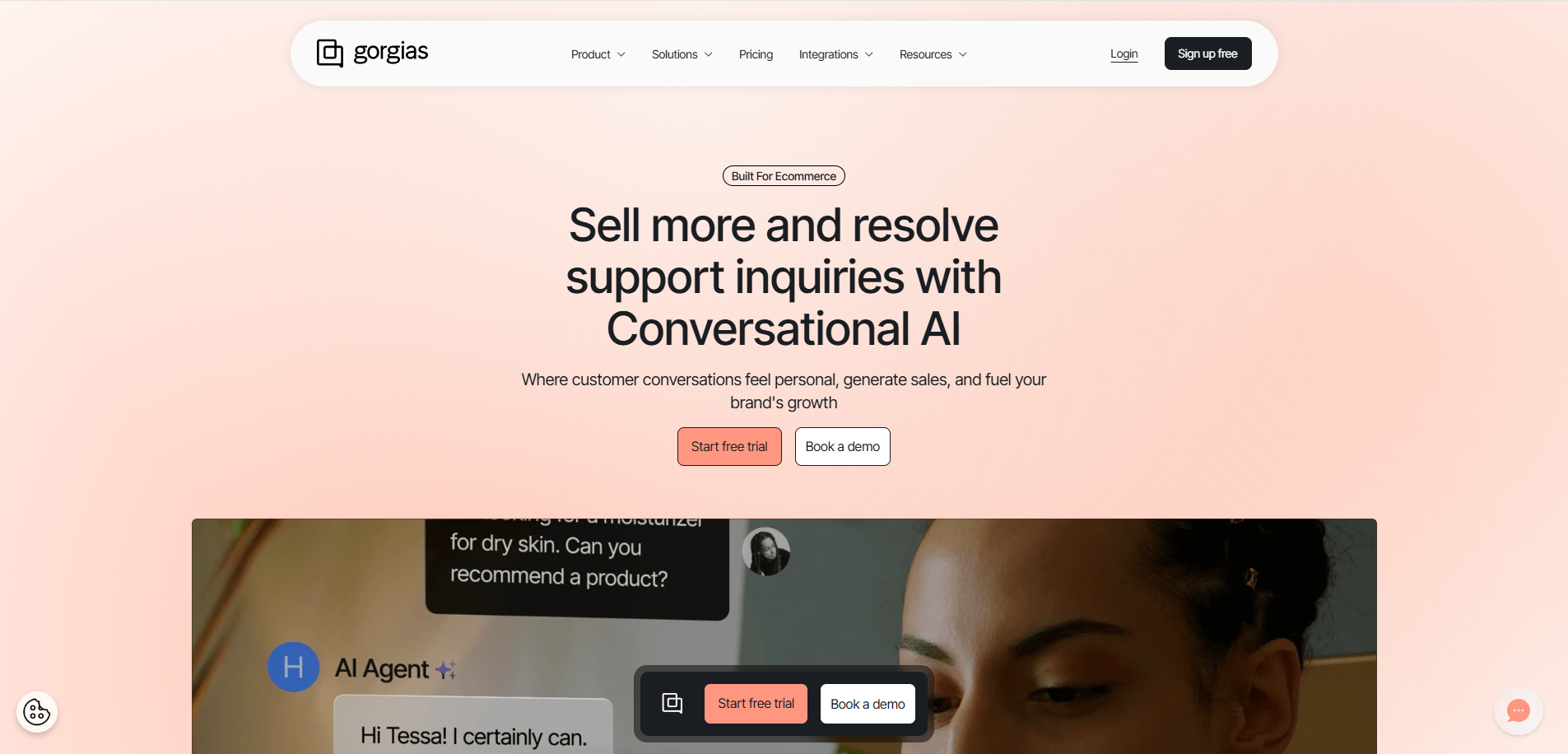
Best for Shopify-first ecommerce brands that want AI support, order management, revenue attribution, and social support inside one ecommerce helpdesk.
Product Overview
Gorgias is a customer experience platform built for ecommerce support. It centralizes email, chat, social, WhatsApp, SMS, and voice add-ons, with deep Shopify integration and more than 150 ecommerce integrations.
Its AI Agent is available on email and chat and can answer pre- and post-sales questions, handle returns and refunds, edit orders and subscriptions, generate discounts, recommend products, and optimize through feedback loops.
Pros and Cons
Pros:
- Deep Shopify and ecommerce workflow integration.
- Strong support for order tracking, returns, refunds, subscriptions, and product recommendations.
- Revenue tracking connects support conversations to sales impact.
- Strong social support coverage across channels like Facebook, Instagram, TikTok, WhatsApp, and SMS.
- AI Agent pricing is tied to automated resolutions.
Cons:
- Best fit is ecommerce support, not broader enterprise service automation.
- AI Agent is listed for email and chat, while SMS and voice are add-ons.
- Pricing scales by helpdesk tickets and AI Agent resolutions.
- Not a customer self-hosted platform.
Pricing
Starter $300/month (50 tickets). Tiers up to $5,000/month.
Setup
Days for Shopify. Weeks for multi-store.
Tradeoffs
Gorgias is strongest when support, commerce, and revenue are tightly connected: order edits, refunds, discounts, subscriptions, product recommendations, and social DMs. It is not trying to be a horizontal enterprise agent platform.
For ecommerce brands, that focus is the advantage. For banks, telecoms, insurers, healthcare providers, or companies with complex internal service journeys, it is the wrong center of gravity.
Employee and Operational Support
#10. DRUID AI: Best Sierra AI Alternative for Employee and Operational AI
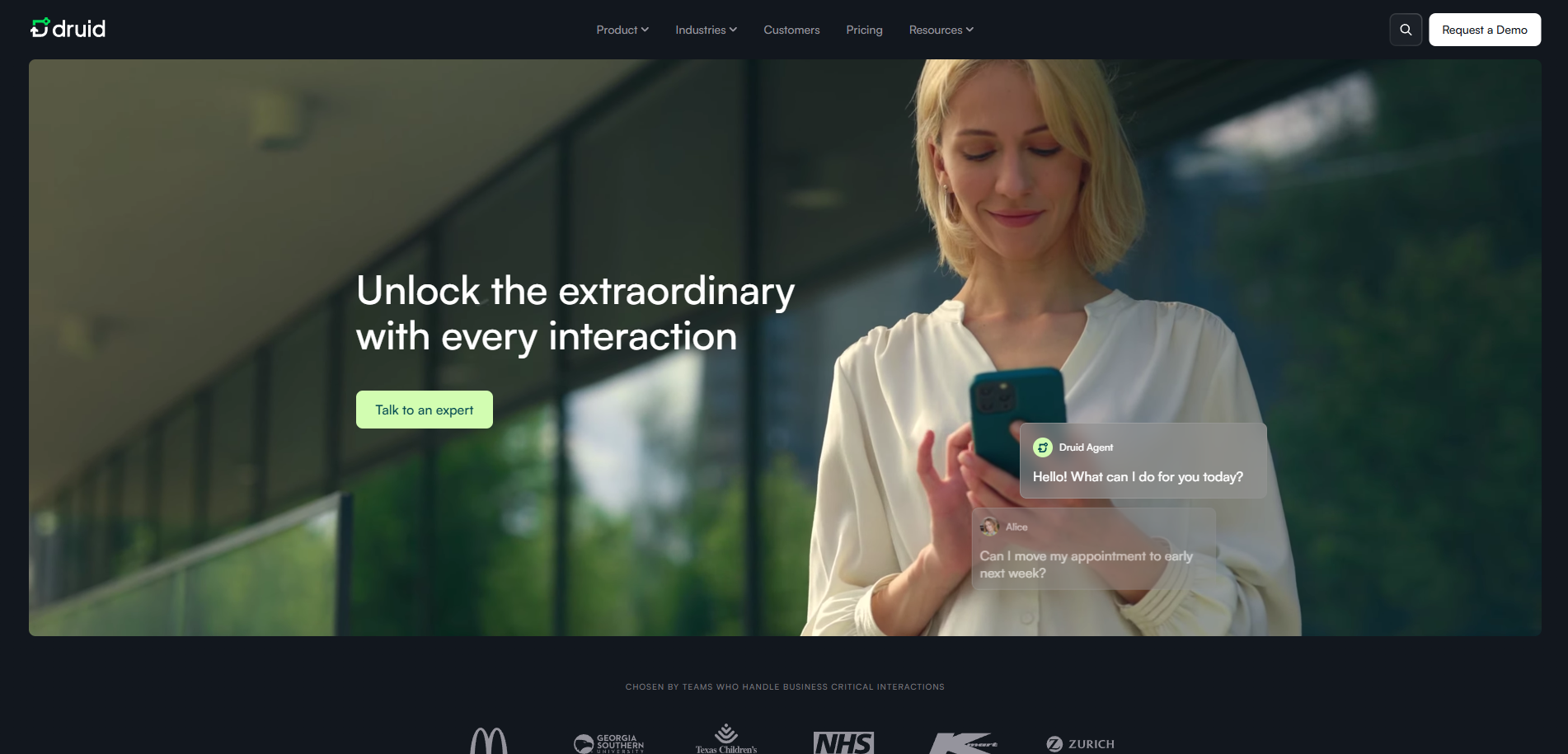
Best for enterprises that want AI agents to automate employee, operational, and customer-facing processes across systems like ERP, CRM, ITSM, HRIS, RPA, and knowledge sources.
Product Overview
DRUID AI is an enterprise AI agent platform focused on process automation and system orchestration. Its platform includes AI agents, DRUID Conductor for orchestration, knowledge grounding, analytics, observability, governance, and integrations across enterprise systems.
It supports voice and digital channels and can connect to systems such as SAP, Salesforce, ServiceNow, Microsoft, Workday, Genesys, and custom APIs.
Pros and Cons
Pros:
- Strong fit for employee, operational, and back-office automation.
- Connects to enterprise systems through prebuilt connectors, MCP, APIs, SQL, RPA, and native integrations.
- Supports cloud, hybrid, and on-premises deployment.
- Covers voice and digital channels.
- Governance, analytics, observability, and auditability are part of the platform story.
Cons:
- Less visible in CX-agent market conversations than Sierra, Decagon, Salesforce, or Intercom.
- Enterprise pricing is custom.
- Broad process automation scope may be more than a team needs for a narrow customer-support agent use case.
Pricing
Custom enterprise pricing.
Setup
Weeks for pre-built templates. Months for custom enterprise.
Tradeoffs
DRUID is strongest when the agent needs to complete internal work across enterprise systems: HR requests, IT tickets, finance workflows, healthcare operations, ERP updates, or service processes with RPA/API handoffs.
It is less compelling for teams that mainly want a polished CX concierge or a helpdesk-native support agent. The buyer should be looking for process execution, not just conversational resolution.
#11. Decagon: Best Sierra AI Alternative for Managed CX Agents
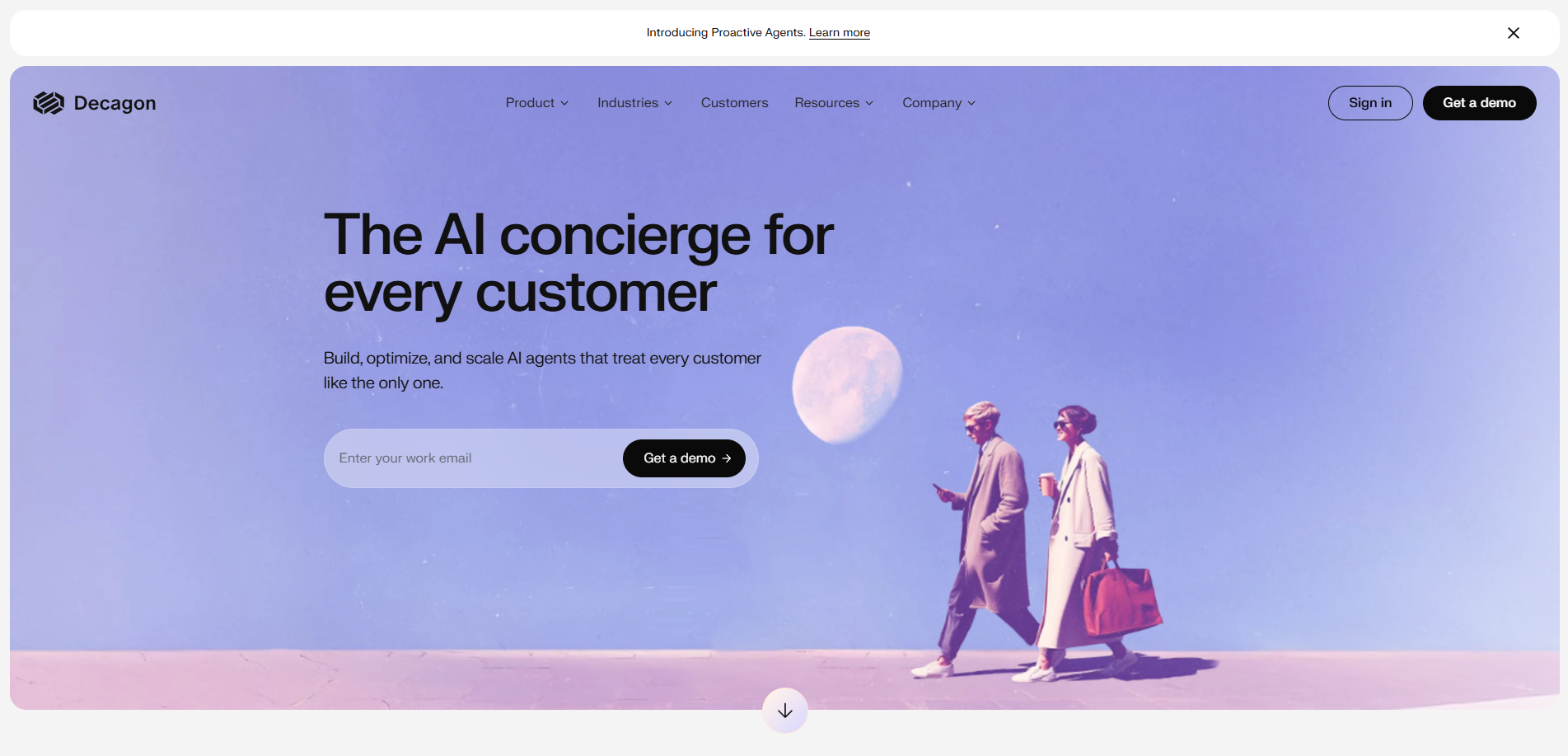
Best for CX teams that want a managed AI agent platform for customer service across chat, email, and voice, with strong tooling for workflow authoring, QA, observability, and continuous improvement.
Product Overview
Decagon is a managed conversational AI platform for customer experience. Its core abstraction is Agent Operating Procedures, or AOPs: natural-language instructions that define agent workflows and compile into validated logic. Decagon also offers voice, chat, email, integrations with systems like Zendesk, Salesforce, and Intercom, Trace View for debugging agent behavior, Watchtower for always-on QA, and testing, simulations, versioning, insights, and alerting for improving agent performance over time.
Pros and Cons
Pros:
- Strong managed CX agent lifecycle: build, test, observe, improve, and scale.
- AOPs give CX teams a natural-language way to define and iterate agent behavior.
- Trace View gives turn-by-turn visibility into agent logic and tool use.
- Watchtower provides always-on QA across conversations.
- Supports chat, email, and voice, including voice handoffs and outbound campaigns.
- Integrations cover helpdesks, CRMs, knowledge bases, CPaaS platforms, APIs, and MCP.
Cons:
- Managed SaaS operating model, not a customer self-hosted platform.
- Best fit is CX automation, not broader enterprise agent ownership across internal software operations.
- Pricing is custom.
- Teams that want code-first ownership of the full agent runtime, release process, and deployment model may find the platform too vendor-operated.
Pricing
Custom pricing. Contact Decagon for a quote.
Setup
Days for initial deployment. Weeks for full optimization.
Tradeoffs
Decagon’s strength is not just autonomy. It is the managed improvement loop around autonomy: AOPs for workflow authoring, Trace View for debugging, Watchtower for QA, simulations and testing before release, and insights after launch. That makes it a strong choice for CX teams that want a vendor-operated system for improving customer service agents over time.
It is less suited when the strategic goal is to make the agent platform part of the company’s own engineering, deployment, security, and release operation.
Why Choose Sierra AI Alternatives
Ownership vs. Managed Service Dependency
Sierra operates like a consulting engagement. Changing workflows or updating scripts often requires Sierra's engineering team.
Rasa is built for technical enterprise teams that want the agent platform to fit their own architecture, deployment model, engineering workflow, security process, and release process. Teams can modify agent logic, connect internal systems, manage releases through their own software practices, and run the platform in the environment their business requires.
Deployment Control for Regulated Industries
For banks, insurers, healthcare organizations, telecoms, and public-sector teams, deployment model is often a buying requirement, not a preference. Sierra’s public materials focus on Agent OS as a managed platform. Rasa supports self-hosted, private-cloud, and air-gapped deployment, so customer data, systems, and agent operations can stay inside the buyer’s environment.
Pricing Model
Sierra publicly emphasizes outcome-based pricing: customers pay when the agent delivers defined business outcomes such as resolved support queries, saved cancellations, upsells, or cross-sells.
Rasa uses annual conversation-volume licensing. That makes it easier for technical teams to model platform costs separately from LLM, speech, hosting, implementation, and internal engineering costs.
Governance and Release Control
Sierra gives CX teams strong managed lifecycle tooling: no-code building, Ghostwriter-assisted updates, simulations, traces, insights, and optimization workflows.
Rasa is stronger when governance needs to be part of the company’s own software operation. Teams can use flexible agent behavior where natural conversation matters, then add stricter controls where the use case requires it: approvals, policy checks, required steps, backend actions, handoffs, exact wording, tests, review, and controlled releases.
How To Choose the Right Alternatives to Sierra AI
Step 1: Choose the operating model
Start with the operating model, not the feature list.
Sierra is a managed CX agent platform. That can be the right choice when you want a vendor-operated system for building, improving, and scaling customer service agents.
Rasa, Kore.ai, DRUID, and some enterprise platforms fit a different buying motion: the agent platform becomes part of your own software, service, data, and integration environment.
Step 2: Define Your Deployment Requirement
For regulated teams, deployment is often the first filter. If customer data, conversation data, or backend actions must stay inside your environment, prioritize platforms with self-hosted, private-cloud, hybrid, VPC, or on-premises options.
Rasa supports self-hosted, private-cloud, and air-gapped deployment. Kore.ai and DRUID also support enterprise deployment options. For managed CX platforms, check the exact data residency, private deployment, retention, and vendor-access model before shortlisting.
Step 3: Evaluate Voice Architecture
If you need a standalone phone automation platform, voice-first vendors like Parloa, Decagon, Retell, Vapi, or Synthflow may be stronger fits depending on your buyer and use case.
If voice is one channel in a broader enterprise agent platform, look for shared logic, shared context, backend integrations, handoff patterns, testing, and governance across voice and digital channels. That is where Rasa’s voice model is strongest.
Step 4: Model TCO at Your Scale
Different vendors charge in different ways: outcome-based pricing, per-resolution pricing, per-conversation pricing, per-seat pricing, usage-based pricing, or annual conversation-volume licensing.
Model the full cost at 12 and 24 months. Include platform fees, LLM costs, speech costs, hosting, integrations, implementation, internal engineering time, maintenance, and expected conversation growth.
Step 5: Run a Production Pilot
Do not pilot the easiest FAQ use case. Pick a journey that reflects your real production risk: authentication, backend actions, policy checks, handoffs, interruptions, missing data, user corrections, and channel changes.
Track the metrics that matter after launch: resolution quality, escalation quality, containment, latency, cost per completed journey, auditability, and how quickly your team can fix failures once real conversations expose them.
Key Features to Look for When Exploring the Sierra AI Alternatives
Operating Model
Start with how the platform is meant to be operated.
Some vendors, including Sierra, are built around a managed CX agent model. That can work well when you want the vendor’s platform and services to handle much of the agent lifecycle.
Other platforms are built for teams that want the agent system to become part of their own software and service operation. In that case, look for code access, release control, integration flexibility, and deployment options that fit your architecture.
Deployment Flexibility
For regulated industries, deployment is often the first filter. Check whether the platform supports self-hosted, private-cloud, hybrid, VPC, dedicated, or air-gapped deployment, and what data the vendor can access.
Do not stop at “data residency.” Ask where conversation data, voice data, logs, prompts, model calls, backend actions, and audit records live.
Voice and Digital Channels
Voice should not be treated as a checkbox.
A voice-first platform may be the best fit for standalone phone automation. But if voice is one part of a broader enterprise agent strategy, look for shared logic, shared context, shared governance, and shared analytics across voice and digital channels.
Rasa supports voice through channel connectors and speech provider integrations, while keeping voice and digital agents in one operating model.
Governance and Control
The right platform should let teams decide where the agent can behave flexibly and where stricter controls are required.
Look for controls around approvals, policy checks, required steps, backend actions, handoffs, exact wording, testing, review, and release gates. This matters most for high-risk journeys like payments, claims, account changes, identity verification, regulated disclosures, and service cancellations.
Integration Depth
Enterprise agents need to do more than answer questions. They need to retrieve data, trigger workflows, update records, create tickets, process requests, and hand off with context.
Compare how each platform connects to CRMs, ERPs, ticketing systems, contact center platforms, knowledge systems, internal APIs, MCP servers, and custom backend services.
Observability and Auditability
A production agent platform needs clear visibility into what happened, why it happened, and what changed between releases.
Look for conversation traces, tool-call records, event history, latency and cost visibility, handoff records, test results, QA workflows, and audit-friendly logs. This is what lets teams debug failures, prove compliance, and improve the system after real customer conversations expose edge cases.
Context and Memory
Customer journeys rarely stay inside one clean session. People switch channels, return later, correct themselves, change their minds, and bring up earlier issues.
Evaluate how each platform handles session context, long-term memory, user preferences, handoffs, and cross-channel continuity. The goal is not just “remembering” information. The goal is using the right context at the right time, with rules for what should be stored, shared, expired, or ignored.
Pricing and Cost Predictability
Pricing models vary widely: outcome-based, per-resolution, per-conversation, per-seat, usage-based, and annual volume licensing.
Model the full cost, not just the vendor line item. Include platform fees, LLM usage, speech providers, hosting, implementation, integrations, maintenance, and internal engineering time. The cheapest pilot can become expensive when conversation volume, voice usage, and backend complexity increase.
Cost Comparison: Sierra AI vs. Competitors
Which of the Alternatives to Sierra AI Is Right for Your Business?
- Need enterprise ownership + self-hosted + voice: Rasa. Deterministic governance, native voice, your environment.
- Need enterprise omnichannel + on-prem: Kore.ai. Pre-built industry agents, Gartner Leader.
- Need CRM-native contact center: Salesforce Agentforce. Deepest CRM context.
- Need no-code AI automation: Ada. Fastest no-code resolution.
- Need DACH voice AI: Parloa. Voice-first, European language focus.
- Need customer support resolution: Intercom Fin. Highest resolution rate.
- Need help desk AI layer: Zendesk AI. Best knowledge management.
- Need ecommerce support: Gorgias. Deepest Shopify integration.
- Need employee + operational AI: DRUID AI. Internal processes + customer-facing.
- Need autonomous resolution: Decagon. Autonomous-first philosophy.
FAQs
What are the main reasons enterprises evaluate Sierra AI alternatives?
The usual reasons are operating model, deployment, cost modeling, and ownership. Sierra is a managed CX agent platform. That can be valuable for teams that want a vendor-operated agent lifecycle, but it may not fit companies that need the platform to run inside their own architecture, engineering workflow, security process, and release process.
Is Sierra AI open source or self-hostable?
Sierra is a closed managed platform. Its public materials do not describe a customer self-hosted deployment option.
Rasa offers a free Developer Edition and supports self-hosted, private-cloud, and air-gapped deployment for teams that need the agent platform to run in their own environment.
How does Rasa differ from Sierra AI?
Sierra is built around a managed CX agent operating model. Rasa is built for technical enterprise teams that want to own how the agent platform is deployed, integrated, tested, governed, and released.
Sierra is a strong fit when the buyer wants a vendor-managed platform for customer service agents. Rasa is a strong fit when the agent platform needs to become part of the company’s own software and service operation.
Does Sierra AI support voice and chat from one platform?
Yes. Sierra supports voice, chat, and other customer experience channels through its managed platform.
Rasa also supports voice and digital channels in one operating model. Rasa voice deployments use channel connectors and speech provider integrations, which makes Rasa a better fit when voice needs to share logic, context, integrations, testing, and governance with digital agents.
Which Sierra AI alternative is easiest to implement?
It depends on the use case.
Intercom Fin is often the fastest for help-center-backed support automation. Zendesk AI is practical for teams already running Zendesk. Gorgias is fast for Shopify-centered ecommerce support. Ada is strong for no-code customer service automation.
Rasa, Kore.ai, DRUID, and Salesforce usually require more planning because they are used for deeper enterprise workflows, integrations, governance, or deployment requirements.
Are there any free Sierra AI alternatives?
Rasa Developer Edition is free for teams building custom agents, with usage limits. Some SMB support tools outside this list may offer free plans, but most enterprise AI agent platforms use custom, usage-based, outcome-based, or annual contract pricing.
Do Sierra AI alternatives support phone calls?
Yes, but the voice model varies by vendor.
Sierra, Parloa, Decagon, Salesforce, Kore.ai, Ada, and Rasa all support voice in different ways. Voice-first vendors are usually strongest for standalone phone automation. Rasa is strongest when voice is part of a broader enterprise agent platform across systems, teams, and digital channels.
Which Sierra AI alternative is best for regulated industries?
Rasa is the strongest fit when regulated teams need customer-controlled deployment, auditability, model and provider choice, and release control. This is especially relevant for banks, insurers, healthcare organizations, telecoms, and public-sector teams.
Kore.ai and DRUID also support enterprise deployment options, so they may fit some regulated use cases depending on the buyer’s operating model and product requirements.
Can Sierra AI alternatives handle multilingual customer interactions?
Yes. Most enterprise AI agent platforms now support multilingual use cases in some form.
Intercom Fin supports dozens of languages. Kore.ai and Cognigy have broad multilingual coverage. Parloa has strong voice and multilingual contact center positioning. Rasa supports multilingual agents through configurable language, model, and provider choices, with the deployment and governance model controlled by the customer.