Botpress is fast. Its visual flow editor, cloud hosting, and integrated LLM access help teams get an AI agent live quickly, while developers can extend behavior with code through the platform's APIs and SDKs. For product teams that need a working AI chatbot quickly and can accept the trade-offs of cloud-hosted, vendor-managed infrastructure, Botpress works.
But enterprise teams comparing Rasa vs Botpress are usually asking the same set of questions: how much of the agent stack do we need to own, where we can deploy, and what happens when our requirements outgrow a visual builder? That's where the comparison gets interesting. Most of the existing Botpress and Rasa coverage frames the choice as "user-friendly visual interfaces vs code-driven complexity." That framing misses what actually matters at the enterprise tier: ownership, data sovereignty, and the depth of orchestration that both Rasa and Botpress can support in production.
This post walks through the key differences between Botpress and Rasa across architecture, deployment, dialogue understanding, voice support, pricing, and the use cases each platform handles best.
Rasa vs Botpress at a Glance
Both Botpress and Rasa have open-source roots and active developer communities, both are built for production AI chatbots, and both support multi-channel agent delivery. Where they diverge is the level of control and customization their architecture is designed for, and the kind of organization that maps cleanly to each. The enterprise buying decision usually comes down to the commercial platform, deployment model, governance, and long-term operating fit. The rest of this post unpacks those differences.
What Rasa and Botpress Are in 2026
A lot of the Rasa vs Botpress comparisons online still describe Rasa as "a tool for research and data science teams." That framing was accurate a few years ago when Rasa was primarily a developer framework. It's not where the product sits now.
Where does Rasa sit today?
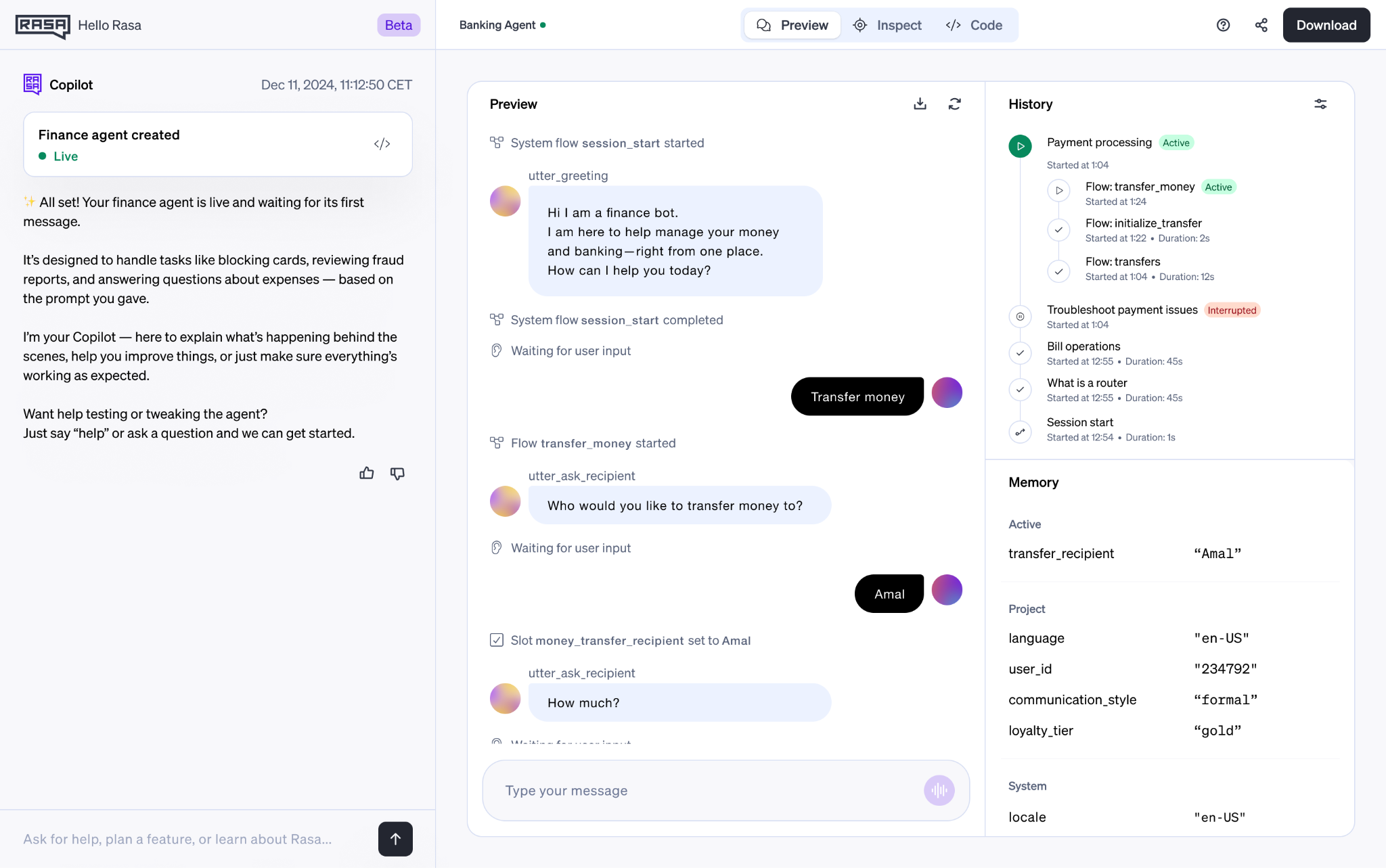
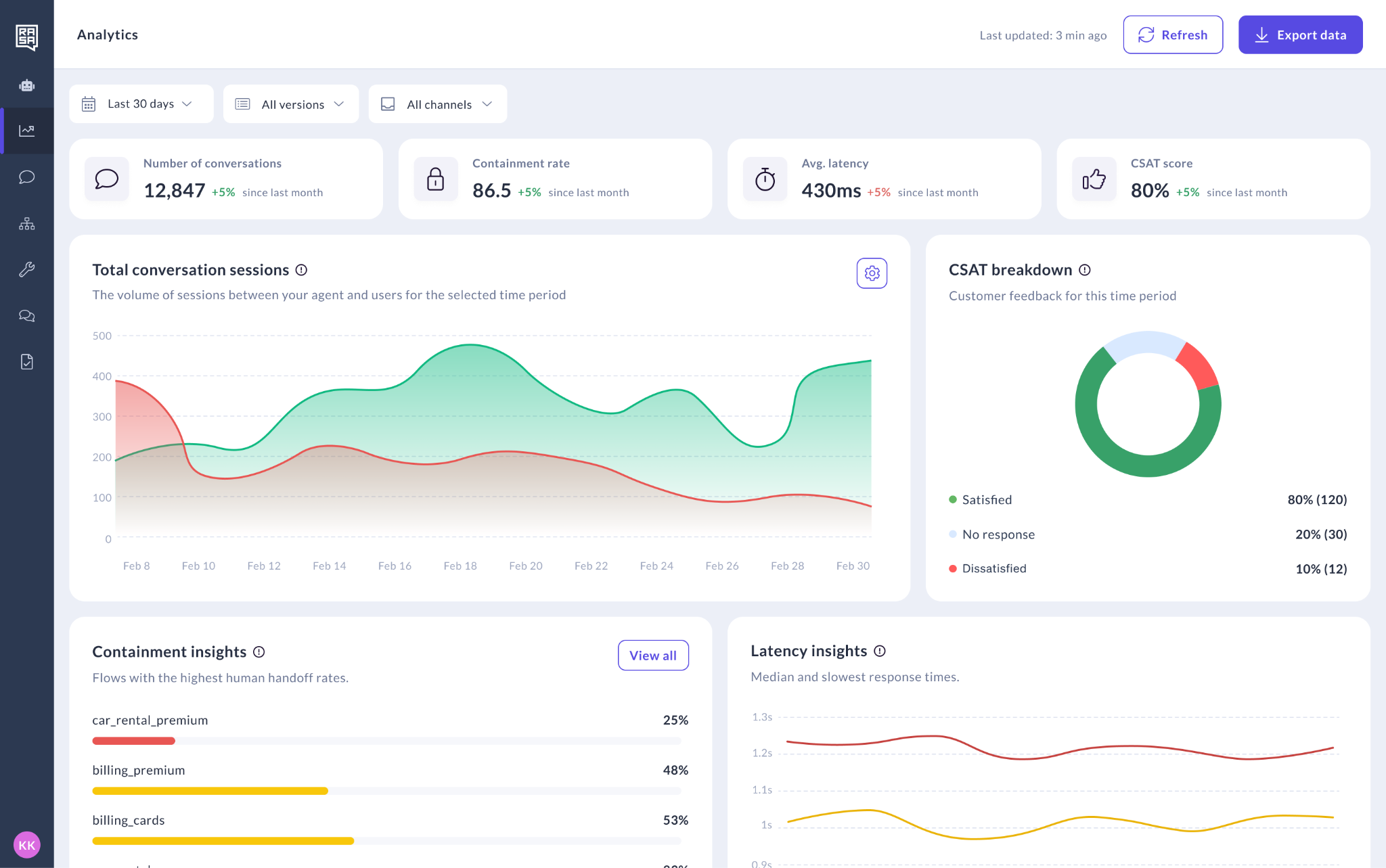
Rasa is the enterprise agent orchestration platform for customer-facing and employee-facing AI agents. The architecture centers on three layers: an orchestrator that decides what happens next across skills, a skills system that packages reusable units of business capability, and a memory layer that carries context across channels and sessions. Teams build agents in Rasa Studio for visual prototyping and refinement, then developers extend backend logic, custom actions, and integrations where the use case requires it.
Rasa's strongest fit is enterprises in regulated industries that need to run on their own infrastructure. The platform was named a Strong Performer in The Forrester Wave™: Conversational AI Platforms For Customer Service, Q2 2026, and is built for regulated environments such as banking, telecom, healthcare, and government, where teams need to own AI-powered service systems end-to-end.
What about Botpress?
Botpress is an AI agent platform with a strong visual builder, integrated LLM support, and cloud-first hosting. It's designed for product and developer teams that want to build conversational AI quickly without managing the underlying infrastructure. The visual builder lets non-technical users contribute to chatbot development, and developers can extend behavior through Botpress's APIs, SDKs, and custom code when the visual editor isn't expressive enough.
Botpress offers built-in tools for working with knowledge sources (uploading PDFs, scraping websites, connecting APIs), supports bring-your-own-LLM and access to multiple LLM providers, and supports larger teams and enterprise requirements through Botpress Enterprise. The combination of low-code visual interfaces and the option to write custom logic when needed makes it a strong fit for teams that want to ship working chatbots in weeks rather than months.
Architecture and Approach
The biggest difference between Botpress and Rasa shows up in how each platform structures the agent itself.
Rasa's orchestration, skills, and memory model
Rasa's architecture is built around three first-class layers. The orchestrator coordinates what happens next: which skill to invoke, what context to pass, and how to maintain continuity when users jump between topics or transfer across channels. Skills are composable units of capability that come in two modes: guided skills handle the critical paths where reliability and compliance matter, and autonomous (prompt-driven) skills cover the long tail with flexibility. Each skill defines what it is allowed to do, what it must check, when to escalate, and what a successful outcome looks like. Memory carries context across sessions and channels so the agent doesn't ask returning customers to repeat themselves, which keeps the experience continuous rather than restarting on every interaction.
This model is explicitly designed for production agents that span multiple systems and teams. The orchestrator's job is to shorten the path to the first meaningful action: instead of long greetings and clarifying questions, the right skill gets invoked with the right context as quickly as possible. A skill written for a billing inquiry can be invoked from chat or voice, the orchestrator manages the handoff to a human agent when policy requires it, and memory ensures the human gets full context rather than a transcript dump. Rasa's framework gives developers full control over how each layer behaves; Rasa Studio gives non-engineers a place to prototype and refine agent behavior, while developers still own backend logic, integrations, and production controls.
Botpress's visual flow editor model
Botpress's architecture centers on the visual flow editor. Conversation flows are designed as a graph of nodes (questions, conditions, integrations, LLM calls), connected through a drag-and-drop interface. Built-in tools handle common patterns like knowledge base ingestion, NLU intent recognition, and entity extraction out of the box, where Rasa typically gives engineering teams more direct control over how each capability is configured, tested, and deployed. The visual interface makes it relatively easy for non-developers to build and modify conversation flows.
For more advanced features, developers can write JavaScript inside flow nodes, build custom integrations, and extend the platform's core features. Botpress's approach combines low-code building with code-level escape hatches, which works well for teams that want speed-to-first-deployment without giving up the option to add custom logic later.
The honest version of the comparison: Botpress's visual flow editor is genuinely better for fast prototyping and for teams without engineering depth. Rasa's orchestration model is better for production systems where the agent has to span multiple business domains, integrate deeply with backend systems, and stay maintainable as it grows beyond the initial use case.
Deployment and Data Sovereignty
For enterprise buyers comparing chatbot platforms, deployment is often the deciding factor. This is where Rasa and Botpress diverge most clearly.
Rasa is built for self-hosted deployment from day one. You can run the platform on-premises, in your own private cloud, or in a hybrid configuration. The training data, conversation logs, and customer data stay on your infrastructure under your access controls. For many teams in financial services, healthcare, government, telecom, or insurance, this is not a nice-to-have. It can be a hard requirement that disqualifies platforms without a credible self-hosted or private deployment model. Rasa's enterprise security includes role-based access control, audit logging, and the kind of governance that regulated industries need to satisfy auditors. Because that deployment model is core to the architecture, the self-hosted conversation is straightforward.
Botpress is cloud-only for new development. Botpress's own documentation confirms that Botpress v12 (the legacy self-hosted version) and all self-hosted versions are officially sunset and no longer available for purchase, download, or new deployments; Botpress Cloud is the platform Botpress recommends for all new builds. For new builds, Botpress Cloud is the supported path across plans, and teams should validate any enterprise-specific deployment commitments directly with Botpress. Botpress Enterprise is where teams should validate requirements such as data residency, custom retention policies, access controls, BAA/HIPAA coverage, and support commitments. For teams that don't have a hard data sovereignty constraint, the cloud-hosted model means one-click deployment and no infrastructure operations to manage. For teams that do have hard self-host or on-prem requirements, Botpress's current model won't fit, and the comparison narrows toward platforms (like Rasa) where self-hosted deployment is a first-class architectural choice.
The practical question for buyers: if you have to demonstrate to a regulator or compliance team that customer data never leaves your infrastructure, which platform makes that conversation easier?
Dialogue Understanding and AI Models
Both Botpress and Rasa handle natural language, but they take different paths to it.
Rasa's dialogue understanding is designed to evaluate the full context of a conversation rather than pattern-match against a fixed list of intents. Where traditional NLU is built around predefined intents that require extensive manual setup and breaks down when users phrase things in unexpected ways, Rasa uses large language models to interpret what the user actually means based on conversation history. The platform is LLM-agnostic, so teams choose their model (or run their own), and machine learning improvements happen through curated examples, retrieval-augmented generation, and fine-tuning where appropriate. Teams can still use structured intent and entity patterns where they make sense, but the modern Rasa story is broader: dialogue understanding, skills, orchestration, and memory working together.
Botpress combines visual flows, knowledge sources, NLU concepts such as intents and entities, and LLM-driven responses, with access to multiple LLM providers and a bring-your-own-LLM option. That combination makes it fast to get useful behavior working, especially for FAQ, lead qualification, support triage, and workflow automation. Botpress's LLM-first approach can reduce training data requirements for many common patterns compared with traditional intent classification, lowering the barrier to getting a working chatbot live quickly. For teams without ML expertise or large training datasets, this matters: Botpress can produce reasonable performance on common patterns without the manual setup that traditional NLU requires.
Where each platform wins on dialogue: Botpress is faster to a working baseline and can cover a lot of ground with modern LLM-driven responses. Rasa goes deeper for teams that need fine-grained control over how the agent handles complex queries, multi-turn reasoning, runtime orchestration, and high-stakes actions where hallucinated responses aren't acceptable. The trade-off isn't whether either platform can use modern AI; it's how much control the team needs over runtime behavior, deployment topology, and long-term governance.
Voice, Channels, and Integration
Voice is one of the clearest differentiators in the Rasa vs Botpress comparison.
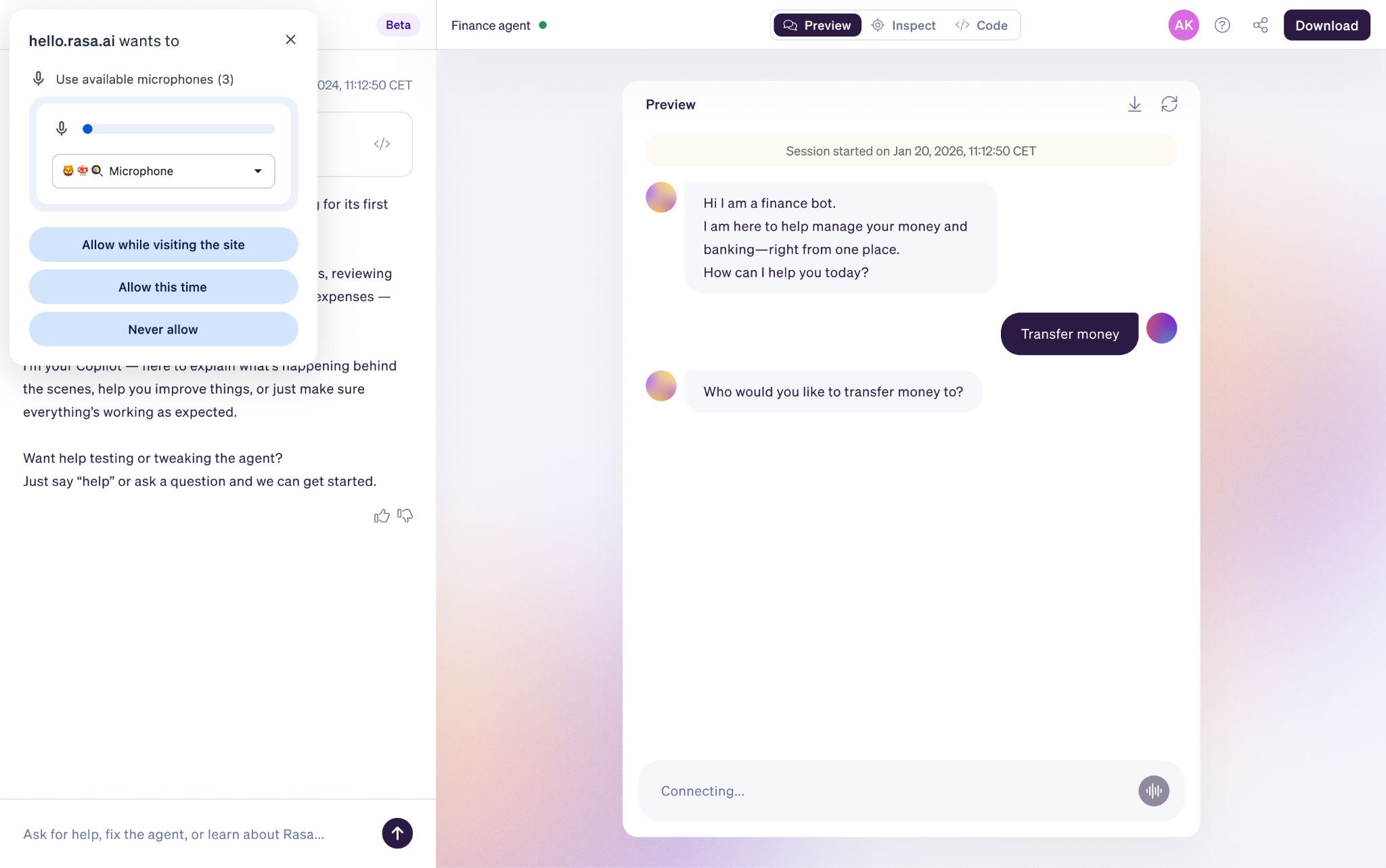
Rasa's voice capabilities support sovereign voice: voice agents on your terms, with your choice of speech providers, deployed where the business requires. Voice-stream connectors link the agent directly to telephony and contact center infrastructure, including Jambonz (which Rasa documents as a Voice Gateway), Twilio Media Streams, AudioCodes Voice Stream, and Genesys Cloud AudioConnector. The streaming-first design supports natural turn-taking, fast recovery from speech-recognition errors, and a consistent tone in emotionally charged interactions. For enterprises running voice as a core channel, such as call centers, IVR replacement, or voice-enabled employee tools, Rasa's voice infrastructure is built to handle production load and integrate with the speech providers and telephony stacks teams already use, while giving teams more control over where voice data is processed and stored.
Botpress offers voice and channel support, with integrations across common messaging channels (Facebook Messenger, WhatsApp, web chat, Slack, Microsoft Teams). For teams whose primary channels are messaging apps and where voice is a secondary requirement, Botpress's coverage is solid. For teams with strict telephony, streaming, latency, or contact center infrastructure requirements, validate the exact architecture during evaluation; this is where Rasa's voice-stream model has more enterprise depth out of the box.
Both platforms support API and webhook integrations with backend systems, both can connect to CRMs, ticketing systems, and custom integrations through code, and both offer SDKs for building custom channels. Botpress leans on prebuilt connectors and templates to shorten time-to-deploy, while Rasa offers flexible API integrations through developer-controlled setup, which gives engineering teams more control over how each integration behaves in production. Both approaches require manual setup at the integration boundary; the difference is how much of the surrounding orchestration, observability, and deployment topology each platform asks the team to own. The integration capabilities at the basic level are comparable; the depth and the deployment flexibility around voice is where Rasa pulls ahead for enterprise voice use cases.
Pricing and Licensing
Both Botpress and Rasa offer free tiers that let teams evaluate the platform before committing.
Botpress includes a free monthly AI credit for building and testing, then lets teams set AI spend caps and scale usage through paid plans and add-ons. Paid tiers (Pay-as-you-go, Plus, Team, and Managed) scale based on usage and feature requirements, and Botpress Enterprise pricing is custom; teams should validate deployment topology, data residency, retention, access controls, and support commitments directly with Botpress.
Rasa offers a Free Developer Edition that gives teams full access to the platform for development and evaluation, with usage caps suitable for building and testing. Rasa enterprise licensing is custom and depends on conversation volume, deployment model, support requirements, and which advanced features are in scope. Rasa's pricing model is predictable for teams that need to budget for production agents at scale; Botpress's usage-based model is predictable for teams whose volume is well-known and stable.
For finance teams comparing total cost of ownership, the question to ask each vendor: at our expected production volume, what does year-two and year-three pricing look like, and what triggers a tier change?
When to Choose Rasa vs Botpress
Honest version: neither platform wins universally. The decision depends on what your project needs and what your team can support.
Choose Rasa when
- You operate in a regulated industry (financial services, healthcare, telecom, insurance, government) and need on-premise or private cloud deployment for data sovereignty
- Your AI agents need to span multiple business domains, channels, or teams, and you need an orchestration layer that maintains continuity across all of them
- Voice is a primary channel, and you need native integration with your telephony or contact center stack
- You want full control over the LLM you use, the deployment topology, and how the agent behaves in production
- Your team has the technical expertise and engineering investment to operate the platform long-term
- Long-term ownership matters more than short-term speed-to-deployment
Customer support automation at enterprise scale is one of the most common Rasa use cases, but the same architecture also fits internal employee agents, voice-enabled service deployments, and complex multi-agent workflows where composability across skills and channels matters.
Choose Botpress when
- You're a product or developer team that needs to ship a working chatbot in weeks, not months
- Your use case is well-served by visual flow editor design, and the team includes non-developers who need to contribute
- Cloud-hosted infrastructure works for your data and compliance requirements
- You want built-in features for knowledge base ingestion (PDFs, websites, APIs) without building those capabilities yourself
- Your AI chatbot scope is bounded enough that a visual builder won't constrain you in 12-18 months
- Speed of prototyping matters more than depth of customization
For small-to-medium businesses without dedicated ML or platform engineering resources, Botpress is often the more practical starting point. Some teams may start with a visual builder and later evaluate platforms like Rasa as deployment, orchestration, compliance, or ownership requirements mature, while others stay on a visual builder permanently because their use cases never push beyond what it offers.
If your evaluation includes platforms beyond these two, the chatbot framework comparison covers a broader landscape, including Cognigy, Kore.ai, and others.
Build Enterprise Agents on Your Terms
The honest framing of Rasa vs Botpress is this: they are two platforms with open-source roots, aimed at different segments of the AI chatbot and agent platform market. Botpress is the right answer when speed and visual building matter most, and the cloud-hosted model works for your data requirements. Rasa is the right answer when you need to own the platform, deploy where your security model requires, and operate complex agents across multiple channels and teams over the long term.
If you're evaluating Rasa for enterprise AI agents, the free Developer Edition gives engineering teams hands-on access to the platform, the orchestration layer, the skills system, and Rasa's voice capabilities without an upfront commitment. Walk through a real use case, measure how quickly the agent gets a real customer to a first meaningful action, validate the deployment model against your environment, and see whether the architecture fits how your team works.
When you're ready to talk through what an enterprise deployment looks like for your specific industry and compliance requirements, connect with the Rasa team for a conversation about scope, integration, and what production rollout would involve.
Frequently Asked Questions
What is the difference between Rasa and Botpress?
The core difference: Rasa is an enterprise agent orchestration platform built for self-hosted deployment, deep customization, and long-term ownership of the AI agent stack. Botpress is an AI agent platform built around fast development, a drag-and-drop visual builder, and Botpress Cloud as the supported path for new builds (Botpress v12 self-hosted has been officially sunset). Rasa fits regulated enterprises that need to own the full stack; Botpress fits product and developer teams that want to ship agents quickly on a managed cloud.
Is Rasa good for enterprise use?
Yes. Rasa is built for enterprise from the architecture up: self-hosted and on-premise deployment, role-based access control, audit logging, multi-channel orchestration, voice infrastructure, and LLM flexibility. The platform was named a Strong Performer in The Forrester Wave™: Conversational AI Platforms For Customer Service, Q2 2026, and is used in production by large enterprises in financial services, telecom, healthcare, and government. The trade-off compared to vendor-managed cloud platforms is that Rasa requires engineering investment and technical expertise to operate well; the upside is full control and data sovereignty.
What is the alternative to Rasa?
The closest alternatives depend on what you're optimizing for. For teams that want similar enterprise depth with a different vendor approach, Cognigy and Kore.ai are common considerations. For teams that prioritize visual building and cloud-first hosting, Botpress is the most direct alternative. For teams looking at autonomous-first managed platforms, Decagon and Sierra come up. The right alternative depends less on Rasa's limitations and more on your deployment, ownership, and customization requirements.
Is Botpress worth it?
For its target use cases, yes. Botpress excels at fast time-to-prototype, has a strong visual builder, and combines low-code accessibility with code-level extensibility for developers. For product teams shipping AI-powered chatbots in Botpress Cloud, where data sovereignty isn't a constraint, Botpress is a defensible choice. For enterprises with hard requirements around on-premise or self-hosted deployment, deep orchestration across multiple business domains, or native voice infrastructure, Botpress's cloud-only model is no longer a fit, and the conversation moves toward platforms built for those requirements from the architecture up.
Is Botpress open source?
Botpress has open-source roots and maintains MIT-licensed open-source packages on GitHub. The legacy self-hosted Botpress v12 has been officially sunset, and Botpress Cloud is the only supported path for new development; current users do not get a self-hostable open-source distribution of the full platform. The practical decision for most teams is less about the source code itself and more about whether a managed cloud model fits the deployment, data residency, and ownership requirements you actually have.
Is Rasa open source?
Rasa has open-source roots and a developer-friendly architecture, with a Free Developer Edition for development and evaluation, plus enterprise licensing for production deployments at scale. That open architecture is one of the reasons enterprises choose Rasa for long-term builds: full visibility into how the agent behaves, deep extensibility across the stack, and a deployment model designed for teams that want to own the platform.
.png)

.png)
.png)