NiCE completed its acquisition of Cognigy in September 2025, bringing Cognigy’s conversational and agentic AI platform into the CXone Mpower portfolio. The deal strengthens Cognigy’s position inside contact center transformation, but it also changes the buying question for enterprise teams. Cognigy is now less of an independent conversational AI platform decision and more closely tied to a broader NiCE CX strategy.
For active buyers, that creates a practical evaluation moment. Cognigy remains a strong enterprise contact center platform with visual tooling, Voice Gateway, agent assist, analytics, and omnichannel automation. But teams comparing alternatives should look carefully at roadmap fit, deployment model, engineering workflow, voice architecture, integration depth, release control, and how much of the agent operating model they want to own themselves.
This guide compares 10 Cognigy alternatives across buyer fit, deployment options, voice support, governance, pricing model, and production operating model. The goal is not to find a generic “best” platform. It is to help enterprise teams decide whether they need a managed contact center automation platform, a voice-first provider, a low-code builder, a cloud ecosystem product, or a developer platform they can run as part of their own software operation.
What Are the Best Cognigy Alternatives? Top Cognigy Competitor Comparison and Ratings Chart
10 Best Cognigy Alternatives for Enterprise Conversational AI in 2026
Best for Regulated Enterprises
#1. Rasa: Best Cognigy Alternative for Technical Enterprise Teams That Need Customer-Controlled Deployment
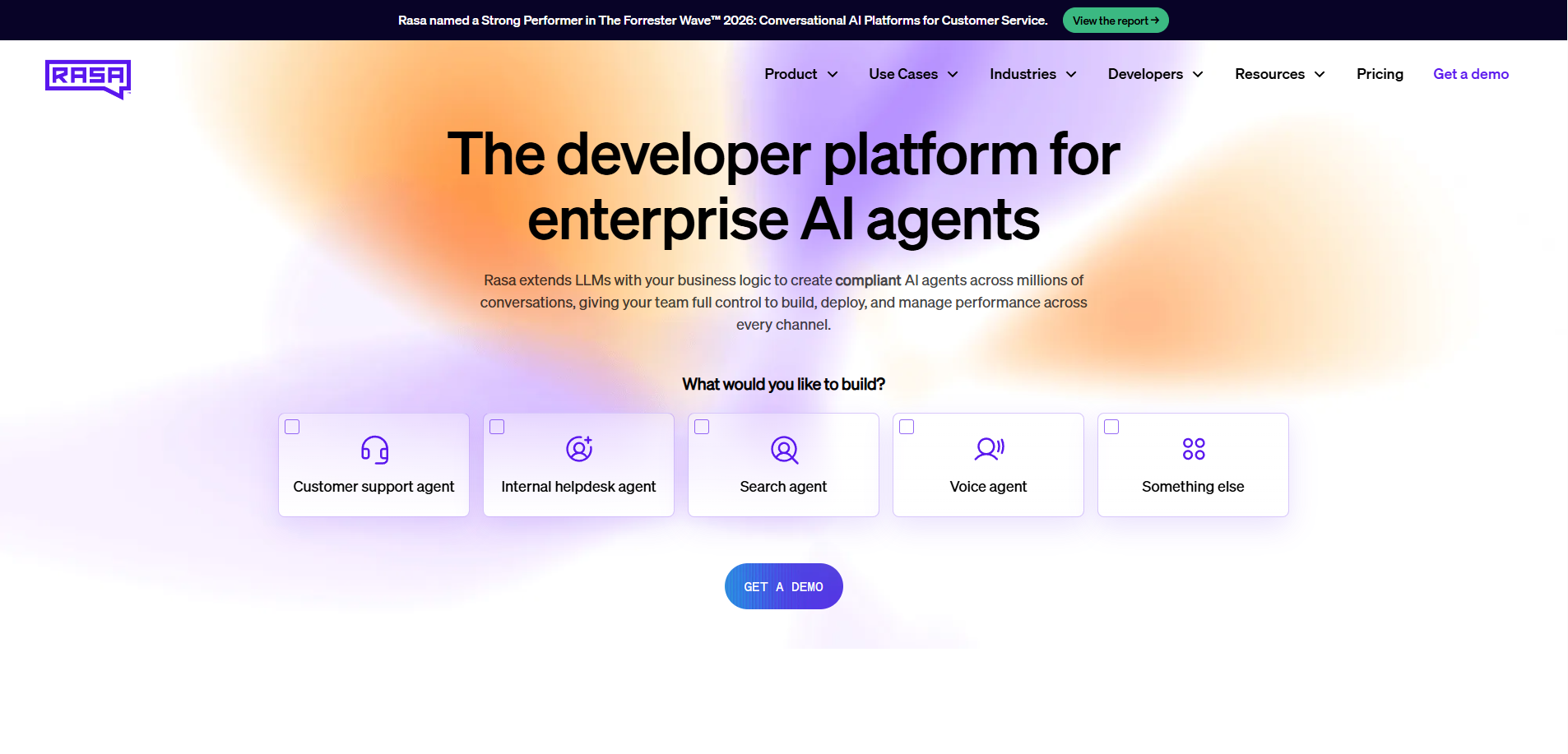
Rasa is the developer platform for enterprise AI agents. Cognigy is a strong enterprise contact center platform with visual tooling, Voice Gateway, agent assist, analytics, and omnichannel automation. Rasa is a better fit for technical enterprise teams that want the agent platform to fit their own architecture, engineering workflow, deployment model, integrations, and release process.
Best for regulated enterprises in banking, healthcare, telecom, insurance, and public sector environments that need customer-controlled deployment, deep backend integration, governed workflows, and voice plus digital channels in one operating model.
Score: 9.4/10. Highest marks for governance (10/10), deployment flexibility (10/10), voice (10/10), and pricing transparency (9/10). Scored lower on review volume (6/10) vs. Cognigy's established enterprise base.
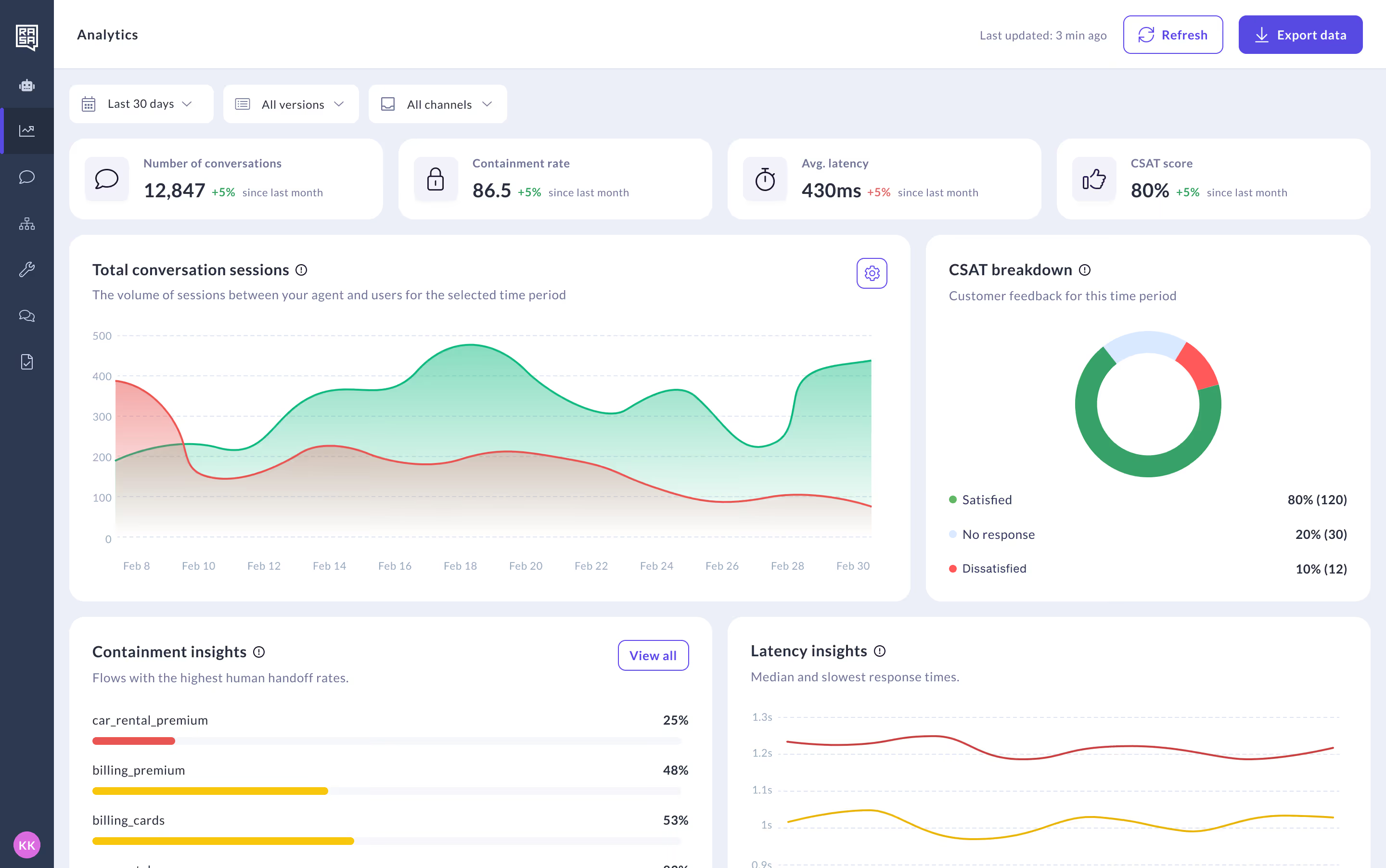
Product Overview
Rasa is built for teams that want AI agents to become part of their own software and service operation. Instead of managing the agent only inside a hosted SaaS workspace, teams can build, test, deploy, observe, and improve agents using the same engineering practices they already use for production software.
The Rasa Platform includes Framework, Orchestrator, and Studio. The patented Orchestrator manages how agents move through conversations, activate skills, handle context, and coordinate work across systems. Teams can decide where the agent should act with more autonomy and where specific business outcomes, authorization steps, or review paths need tighter control.
Rasa Studio gives teams a place to prototype, test, review, and refine agent behavior. It helps non-engineering stakeholders participate in the improvement loop without making the production system depend on a no-code workspace as the only source of truth.
Rasa supports voice and digital channels in one operating model. For voice, Rasa works through channel connectors and speech-provider integrations, including options such as Twilio, AudioCodes, Genesys Cloud, Jambonz, Deepgram, Azure, Cartesia, and Rime. This makes Rasa strongest when voice is one part of a broader enterprise agent platform, rather than a standalone phone-agent tool.
Pricing
Developer Edition (Free): Full access to Rasa. One bot per company, up to 1,000 external conversations/month (100 for internal agents). Community support via the Rasa Forum.
Enterprise (Custom): Premium support, dedicated CSM, advanced security features, custom onboarding, Rasa Studio for refining design and review. Contact Rasa for a quote.
Pricing is based on annual conversation volume, not per-user or per-seat. Contrast with Cognigy's $100K-$350K+/year contracts plus separately billed voice minutes, LLM tokens, and add-ons (Agent Copilot, Knowledge AI).
Integrations
Rasa connects to enterprise systems through custom actions, APIs, channel connectors, MCP-style integration patterns, and backend services owned by the customer.
This is where Rasa is meaningfully different from a packaged contact center platform. Teams can integrate the agent into their own systems of record, authorization logic, business workflows, and release pipelines instead of adapting everything to a vendor-controlled operating model.
Setup
Rasa supports self-hosted, private-cloud, and air-gapped deployment. Enterprise customers get onboarding and implementation guidance to align the platform with their architecture, security process, integrations, and release workflow.
Setup depends on the complexity of the use case, number of backend systems, channel requirements, and governance needs. For teams with engineering resources, the tradeoff is clear: more ownership and architectural fit, but more responsibility than a fully managed SaaS deployment.
Pros and Cons
Pros:
- Customer-controlled deployment, including self-hosted, private-cloud, and air-gapped options.
- Patented Orchestrator for managing agent behavior, context, and skill activation.
- Fits existing engineering workflows, including codebase, version control, testing, staging, rollout, and controlled releases.
- Supports voice and digital channels in one operating model.
- Strong fit for backend-integrated service journeys, not just FAQ or deflection use cases.
- Model, infrastructure, and speech-provider choice.
- Annual conversation-volume licensing, not per-seat pricing.
Cons:
- Requires technical resources or an implementation partner.
- More involved than no-code platforms for simple chatbot use cases.
- Not the best fit for teams that want the vendor to own the full build, operation, and optimization loop.
Tradeoffs
Choose Rasa when the agent needs to operate as part of your enterprise architecture: connected to backend systems, governed by your policies, released through your engineering process, and deployed where your business requires.
Choose Cognigy when your priority is a mature contact center automation platform with visual tooling, packaged CX workflows, Voice Gateway, and a roadmap increasingly connected to NiCE CXone Mpower.
The core tradeoff is operating model. Cognigy is stronger when the agent belongs primarily inside a contact center platform. Rasa is stronger when the agent needs to become part of the company’s own software stack across channels, teams, systems, and regulated workflows.
Support
Rasa Enterprise includes production enablement, onboarding, implementation guidance, architecture alignment, deployment guidance, integration guidance, and best-practice reviews. Community resources are available through the Rasa Forum, documentation, and learning materials.
Mini Case Study
Deutsche Telekom deployed Rasa for internal IT support across 10,000+ employees in German and English. 50% of service desk inquiries resolved autonomously. 30% reduction in agent workload. Non-technical IT experts use Rasa Studio to design conversation flows without engineering support.
See How Rasa Compares to Cognigy's Managed Approach
#2. IBM watsonx Assistant: Best Cognigy Alternative for IBM-Stack Regulated Industries
Best for enterprises already standardized on IBM that want conversational AI, IBM governance, and deployment through IBM Cloud or IBM Cloud Pak for Data.
Score: 7.0/10. Strong on-prem deployment (9/10) and IBM compliance framework (8/10). Scored lower on voice (6/10 - voice is add-on), setup speed (5/10), and governance architecture vs. Rasa's Orchestrator (6/10).
Product Overview
IBM watsonx Assistant lets teams build AI assistants for digital and voice channels inside the broader IBM software ecosystem. It is a strong fit for regulated enterprises that already use IBM Cloud, IBM Software Hub, Cloud Pak for Data, watsonx, or IBM consulting and support relationships.
The main advantage is ecosystem fit. IBM gives enterprise buyers a familiar procurement path, compliance posture, governance model, and deployment pattern. For organizations already committed to IBM infrastructure, watsonx Assistant can be easier to justify than adopting a more independent agent platform.
IBM also supports phone use cases through voice and SIP-based integrations, including Voice Gateway and Watson Speech services. This makes it a credible option for enterprise IVR and contact center automation, though teams should evaluate how much of the voice architecture sits inside IBM’s stack and how easily it fits their existing telephony and speech-provider strategy.
Pros and Cons
Pros:
- Strong fit for IBM-standardized enterprises.
- Available through IBM Cloud and IBM Cloud Pak for Data deployment patterns.
- Familiar governance, procurement, security, and support model for IBM customers.
- Supports web, application, and phone-based assistant experiences.
- Works naturally with the broader watsonx and IBM enterprise software portfolio.
Cons:
- Best fit is inside the IBM ecosystem.
- Implementation can be heavy for teams that are not already invested in IBM infrastructure.
- Voice support depends on IBM’s voice and telephony integration model, rather than an open speech-provider strategy.
- Less suited to teams that want a lighter developer platform built around their own codebase, release process, and mixed-provider architecture.
Pricing
Lite (free tier). Plus from $140/month + usage. Enterprise custom.
Setup
Weeks for cloud deployment. Months for on-premises enterprise.
Tradeoffs
IBM watsonx Assistant is the strongest Cognigy alternative for enterprises that want to stay inside IBM’s operating model. It gives regulated buyers a familiar stack, mature enterprise support, and deployment options that align with IBM infrastructure.
Rasa is a stronger fit for technical teams that want the agent platform to fit their own engineering workflow, model strategy, voice stack, backend integrations, and release process outside a single enterprise software ecosystem.
Best for Fast Voice Deployment
#3. Retell AI: Best Cognigy Alternative for Fast Phone Agent Deployment

Best for teams that want to launch AI phone agents quickly, especially for inbound or outbound call automation where voice is the primary channel.
Score: 6.6/10. Fastest voice deployment (10/10) and pricing transparency (9/10). Scored lower on governance (3/10), deployment flexibility (3/10), integration depth (5/10), and multi-channel support (3/10 - voice-only).
Product Overview
Retell AI is a voice-agent platform built for fast phone automation. Its center of gravity is developer-friendly voice deployment: phone numbers, SIP and telephony integrations, low-latency conversation, call testing, analytics, and APIs for building custom call flows.
Compared with Cognigy, Retell is much narrower. Cognigy is a broader enterprise contact center automation platform with visual tooling, omnichannel support, Voice Gateway, agent assist, and CX operations features. Retell is strongest when the immediate job is to get a phone agent live quickly without adopting a heavier enterprise conversational AI platform.
That makes Retell a strong choice for teams building appointment booking, lead qualification, call routing, reminders, surveys, collections, or other phone-first workflows. It is less suited as the main enterprise agent platform for teams that need deep cross-channel continuity, multi-team release governance, regulated workflow control, and long-term ownership across chat, voice, app, and backend service journeys.
Pros and Cons
Pros:
- Fast path to phone-agent prototyping and deployment.
- Strong fit for voice-first use cases.
- Developer-friendly APIs and telephony integration options.
- Published usage-based pricing model.
- Useful for both inbound and outbound phone automation.
Cons:
- Voice-first platform, not a full omnichannel enterprise agent operating model.
- Teams still need to design the broader architecture around backend systems, governance, QA, release control, and non-voice channels.
- Less suited to complex regulated service journeys that span voice, chat, app, human handoff, and multiple systems of record.
- Enterprise deployment, data residency, and compliance requirements need to be evaluated case by case.
Pricing
$0.07/minute (published, transparent). Volume discounts available. Enterprise custom.
Setup
Hours for demo calls. Days for production with telephony and basic integrations.
Tradeoffs
Retell is one of the better options when the primary requirement is fast phone automation. It gives teams a focused voice-agent platform without the weight of a full enterprise conversational AI suite.
Rasa is the better fit when voice is one channel in a broader enterprise agent operating model. If the agent needs to work across voice and digital channels, connect to backend systems, follow governed workflows, fit an existing engineering release process, and run in customer-controlled environments, Rasa is the stronger Cognigy alternative.
Best for Premium Voice AI
#4. PolyAI: Best Cognigy Alternative for Premium Contact Center Voice
Best for enterprises that want high-quality voice automation for customer service, especially where the phone experience is the primary channel.
Score: 7.4/10. Highest voice quality (10/10) and customer satisfaction metrics (9/10). Scored lower on deployment flexibility (4/10), pricing transparency (4/10), and self-hosted option (2/10).
Product Overview
PolyAI is a voice-first enterprise AI agent platform for contact centers. It focuses on natural phone conversations, customer service automation, call containment, and brand-sensitive voice experiences. PolyAI describes its product as a full-stack dialog agent built for enterprise customer engagement, with proprietary models trained on enterprise conversations.
Compared with Cognigy, PolyAI is more specialized. Cognigy offers a broader contact center automation platform with visual tooling, omnichannel orchestration, Voice Gateway, agent assist, and analytics. PolyAI is strongest when the main buying requirement is the quality of the spoken customer experience.
PolyAI is a good fit for large service organizations that want a vendor-led voice deployment and a polished contact center experience. Its public marketplace listing positions the product as a voice-first omnichannel platform for enterprise customer service, with support for customer service conversations across multiple languages and large enterprise brands.
Pros and Cons
Pros:
- Strong fit for high-volume contact center voice automation.
- Voice-first product focus.
- Good option for brand-sensitive phone experiences.
- Designed for enterprise customer service environments.
- Vendor-led delivery can reduce the burden on internal teams.
Cons:
- Less suited to teams that want the agent platform to live inside their own engineering workflow.
- Public materials do not describe a customer self-hosted deployment option.
- Buyers should evaluate how much control they have over models, speech stack, release process, and backend integration patterns.
- Less natural fit when voice is only one channel in a broader enterprise agent platform.
Pricing
Custom enterprise pricing. Typically positioned at a premium to Cognigy.
Setup
Weeks for vendor-led implementation.
Tradeoffs
PolyAI is the stronger choice when premium phone automation is the main goal and the buyer wants a specialist voice AI partner.
Rasa is the stronger Cognigy alternative when voice needs to work as part of a broader enterprise agent operating model across voice, chat, app, backend systems, governed workflows, and customer-controlled deployment.
Best for Global Omnichannel CX
#5. Yellow.ai: Best Cognigy Alternative for Global Omnichannel Customer Experience
Best for enterprises that want a broad CX automation platform across chat, voice, email, SMS, WhatsApp, and campaign-oriented customer engagement.
Score: 6.8/10. Strong omnichannel (8/10) and multilingual support (9/10). Scored lower on governance (5/10), deployment flexibility (4/10), and pricing transparency (5/10).
Product Overview
Yellow.ai is an enterprise CX automation platform for building AI agents across customer service, employee support, and customer engagement channels. Its center of gravity is omnichannel automation: digital messaging, voice, email, WhatsApp, live agent handoff, integrations, analytics, and multilingual support.
Compared with Cognigy, Yellow.ai is closer to a broad CX platform than a specialist voice or developer framework. It is a strong option for teams that want one vendor for global customer engagement across many channels, especially where regional messaging channels, language coverage, and CX operations matter more than deep engineering ownership.
Yellow.ai is a good fit for global service teams, retail, banking, travel, ecommerce, and support organizations that want packaged CX automation with a managed platform experience.
Pros and Cons
Pros:
- Broad omnichannel coverage across digital, messaging, and voice channels.
- Strong fit for multilingual global customer experience.
- Useful for customer service, employee support, marketing, and engagement use cases.
- Large integration catalog and CX-focused templates.
- More packaged operating model than developer-first platforms.
Cons:
- Less suited to teams that want the agent platform to live inside their own codebase and release workflow.
- Custom pricing can make total cost harder to estimate before scoping.
- Buyers should validate deployment, data residency, model choice, and infrastructure requirements for regulated environments.
- Governance is more platform-led than engineering-led.
Pricing
Custom enterprise pricing. Contact Yellow.ai.
Setup
Weeks for production deployments.
Tradeoffs
Yellow.ai is a strong Cognigy alternative when the buyer wants broad omnichannel CX automation with multilingual reach and packaged platform operations.
Rasa is stronger when the agent needs to become part of the company’s own software operation, with deeper engineering workflow fit, backend integration ownership, governed service workflows, customer-controlled deployment, and voice plus digital channels running through one enterprise agent architecture.
Best for No-Code / Design Teams
#6. Voiceflow: Best Cognigy Alternative for Visual Agent Design and Prototyping
Best for product, CX, and design teams that want a collaborative visual workspace for building and testing AI agents across web, messaging, and phone channels.
Score: 6.2/10. Strong visual builder (9/10) and collaboration (8/10). Scored lower on governance (4/10), deployment (3/10), voice architecture (5/10), and enterprise readiness (5/10).
Product Overview
Voiceflow is a visual AI agent builder with a strong design and collaboration workflow. Teams can map conversation logic, connect knowledge sources, test agent behavior, and deploy agents to channels such as web chat, WhatsApp, SMS, and phone.
Compared with Cognigy, Voiceflow is lighter and easier to start with. It is a better fit for teams that want to prototype, design, and iterate quickly without adopting a heavier enterprise contact center platform. Voiceflow also supports phone agents through connected numbers and telephony providers such as Twilio, Vonage, and Telnyx.
Voiceflow is not only a prototyping tool, but its strongest advantage is still the visual builder experience. It works well for teams that want business, product, and design stakeholders to collaborate directly on agent behavior before moving into larger-scale production governance.
Pros and Cons
Pros:
- Visual builder that is approachable for product, design, and CX teams.
- Strong collaboration workflow for designing and testing agents.
- Supports web, messaging, and phone deployment patterns.
- Good fit for fast prototyping and design-led iteration.
- Private cloud hosting is available on Enterprise plans.
Cons:
- Less suited to technical teams that want the agent source of truth to live primarily in their own codebase and release workflow.
- Usage-based credits can make cost planning harder as volume and AI usage grow.
- Enterprise governance, backend integration depth, and release control need careful evaluation for regulated production use cases.
- Not a direct replacement for a full contact center automation platform if the buyer needs packaged CCaaS-style operations.
Pricing
Free plan. Plus $60/editor/month. Enterprise custom. Additional editors $50/month each.
Setup
Days for basic prototyping. Weeks for production with integrations.
Tradeoffs
Voiceflow is a strong Cognigy alternative when the buyer wants a collaborative visual workspace for designing, testing, and launching agents quickly.
Rasa is stronger when the agent needs to operate inside the company’s own architecture, release process, backend systems, governed workflows, and customer-controlled deployment model.
Best for Broad Enterprise AI Agent Platform
#7. Kore.ai: Best Cognigy Alternative for Broad Enterprise AI Agent Programs
Best for large enterprises that want a broad AI agent platform with low-code tooling, pro-code extension points, prebuilt industry agents, contact center support, governance, observability, and enterprise deployment options.
Score: 7.2/10. Strong enterprise depth (8/10), on-prem option (8/10), and Gartner Leader recognition (9/10). Scored lower on setup speed (5/10 - months-long deployments), pricing transparency (5/10), and integration reliability (6/10 per Capterra reviews).
Product Overview
Kore.ai is one of the more mature enterprise AI agent platforms in this category. Its product surface is broader than Cognigy’s core contact center automation focus, covering customer service, employee service, process automation, agent assist, enterprise search, workflow automation, and prebuilt industry agents.
Kore.ai is a strong fit for enterprises that want one platform for many agent initiatives across banking, healthcare, retail, HR, IT, and contact center operations. It combines visual bot building, generative AI tooling, model management, memory, guardrails, evaluation, analytics, and contact center capabilities through products such as the Agent Platform, GALE, AI for Service, AI for Work, AI for Process, SmartAssist, and Agent Marketplace.
Kore.ai also has a more technical side than many low-code CX platforms. It supports custom scripts, code tools, SDKs, APIs, MCP integrations, A2A-style agent orchestration, and deployment options that can include cloud, private environments, Kubernetes, VMs, and on-premises patterns.
Pros and Cons
Pros:
- Broad enterprise platform for many agent use cases, not only customer support.
- Low-code builder plus pro-code extension points.
- Prebuilt industry agents and templates.
- Contact center support through SmartAssist and Agent Assist.
- Governance, guardrails, evaluation, observability, and analytics are built into the platform.
- Supports enterprise deployment patterns beyond standard public SaaS.
Cons:
- Large platform surface can create a learning curve.
- Implementation can be heavy for teams with complex workflows, integrations, and governance requirements.
- Custom pricing makes early cost comparison harder.
- Teams that want the agent source of truth to live primarily in their own codebase may find the platform model too workspace-led.
Pricing
Custom enterprise pricing. No public pricing. Similar six-figure range to Cognigy.
Setup
Weeks for pre-built agents. Months for custom enterprise.
Tradeoffs
Kore.ai is a strong Cognigy alternative for enterprises that want a broad, packaged AI agent platform with industry solutions, contact center capabilities, governance tooling, and multiple deployment options.
Rasa is stronger for technical teams that want deeper ownership of the agent architecture, codebase, deployment model, model strategy, backend integrations, and release process.
Best for Helpdesk-Native Support AI
#8. Intercom Fin: Best Cognigy Alternative for Fast Customer Support Automation
Best for SaaS and digital-first support teams that want an AI agent inside the helpdesk, with fast setup and outcome-based pricing.
Score: 7.0/10. Fastest setup (10/10) and strong resolution rate (9/10). Scored lower on governance (3/10), deployment (3/10), voice (3/10), and pricing predictability at scale (5/10).
Product Overview
Intercom Fin is an AI agent for customer service. It is strongest when the support operation already runs through Intercom, or when a team wants to add Fin to an existing helpdesk such as Salesforce, HubSpot, Freshdesk, or other supported systems. Intercom positions Fin as quick to set up, with support for email, live chat, phone, and external-system actions.
Compared with Cognigy, Fin is much more helpdesk-native. Cognigy is a broader enterprise conversational AI and contact center automation platform with visual tooling, Voice Gateway, agent assist, analytics, and omnichannel CX orchestration. Fin is a better fit when the buyer’s main goal is to resolve support conversations from help content, policies, customer data, and configured procedures without running a larger conversational AI platform program.
Fin also now supports phone through Fin Voice, which can answer calls, use help content, and hand off to a human teammate with context through existing telephony providers.
Pros and Cons
Pros:
- Fast setup for support teams with existing help content.
- Strong fit for SaaS and digital support operations.
- Works across email, live chat, phone, and helpdesk workflows.
- Outcome-based pricing means teams pay when Fin delivers a defined outcome.
- Good option when the helpdesk is the main operating surface.
Cons:
- Best fit is still customer support, not broad enterprise agent orchestration.
- Public materials do not describe a customer self-hosted deployment option.
- Outcome-based pricing can become expensive at high volume.
- Less suited to regulated service journeys that need customer-controlled deployment, deep backend authorization logic, and engineering-led release governance.
Pricing
$0.99/resolution. Intercom seat: Essential $29/seat/mo, Advanced $99/seat/mo, Expert $132/seat/mo.
Setup
Under one hour for basic. 1-2 weeks for production.
Tradeoffs
Intercom Fin is a strong Cognigy alternative when the buyer wants fast AI support automation inside a helpdesk, especially for content-backed support and common customer service workflows.
Rasa is stronger when the agent needs to operate beyond the helpdesk across backend systems, regulated workflows, voice and digital channels, customer-controlled deployment, and an engineering release process owned by the enterprise.
#9. Ada: Best Cognigy Alternative for CX-Led AI Customer Service Automation
Best for CX teams that want a managed AI customer service platform for support automation across chat, email, social, voice, and helpdesk workflows.
Score: 6.4/10. Strong no-code builder (9/10) and multi-language (8/10). Scored lower on governance (5/10), deployment (3/10), voice (4/10), and pricing transparency (4/10).
Product Overview
Ada is an AI customer service platform built for CX teams that want to automate support without managing a developer-first agent platform. Its center of gravity is customer service automation: resolving common inquiries, using knowledge and customer data, handing off to human agents, measuring performance, and improving the AI agent over time.
Compared with Cognigy, Ada is lighter and more CX-led. Cognigy is a broader enterprise contact center automation platform with visual tooling, Voice Gateway, agent assist, analytics, and omnichannel orchestration. Ada is strongest when the buyer wants a customer support AI agent that can be managed by CX operations without heavy engineering involvement.
Ada is a good fit for digital support teams, ecommerce, SaaS, fintech, and customer service organizations that prioritize automated resolution, multilingual support, and fast iteration across service channels.
Pros and Cons
Pros:
- CX-friendly platform for customer service automation.
- Strong fit for support teams that want to manage AI agent performance without deep engineering dependency.
- Supports customer service across chat, email, social, and voice use cases.
- Good fit for multilingual support operations.
- Integrates with common helpdesk, CRM, and ecommerce systems.
Cons:
- Less suited to teams that want the agent platform to live inside their own codebase and release workflow.
- Custom pricing makes early cost comparison harder.
- Buyers should validate deployment, data residency, model choice, and infrastructure requirements for regulated environments.
- Not the best fit for complex enterprise service journeys that require deep backend ownership and engineering-led release governance.
Pricing
Custom pricing. Contact Ada for quote.
Setup
Days for basic deployment. Weeks for production.
Tradeoffs
Ada is a strong Cognigy alternative when the buyer wants a CX-led AI customer service platform that support teams can operate without building a full agent architecture themselves.
Rasa is stronger when the agent needs to operate inside the company’s own software stack, connect deeply to backend systems, follow governed workflows, support customer-controlled deployment, and move through an engineering-owned release process.
#10. Google Conversational Agents / Dialogflow CX: Best Cognigy Alternative for Google Cloud Teams
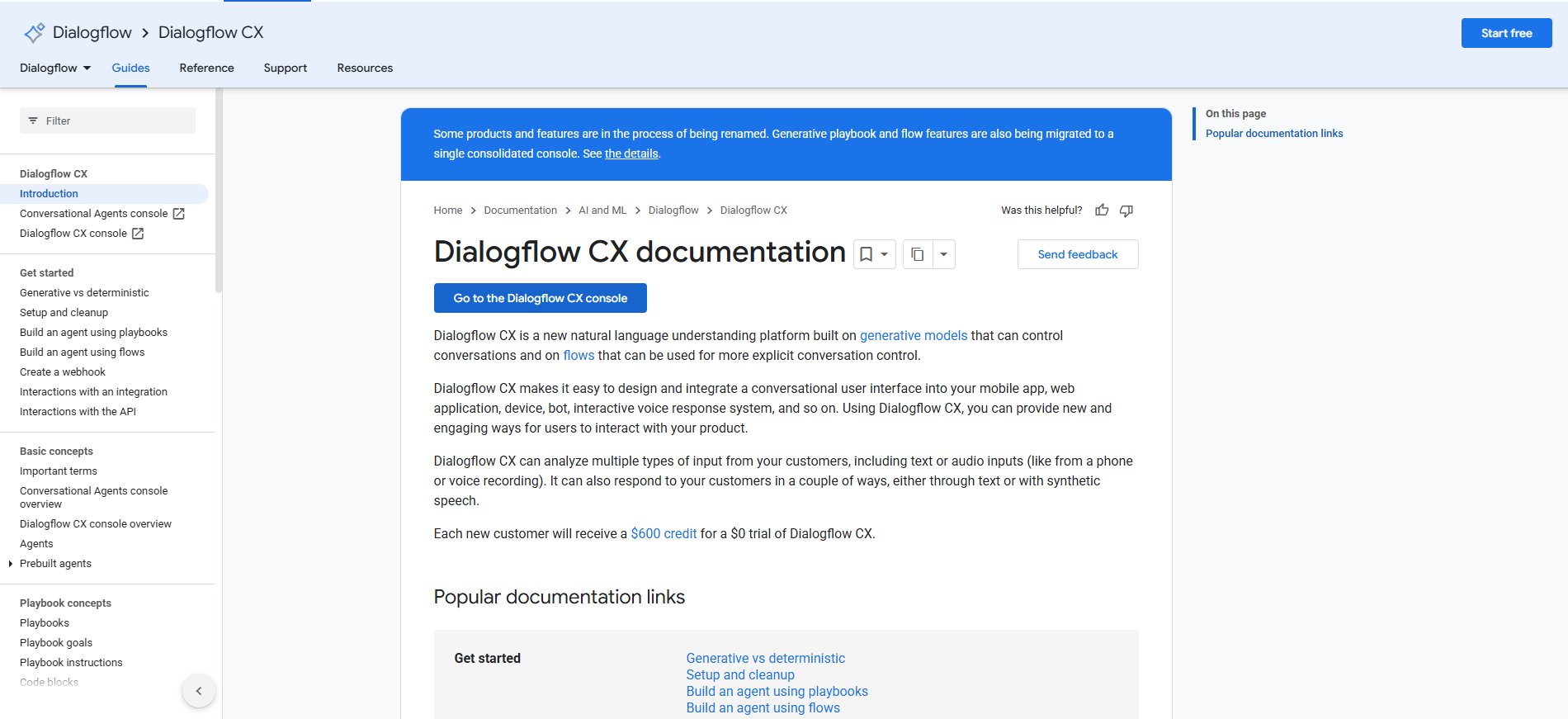
Best for enterprises already committed to Google Cloud that want conversational agents connected to Google’s contact center, telephony, generative AI, and cloud services.
Score: 6.6/10. Strong NLU accuracy (9/10) and GCP integration (8/10). Scored lower on deployment flexibility (4/10), governance (5/10), and voice architecture (6/10).
Product Overview
Google’s enterprise conversational AI stack now sits under Conversational Agents and Gemini Enterprise for Customer Experience. Dialogflow CX capabilities remain important, but Google has been consolidating the experience around the newer Conversational Agents console, which brings together Dialogflow CX and Vertex AI Agent Builder features.
For buyers comparing Cognigy alternatives, Google is strongest when the enterprise already wants to build around GCP, Gemini, Google telephony, and Contact Center AI patterns. Dialogflow CX provides flow-based agent design, intents, entity extraction, fulfillment, versions, environments, and built-in integrations. Google also supports phone use cases through Dialogflow CX Phone Gateway and SIP trunk integration with the Google Telephony Platform.
Compared with Cognigy, Google is less of a standalone conversational AI vendor and more of a cloud ecosystem choice. It is a strong fit for teams that already run AI, data, contact center, and application infrastructure on Google Cloud.
Pros and Cons
Pros:
- Strong fit for Google Cloud-standardized enterprises.
- Flow-based agent design with versions and environments.
- Good integration with Google Cloud services, Gemini, and contact center tooling.
- Telephony support through Phone Gateway and SIP trunk integration.
- Usage-based cloud pricing model.
Cons:
- Best fit is inside the Google Cloud operating model.
- Public materials do not describe a customer self-hosted deployment option.
- Complex enterprise implementations can require significant GCP, telephony, and integration expertise.
- Less suited to teams that want cloud-neutral agent architecture across mixed infrastructure and provider choices.
Pricing
Pay-as-you-go. Free tier for text. Session and audio-minute pricing.
Setup
Days for basic bots. Weeks for complex telephony deployments.
Tradeoffs
Google Conversational Agents is a strong Cognigy alternative for enterprises that already want to build customer service AI inside the Google Cloud ecosystem.
Rasa is stronger when teams want the agent platform to fit a cloud-neutral architecture, customer-controlled deployment model, existing engineering workflow, mixed model and speech-provider strategy, and backend systems outside a single cloud ecosystem.
Why Choose Cognigy Alternatives
Post-Acquisition Roadmap Fit
Cognigy is now part of NiCE. That gives Cognigy more reach inside the contact center market, but it also changes the buying context. Enterprises evaluating Cognigy should ask how the roadmap, packaging, deployment options, and commercial model will evolve inside the broader NiCE CXone Mpower strategy. Buyers that want an independent agent platform, or one that is not tied to a single CCaaS ecosystem, may want to compare alternatives.
Different Operating Models
Cognigy is a strong enterprise contact center automation platform with visual tooling, Voice Gateway, agent assist, analytics, and omnichannel CX automation. But not every team wants the same operating model. Some want a managed CX platform. Some want a fast helpdesk AI agent. Some want a voice-first provider. Others want a developer platform they can run as part of their own software operation. The right alternative depends on where the agent needs to live and who will own it after launch.
Faster Paths for Narrower Use Cases
Cognigy is built for complex enterprise programs, which can require significant design, integration, and implementation work. That may be the right tradeoff for a large contact center transformation. It can be too heavy for narrower use cases. Intercom Fin is faster for helpdesk-native support automation. Retell AI is faster for phone-agent deployment. Voiceflow is faster for visual prototyping. The tradeoff is that these tools may not provide the same enterprise platform depth.
Customer-Controlled Deployment
Regulated enterprises often need more than a vendor-hosted workspace. They may need private-cloud, self-hosted, or air-gapped deployment, along with control over infrastructure, data handling, model providers, release processes, and backend authorization. Rasa is a stronger fit for teams that need the agent platform to operate inside their own architecture rather than primarily inside a managed SaaS environment.
Engineering Workflow and Release Control
Enterprise agents are not finished after launch. Teams need to update policies, connect new systems, test changes, review behavior, manage releases, and explain what happened when something breaks. Cognigy gives teams a mature visual platform for building and managing conversational experiences. Rasa is stronger for technical teams that want agents to move through their existing engineering workflow, including code review, testing, staging, rollout, and controlled releases.
Cost Model Clarity
Cognigy buyers should model the full cost of the platform, including licenses, implementation, voice, telephony, LLM usage, add-ons, and ongoing operations. The same is true for every alternative. Rasa uses annual conversation-volume licensing. Retell AI uses usage-based voice pricing. Intercom Fin prices around outcomes. Voiceflow uses plan and credit-based pricing. At enterprise scale, the pricing model matters as much as the headline price.
How To Choose the Right Cognigy Alternative
Step 1: Start With the Job the Agent Needs to Do
Do not start with the vendor list. Start with the work the agent has to own. A helpdesk AI agent, a phone automation layer, a multilingual CX assistant, and a regulated service agent that updates backend systems are different buying decisions. Intercom Fin may be enough for support automation. Retell AI may be enough for phone-first workflows. Cognigy, Kore.ai, Ada, and Yellow.ai fit broader CX platform needs. Rasa fits when the agent needs to operate inside your enterprise architecture across systems, channels, policies, and release workflows.
Step 2: Decide Where the Agent Should Live Operationally
Some teams want the agent managed inside a vendor platform. Others want the agent to become part of their own software and service operation. Cognigy is strong when the buyer wants a mature contact center automation platform with visual tooling and packaged CX operations. Rasa is stronger when technical teams need the agent platform to fit their codebase, deployment model, security process, backend integrations, testing, staging, rollout, and long-term release control.
Step 3: Map Your Channel and Voice Requirements
If voice is the main product, compare voice-first vendors carefully. PolyAI is strong for premium contact center voice. Retell AI is strong for fast phone-agent deployment. Cognigy has Voice Gateway for enterprise contact center use cases. Rasa supports voice through channel connectors and speech-provider integrations, making it stronger when voice is one channel in a broader enterprise agent platform across digital channels, backend systems, and governed workflows.
Step 4: Validate Deployment, Security, and Data Requirements
Regulated buyers should verify deployment options directly. Do you need SaaS, private cloud, self-hosted, air-gapped deployment, data residency, customer-controlled infrastructure, or specific model-provider rules? Some vendors offer private or enterprise deployment patterns, but the details matter. If public materials do not clearly describe customer self-hosted deployment, treat it as a question for procurement, security, and architecture review.
Step 5: Model Cost at Production Scale
Do not compare only the starting price. Model platform fees, conversation or resolution pricing, voice minutes, telephony, ASR, TTS, LLM usage, hosting, implementation services, support, and the engineering time required to keep the agent improving after launch. Rasa uses annual conversation-volume licensing. Intercom Fin prices around outcomes. Retell AI uses usage-based voice pricing. Voiceflow uses plan and credit-based pricing. The right model depends on your expected volume, channel mix, and ownership model.
Step 6: Run a Production-Shaped Pilot
Test the hardest realistic workflow before committing. Use a journey that includes backend actions, policy constraints, handoff, user corrections, unhappy paths, and failure handling. Track task completion, escalation quality, latency, cost, testability, release process, and how quickly the team can improve the agent after seeing real issues. A polished demo proves the experience is possible. A production-shaped pilot shows whether the platform fits the way your business actually operates.
Key Features to Look for When Exploring Cognigy Competitors
Deployment and Data Control
Start with where the agent can run and where customer data flows. Regulated enterprises may need SaaS, private cloud, self-hosted, air-gapped deployment, or specific data residency guarantees. Do not rely on broad “enterprise deployment” language. Confirm whether the platform can run in the environment your security and architecture teams require.
Governed Agent Behavior
Look for clear ways to control what the agent can say, do, approve, escalate, and change. The strongest platforms give teams a way to define policies, test behavior, review changes, and trace why the agent acted a certain way. For high-risk workflows, governance needs to be part of the operating model, not a final validation layer added after the agent responds.
Voice Channel Architecture
Voice support is not one feature. It includes telephony integration, streaming behavior, turn-taking, latency, interruption handling, ASR, TTS, handoff, analytics, and how the same logic works across voice and digital channels. Voice-first vendors such as PolyAI and Retell AI may be stronger for standalone phone automation. Rasa is stronger when voice needs to fit into a broader enterprise agent platform across systems, teams, and governed workflows.
Backend Integration and Action Control
A useful enterprise agent needs to do more than answer questions. It needs to check accounts, update records, trigger workflows, verify permissions, and hand off with context. Evaluate how each platform connects to systems of record, how actions are authorized, how failures are handled, and how engineers can extend the integration layer.
Engineering Workflow Fit
Enterprise agents keep changing after launch. Teams need version control, tests, staging, approvals, rollout, rollback, and a clear review process. Visual builders can be fast for configuration, but technical teams should evaluate whether the platform fits their existing software delivery process or creates a separate vendor-controlled workspace.
Observability and Improvement Loop
Look for conversation traces, event history, test results, QA workflows, evaluation tools, analytics, and clear evidence of what changed between releases. The platform should help teams find failures, understand why they happened, and improve the agent without relying only on manual transcript review.
Cost Model at Scale
Compare the full operating cost, not the headline platform fee. Include licenses, conversation or resolution pricing, voice minutes, telephony, ASR, TTS, LLM usage, hosting, implementation services, support, and internal engineering time. A pricing model that looks simple during a pilot can behave very differently at production volume.
Roadmap and Ecosystem Fit
Cognigy’s move into NiCE changes the long-term buying context. For some teams, tighter contact center alignment is a benefit. For others, it raises questions about roadmap independence, packaging, deployment flexibility, and CCaaS ecosystem dependence. The right alternative should match the ecosystem you want to build around, not just the feature checklist you need today.
Cost Comparison: Cognigy vs. Competitors
- Rasa: Developer Edition free. Enterprise custom based on annual conversation volume.
- Cognigy: Pilots from $2,500-$5,000/month. Enterprise $100K-$350K+/year. Voice minutes and LLM tokens bill separately.
- IBM watsonx: Lite free. Plus from $140/month + usage. Enterprise custom.
- Retell AI: $0.07/minute published. Volume discounts.
- Kore.ai: Custom enterprise pricing. Session-based billing with seat licensing.
- Intercom Fin: $0.99/resolution. Intercom seat $29-$132/seat/month.
- Voiceflow: Free plan. Plus $60/editor/month. Additional editors $50 each.
- Dialogflow CX: Pay-as-you-go. Session and audio-minute pricing.
Which of the Cognigy Alternatives Is Right for Your Business?
- Need regulated enterprise + self-hosted + voice: Rasa. Self-hosted from day one, the patented Orchestrator for architectural governance over agent behavior, native voice, no acquisition roadmap risk.
- Need IBM stack + regulated: IBM watsonx Assistant. On-prem, IBM compliance framework.
- Need fast voice deployment: Retell AI. Days, not months. Transparent per-minute pricing.
- Need premium voice quality: PolyAI. Industry-leading voice realism for brand-sensitive applications.
- Need global multilingual CX: Yellow.ai. 135+ languages at mid-market enterprise pricing.
- Need no-code / design-led building: Voiceflow. Visual builder for product and design teams.
- Need enterprise technical control: Kore.ai. Pre-built industry agents, on-prem option, Gartner Leader.
- Need fast customer support AI: Intercom Fin. Deploys in hours, highest resolution rate.
- Need no-code CX automation: Ada. Fast no-code builder for CX teams.
- Need Google Cloud native: Dialogflow CX. Strong NLU, CCAI telephony.
FAQs
What are the main reasons enterprises evaluate Cognigy alternatives?
Enterprises usually evaluate alternatives when they want a different operating model. Cognigy is a strong enterprise contact center automation platform, especially for teams that want visual tooling, Voice Gateway, agent assist, analytics, and omnichannel CX automation. Alternatives become relevant when buyers want customer-controlled deployment, a cloud-neutral architecture, deeper engineering workflow fit, faster setup for narrower use cases, or a platform that is less tied to a broader CCaaS ecosystem.
How did the NiCE acquisition of Cognigy affect enterprise buying decisions?
The acquisition makes Cognigy part of a larger contact center platform strategy. For some buyers, that is positive because it brings Cognigy closer to NiCE CXone Mpower and the wider NiCE customer base. For others, it creates questions about roadmap independence, packaging, pricing, deployment options, and how closely future Cognigy capabilities will be tied to the NiCE ecosystem.
How does Rasa compare to Cognigy for regulated enterprise deployments?
Cognigy is a mature enterprise CX automation platform with strong contact center capabilities. Rasa is a developer platform for enterprise AI agents that is stronger when technical teams need customer-controlled deployment, backend integration ownership, governed workflows, model and provider choice, and an engineering-led release process. Rasa fits teams that want the agent platform to operate as part of their own software and service architecture.
Does Cognigy support on-premises or self-hosted deployment?
Cognigy has historically offered enterprise deployment options beyond standard public SaaS, including private and on-premises-style environments for some customers. Buyers should confirm the current details directly, including who operates the environment, where data flows, what dependencies remain, and how the deployment model may evolve under NiCE.
Which Cognigy alternatives offer customer-controlled deployment?
Rasa supports self-hosted, private-cloud, and air-gapped deployment. IBM watsonx Assistant and Kore.ai also support enterprise deployment patterns beyond standard public SaaS. For other vendors, buyers should verify whether the platform supports private cloud, dedicated cloud, VPC, hybrid, or true customer self-hosted deployment. If public materials do not clearly describe customer self-hosting, treat it as a procurement and architecture review question.
How long does a Cognigy implementation typically take?
Implementation time depends on use case complexity, channels, integrations, telephony, compliance requirements, and the amount of workflow design required. Cognigy is built for enterprise programs, so complex deployments can take meaningful implementation work. Narrower alternatives can move faster: Intercom Fin for helpdesk-native support automation, Retell AI for phone-agent use cases, and Voiceflow for visual prototyping. Rasa timelines depend on integration depth and the customer’s technical team.
Which Cognigy alternatives support both voice and digital channels?
Cognigy, Rasa, Kore.ai, Yellow.ai, Ada, Google Conversational Agents, IBM watsonx Assistant, and Voiceflow all support voice and digital use cases in some form. The difference is architecture. Voice-first vendors like PolyAI and Retell AI may be stronger for standalone phone automation. Rasa is stronger when voice needs to share an operating model with chat, app, backend workflows, governed actions, and customer-controlled deployment.
What should enterprises evaluate when choosing a Cognigy alternative?
Start with the job the agent needs to do. Then evaluate channel requirements, deployment model, backend integration depth, governance, release control, voice architecture, observability, pricing model, implementation effort, and who owns improvement after launch. The right answer depends less on the longest feature list and more on whether the platform fits the way the enterprise needs to build, operate, and improve agents.
How does Cognigy’s pricing model compare to alternatives?
Cognigy uses sales-led enterprise pricing, and buyers should model the full cost across platform fees, implementation, voice, telephony, LLM usage, add-ons, support, and ongoing operations. Alternatives use different models. Rasa uses annual conversation-volume licensing. Intercom Fin prices around outcomes. Retell AI uses usage-based voice pricing. Voiceflow combines plan and credit-based pricing. At enterprise scale, the pricing model matters as much as the headline quote.
What makes Rasa different from Cognigy for enterprise deployments?
The difference is operating model. Cognigy gives enterprises a mature contact center automation platform. Rasa gives technical teams a developer platform for enterprise AI agents that can fit their architecture, deployment requirements, backend systems, model strategy, and release workflow. Choose Cognigy when the agent primarily belongs inside a CX platform. Choose Rasa when the agent needs to become part of the company’s own software operation.
Are there open-source Cognigy alternatives?
There are open-source frameworks and SDKs for building conversational and agentic systems, but they usually require teams to assemble more of the production operating layer themselves. Rasa has open-source roots and offers a free Developer Edition, but its main fit in this comparison is not “open source chatbot.” It is an enterprise agent platform for teams that want technical ownership, governed workflows, and customer-controlled deployment.
Which Cognigy alternative is best for high-volume contact center environments?
It depends on the operating model. Cognigy and Kore.ai fit broad enterprise contact center automation. PolyAI is strong for premium voice automation. Retell AI is strong for fast phone-agent deployment. Intercom Fin is strong for helpdesk-native support automation. Rasa is strongest when high-volume service journeys need backend integration, governed workflows, voice and digital continuity, and deployment inside the customer’s own architecture.
Which Cognigy alternative is best for ecommerce support?
For small or mid-sized ecommerce support, Intercom Fin, Gorgias, Tidio, Manychat, or Retell AI may be a better fit than Cognigy, depending on whether the main channel is helpdesk, chat, social messaging, or phone. For larger ecommerce or retail enterprises with complex order management, returns, loyalty, payments, and regulated data requirements, Rasa, Yellow.ai, Kore.ai, or Cognigy may be more appropriate.
Which Cognigy alternative can best handle order tracking and returns?
The key requirement is backend integration, not just intent recognition. The platform needs to look up orders, verify identity, apply return policies, trigger actions, handle failures, and escalate with context. Rasa is strong when teams need to own those backend workflows and release them through an engineering process. Intercom Fin, Gorgias, Yellow.ai, Kore.ai, and Ada can also be strong depending on the commerce stack and support operating model.
Which Cognigy alternative has the best voice quality?
PolyAI is one of the strongest options for premium contact center voice. Retell AI is strong for fast phone-agent deployment. Cognigy has Voice Gateway for enterprise contact center voice. Rasa supports voice through channel connectors and speech-provider integrations, making it a better fit when voice is one channel in a broader enterprise agent architecture rather than the only product requirement.
Does Cognigy support human handoff during voice interactions?
Yes. Cognigy supports human handoff and agent-assist patterns, especially in contact center environments. Buyers should evaluate how much context transfers during handoff, how the receiving agent sees prior conversation history, how the system handles failed automation, and whether the handoff model works across the channels and systems involved in the journey.
Is Cognigy too heavy for small ecommerce stores?
Usually, yes. Cognigy is designed for enterprise contact center and CX automation programs, not small ecommerce teams looking for quick support automation. Smaller ecommerce teams usually get more value from tools built around Shopify, helpdesk automation, social messaging, or fast phone agents. Cognigy becomes more relevant when the business has enterprise-scale service complexity, multiple channels, and deeper integration requirements.
.png)
.png)
.png)