.png)

IBM watsonx Assistant (formerly IBM Watson Assistant) has been a market-leading enterprise conversational AI platform for over a decade, with strong adoption across BFSI, healthcare, government, telco, and other regulated industries where IBM's compliance posture, on-premises deployment, and Watson Discovery knowledge retrieval matter.
For enterprise teams running production watsonx Assistant deployments in 2026, this is a transitional period. IBM has increasingly shifted focus toward watsonx Orchestrate, which expands beyond chat into multi-agent workflow automation. IBM CEO Arvind Krishna has described this shift as moving from AI assistants toward AI agents that automate tasks across enterprise systems.
For enterprises that bought into watsonx Assistant as the chat-centric platform, IBM’s broader shift toward agent orchestration is now a procurement signal.
The recurring drivers behind the IBM Watson alternatives search in 2026 are consistent across enterprise procurement evaluations. watsonx Assistant pricing remains opaque, with custom enterprise contracts typically reaching $100,000+/year at production scale, plus IBM Cloud subscription and watsonx Discovery consumption costs layered on top.
watsonx Assistant runs primarily on IBM Cloud, with on-premises deployment available but requiring IBM Software Hub on Red Hat OpenShift. Watson's NLU, while historically strong, has been outpaced in 2024-2026 by newer foundation models from OpenAI, Anthropic, and Google.
Voice agents stitch Watson NLU, generative response, IBM Speech-to-Text or Text-to-Speech, and telephony as separate services.
Plus, the consolidation of IBM's AI strategy under the watsonx umbrella (Orchestrate, Assistant, Discovery, watsonx.ai) creates strategic uncertainty about which product line will receive ongoing investment.
This guide compares 12 IBM Watson alternatives for enterprise conversational AI in 2026 across deployment flexibility, pricing predictability, IBM ecosystem independence, governance, voice readiness, and total cost of ownership.
Each platform is scored on the same weighted criteria, so CIO, CTO, IT leadership, and contact center architects can match their actual buying constraints to the right alternative, whether the requirement is regulated-industry self-hosting, voice-first contact center automation, multilingual global CX, no-code design teams, hyperscaler-native deployment, or fast knowledge-grounded enterprise agents.
What IBM Watson Alternatives Are There? Competitor Comparison and Ratings Chart
12 Best IBM Watson Alternatives for Enterprise Conversational AI in 2026
The alternatives below are organized by the buying constraint that drives the evaluation:
- regulated enterprise governance,
- IBM ecosystem independence,
- voice-first contact center automation,
- hyperscaler-native deployment,
- global multilingual CX,
- deep-learning specialist platforms,
- banking and finance vertical,
- no-code design teams,
- developer-led custom builds, and
- premium customer service AI agents.
Each category is filtered against the specific IBM watsonx Assistant limitations that drove the alternatives search in the first place.
#1. Rasa: Best IBM Watson Alternative for Regulated Enterprise Self-Hosted Deployment
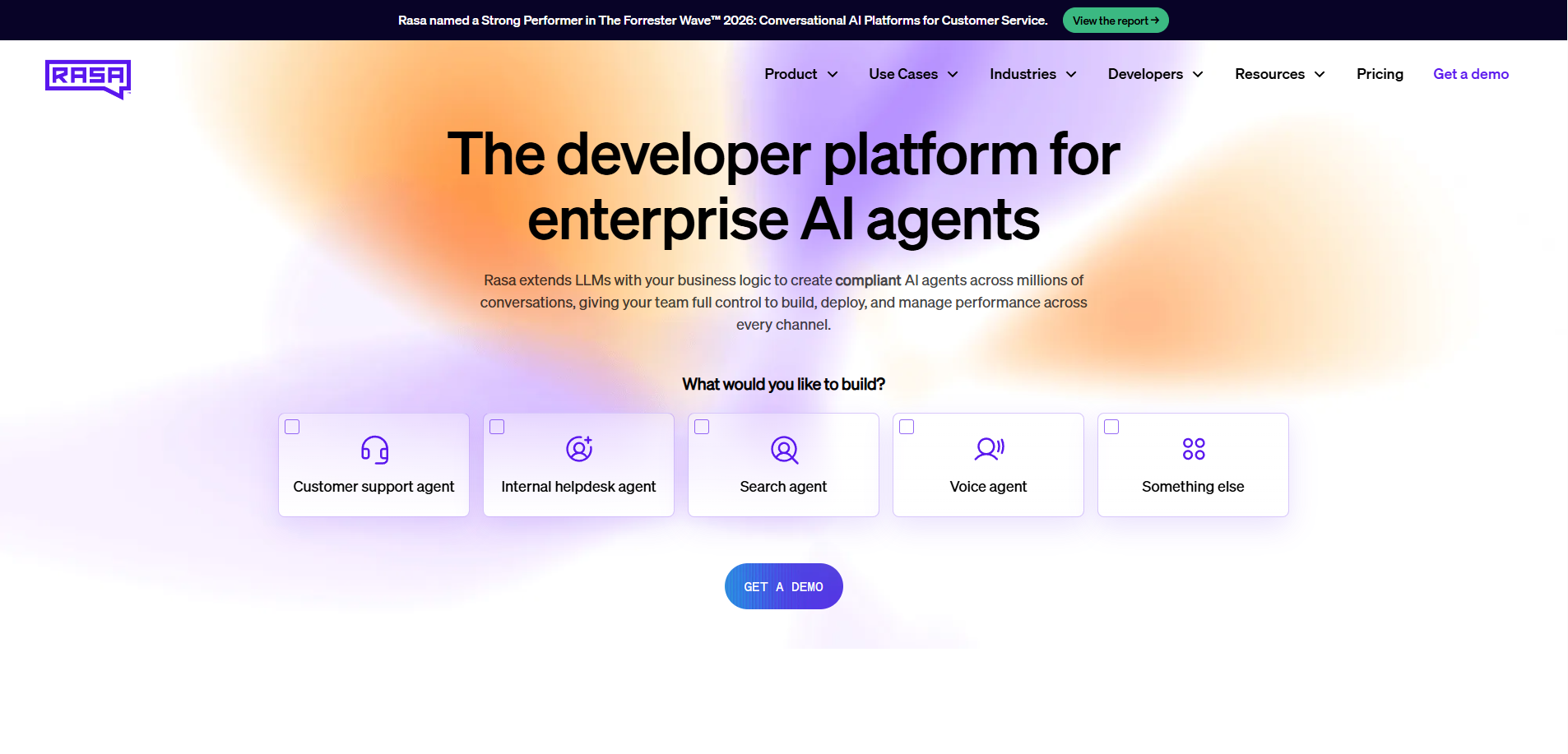
Rasa is the developer platform for enterprise AI agents. It was named a Strong Performer in The Forrester Wave™: Conversational AI Platforms For Customer Service, Q2 2026.
Managed IBM Cloud deployment and installed deployment through IBM Software Hub on Red Hat OpenShift, Rasa gives technical teams more control over deployment, integration, model/provider choices, and the agent release process.
Deutsche Telekom, Autodesk, Swisscom, and Groupe IMA run Rasa in production across digital and voice-enabled use cases in high-volume enterprise environments, including telco, software, insurance, and customer service operations.
Best for engineering organizations in regulated or high-scale industries that need self-hosted, on-premises, private-cloud, or air-gapped deployment without IBM Software Hub or Red Hat OpenShift as the upstream platform dependency.
Rasa is strongest when teams need architectural control over agent behavior, deep integration with internal systems, and licensing that is decoupled from IBM Cloud, search/retrieval, speech, and installed deployment costs.
Score: 9.4/10. Highest marks for governance (10/10), deployment flexibility (10/10), voice (10/10), and pricing transparency (9/10). Scored lower on out-of-the-box pre-built industry templates (7/10) vs. IBM watsonx Assistant's vertical-specific accelerators.
Product Overview
IBM watsonx Assistant gives you a managed conversational AI service tightly coupled to the IBM ecosystem: IBM Watson NLU for intent recognition, watsonx Discovery for knowledge retrieval, IBM Cloud for hosting, IBM Speech-to-Text and Text-to-Speech for voice, and IBM Cloud Pak for Data for on-premises deployment via Red Hat OpenShift.
Rasa takes a different approach. It gives technical teams an agent platform they can run inside their own architecture, connect to their own systems, and operate through their own engineering workflow.
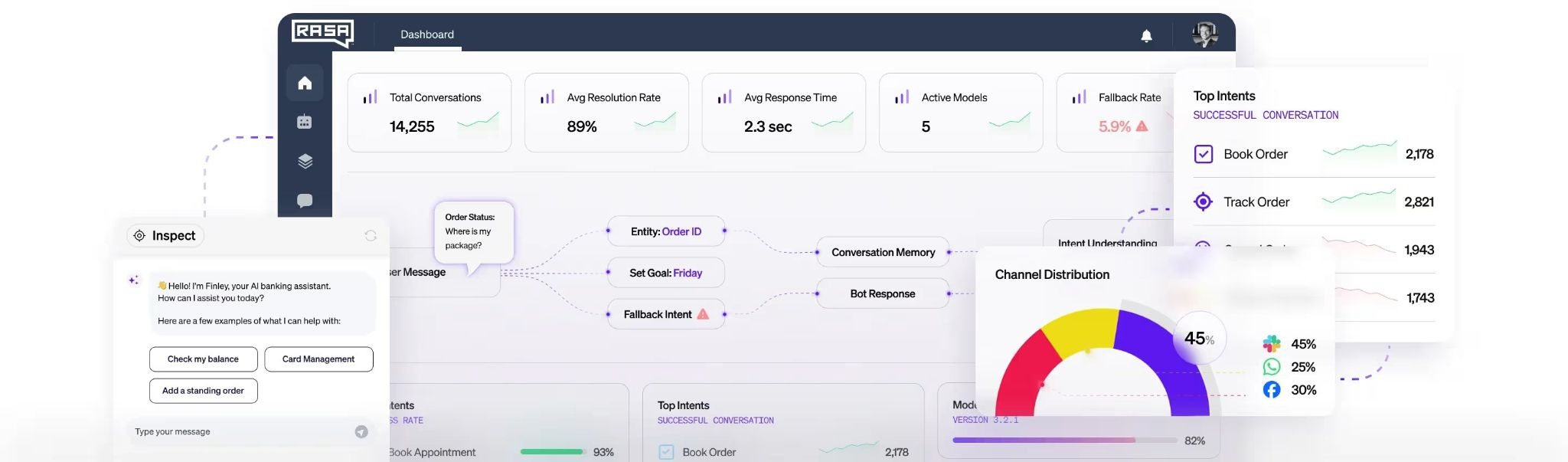
The Rasa platform has three core layers: Framework for building, Orchestrator for runtime coordination, and Studio for review and refinement.
The Orchestrator is Rasa’s patented dialogue management layer. It manages conversation state, selects the next step, coordinates skills, and keeps the interaction coherent across turns. This matters when an enterprise agent has to move between open-ended conversation, required process steps, backend actions, approvals, handoffs, and exact wording.
Rasa lets teams use flexible agent behavior where natural conversation matters, then add stricter controls where the use case requires them: policy checks, required steps, backend action rules, approval gates, handoffs, or fixed responses. For regulated workflows such as KYC, claims intake, account changes, healthcare triage, and prescription refills, those control points need to be visible, testable, and auditable.
Rasa Studio gives non-technical stakeholders a visual place to test, review, and refine agent behavior without owning the codebase. Engineering teams can keep the agent logic aligned with software delivery practices: version control, CI/CD, tests, code review, and controlled releases.
Rasa’s CALM is the platform’s dialogue system that uses language models to interpret user input and manage conversations while adhering to predefined business logic and flows.
Rasa also supports reusable skills across voice and digital channels. The point is not that Rasa is a standalone voice API. The point is that voice can run through the same enterprise agent operating model as chat: shared logic, backend integrations, observability, governance, and release process.
For voice, Rasa supports connectors and speech provider integrations, including Twilio Media Streams, AudioCodes, Genesys Cloud, and Jambonz, with ASR and TTS providers configured as part of the deployment.
IBM voice deployments may also combine multiple IBM and telephony services, so teams should evaluate latency, cost, and operational complexity across the full stack.
Pricing
Developer Edition (Free): Full access to Rasa. One bot per company, up to 1,000 external conversations/month (100 for internal agents). Community support via the Rasa Forum.
Enterprise (Custom): Premium support, dedicated CSM, advanced security features, custom onboarding, Rasa Studio for refining design and review. Contact Rasa for a quote.
Pricing is based on annual conversation volume, not per-request, per-event, or per-query consumption. Contrast with Watson Assistant's typical $100,000+/year enterprise contracts plus IBM Cloud subscription, watsonx Discovery per-query charges, and IBM Cloud Pak for Data licensing for on-premises deployments.
Integrations
Native: MCP server integration, A2A, custom Action Server.
Voice channel connectors for Twilio Voice, Twilio Media Streams, Jambonz, Jambonz Stream, AudioCodes VoiceAI Connect, AudioCodes Voice Stream, and Genesys Cloud.
Backend integrations through Action Server custom actions and MCP server connectivity for CRM, ERP, ticketing, and contact center systems. No IBM Cloud, watsonx Discovery, or IBM Cloud Pak for Data dependencies.
Extensible: teams can replace or extend core modules (RAG pipeline, rephraser, command generator, NLU pipelines) without waiting on a vendor roadmap.
Setup
Self-hosted in your environment from day one. On-premises, private cloud, and air-gapped deployment options. Rasa does not host any customer data, systems, or applications. No IBM Software Hub or Red Hat OpenShift dependency required.
Swisscom went from prototype to production in 20 weeks, doubling automation rates and cutting operational costs by 50 percent.
For Watson Assistant teams already comfortable with skill-based authoring, intent recognition, and dialog node modeling, the migration path is incremental: existing intents, training phrases, and dialog node definitions translate naturally to Rasa's guided and prompt-driven skill primitives.
Pros and Cons
Pros:
- Self-hosted, on-premises, and air-gapped deployment as a first-class option without IBM Software Hub or Red Hat OpenShift upstream dependency.
- Patented Orchestrator manages conversation state, skill coordination, and controlled execution paths.
- No required dependency on IBM Cloud, watsonx Discovery, or IBM Software Hub / Cloud Pak for Data.
- Predictable conversation-volume licensing. No per-request, per-event, or per-query surprises.
- Voice and digital channels can run through the same agent operating model, with connectors for Twilio, Jambonz, AudioCodes, and Genesys Cloud.
- Multi-agent orchestration with shared state, clean handoffs, and unified memory.
- Code-as-source-of-truth: version control, CI/CD, unit tests, code review.
- Choose your own LLM, ASR, and TTS providers. No vendor lock-in.
- Forrester Wave Strong Performer 2026.
Cons:
- Requires engineering resources or an integration partner.
- Fewer pre-built industry templates than Watson Assistant's vertical-specific accelerators.
Tradeoffs
Rasa is best for teams that want the agent platform to fit their own architecture, deployment model, security process, and release workflow. If an organization is already fully standardized on IBM Cloud, watsonx Discovery, and IBM Speech services, and only needs a narrow assistant inside that ecosystem, Watson Assistant may be the simpler default.
Rasa becomes the stronger choice when the agent needs to connect across systems, support voice and digital channels in one operating model, meet regulated deployment requirements, and remain under the customer’s technical control as the use case grows.
Rasa is strongest where customer-controlled deployment, regulated-vertical governance, engineering workflow fit, and IBM ecosystem independence are non-negotiable.
Rasa Studio gives non-technical team members a place to review, test, and refine agent behavior, while engineering teams keep the codebase, CI/CD process, and release workflow under their control.
Choose Watson Assistant if your enterprise is already standardized on IBM Cloud and watsonx Discovery, your primary use case is regulated-industry conversational AI with managed IBM infrastructure, and IBM ecosystem dependency is acceptable.
Choose Rasa if you need customer-controlled deployment, regulated vertical governance, engineering workflow fit, voice and digital channels in one operating model, and pricing decoupled from IBM Cloud consumption.
Support
Rasa Enterprise includes premium support for teams deploying agents in production, including onboarding, implementation guidance, best-practice reviews, and help aligning Rasa with the customer’s architecture, deployment model, integrations, and release process.
Community support via the Rasa Forum. Documentation at rasa.com/docs. Learning resources at learning.rasa.com.
Mini Case Study
Deutsche Telekom deployed Rasa for internal IT support across 10,000+ employees in German and English. 50 percent of service desk inquiries resolved autonomously. 30 percent reduction in agent workload. Non-technical IT experts use Rasa Studio to design conversation flows.
Read the full case study here >
See How Rasa Compares to IBM Watson's Ecosystem Lock-In
#2. Kore.ai: Best IBM Watson Alternative for Broad Enterprise Agent Platform
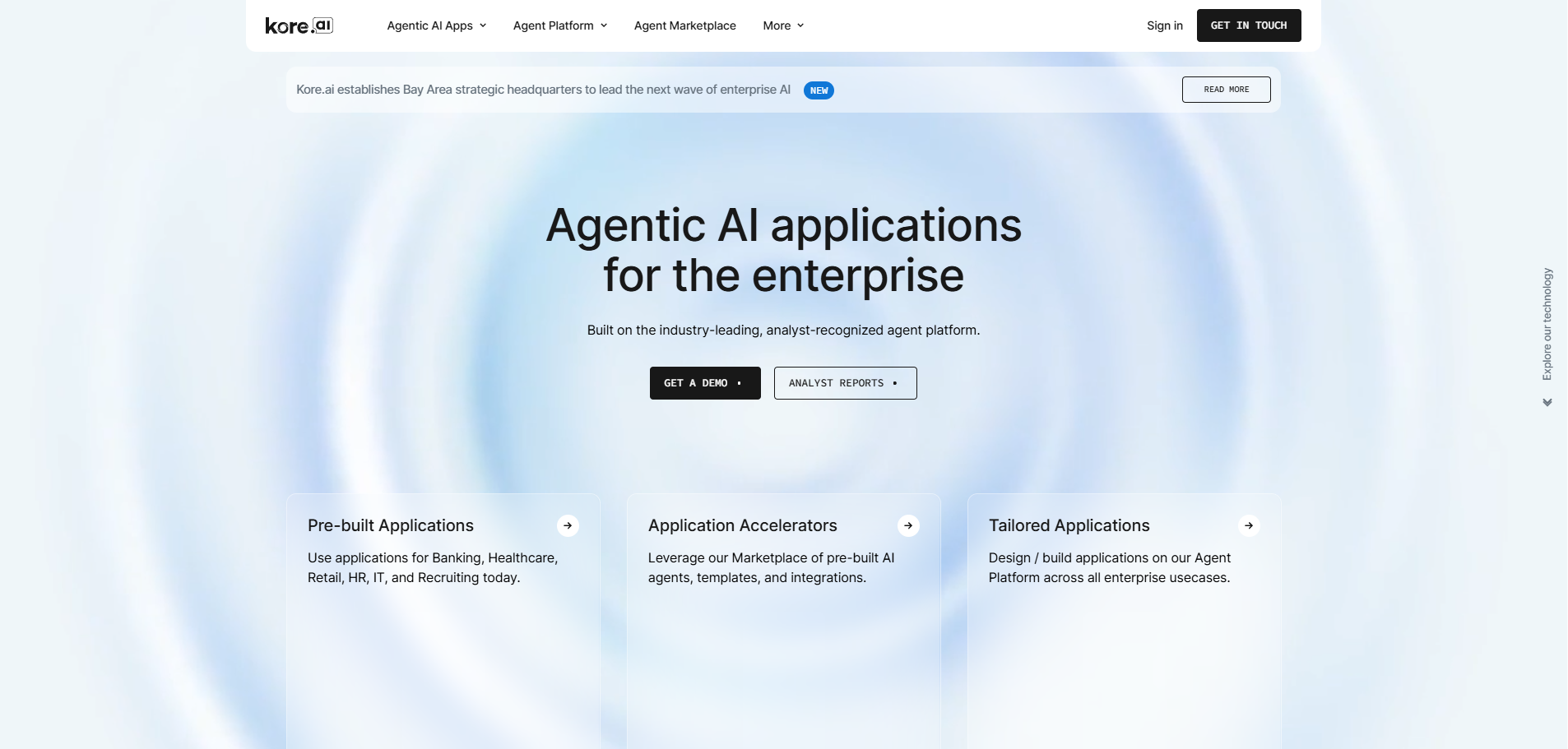
Best for large enterprises that want a broad, packaged AI agent platform with no-code, low-code, and pro-code tooling, industry templates, multi-agent orchestration, enterprise integrations, and governance features.
Score: 7.4/10. Strong enterprise depth (8/10), on-prem option (8/10), and Gartner Leader recognition (9/10). Scored lower on setup speed (5/10, 3-6 month implementations), pricing transparency (5/10), and integration reliability (6/10 per Capterra).
Product Overview
Kore.ai offers a broad enterprise AI Agent Platform, including the newer Artemis edition, for building, governing, and optimizing agents across service, work, and process automation. The platform includes no-code, low-code, and pro-code tooling, pre-built templates, multi-agent orchestration, governance, observability, and enterprise integrations.
Pros and Cons
Pros:
- Pre-built industry agents for BFSI, healthcare, retail.
- Enterprise deployment options to verify by product line and contract.
- Broad enterprise adoption and partner ecosystem.
Cons:
- Implementation effort can vary significantly by use case, integration depth, and deployment model.
- Opaque enterprise pricing (~$300K+/year typical).
- Integration configs reportedly messy per Capterra.
- Steep learning curve.
Pricing
Custom enterprise pricing. No public rate card. Typical deployments $300K+/year per public reporting.
Setup
Weeks for pre-built agents. Months for custom enterprise.
Tradeoffs
Kore.ai is a direct Watson Assistant alternative for enterprises that want a broad packaged agent platform with templates, integrations, governance, and multi-agent capabilities.
The tradeoff is moving from IBM’s ecosystem into Kore.ai’s platform model, with custom pricing and implementation scope to validate during procurement.
4.4/5 Capterra (17 reviews).
#3. Cognigy (NICE): Best IBM Watson Alternative for Contact-Center Voice Automation
Best for enterprise contact centers that want a mature voice and digital automation platform with strong contact-center integrations, Voice Gateway, agent assist, analytics, and NICE CXone alignment.
Score: 7.6/10. Strong omnichannel (9/10), native voice (9/10), on-premises option (8/10), and high-volume voice capability (9/10). Scored lower on governance depth vs. Rasa's Orchestrator (6/10), pricing transparency (5/10), and NICE acquisition roadmap risk (6/10).
Product Overview
Cognigy is an enterprise conversational and agentic AI platform for contact centers, with voice automation through Cognigy Voice Gateway and digital-channel automation through Cognigy.AI. Cognigy was named a Leader in the 2025 Gartner Magic Quadrant for Enterprise Conversational AI Platforms.
Cognigy publicly claims Voice Gateway supports 25K+ concurrent conversations and “tens of thousands” of concurrent live calls.
Cognigy lists 110+ prebuilt tools and integrations in current public materials.
On-premises and air-gapped deployment available.
Pros and Cons
Pros:
- Native voice via Voice Gateway On-premises and air-gapped deployment options.
- Mercedes-Benz, Nestle, Lufthansa enterprise deployments.
Cons:
- NICE ownership may change packaging, roadmap, and CXone alignment over time, so buyers should validate the combined roadmap.
- $100K-$350K+ annual enterprise pricing.
- 2-4 month implementations.
- Multi-line billing (platform + voice + LLM + add-ons).
Pricing
Pilots from $2,500-$5,000/month. Enterprise $100K-$350K+/year. Voice minutes and LLM tokens bill separately.
Setup
Weeks for pre-built templates. 2-4 months for enterprise deployments.
Tradeoffs
Cognigy is strong for contact-center automation inside a packaged CX platform, while Rasa is stronger when the buyer needs customer-controlled deployment, engineering workflow fit, and deeper ownership of the agent operating model.
4.7/5 Gartner Peer Insights (100+ reviews).
#4. Microsoft Copilot Studio: Best IBM Watson Alternative for Microsoft-Native EnterprisesBest for enterprises moving off IBM Cloud onto Microsoft Azure with M365 Copilot licenses deployed and Power Platform as the strategic automation layer, wher
Best for enterprises moving off IBM Cloud onto Microsoft Azure with M365 Copilot licenses deployed and Power Platform as the strategic automation layer, where Copilot Studio's deep Microsoft 365 + Teams + Dynamics 365 integration is the value driver.
Score: 7.0/10. Strong Microsoft 365 ecosystem integration (10/10), citizen-developer maker tooling (8/10), and Azure OpenAI native LLM access (8/10). Scored lower on deployment outside Microsoft (3/10), pricing predictability with Copilot Credits (5/10), and M365 Copilot license dependency at $30/user/mo for many features (5/10).
Product Overview
Microsoft Copilot Studio is the consolidated successor to Power Virtual Agents with deep Microsoft 365, Teams, Dynamics 365, and Azure integration.
Copilot Credits billing model (effective September 1, 2025) at $200/tenant/month for 25,000 credits plus pay-as-you-go.
M365 Copilot license at $30/user/month for many premium features.
Native Microsoft Agent Framework integration for multi-agent orchestration.
Direct alternative for Watson Assistant enterprises migrating to Microsoft cloud.
Pros and Cons
Pros:
- Deepest Microsoft 365 ecosystem integration of any conversational AI platform.
- Low-code maker tool for citizen developers.
- Azure AI Foundry model integration and access to Microsoft’s broader model ecosystem.
- Microsoft Agent Framework for multi-agent orchestration.
Cons:
- Microsoft cloud only with Azure subscription required.
- Copilot Credits pricing complexity ($200/tenant/mo + variable rates + M365 Copilot license at $30/user/mo).
- Voice use cases depend on the broader Microsoft stack, including Dynamics 365 Contact Center, Azure communication/speech services, or Teams-based experiences.
- Microsoft estate hard dependencies (Dataverse, Power Automate, Microsoft Graph).
Pricing
$200/tenant/month for 25,000 Copilot Credits, plus pay-as-you-go credits at variable rates by activity type. M365 Copilot license at $30/user/month for many premium features. Azure subscription required.
Setup
Hours for simple bots within Microsoft tenants. Weeks to months for production agents with custom integrations.
Tradeoffs
Best Watson alternative for Microsoft-committed enterprises that prefer the Microsoft cloud delivery model over IBM Cloud delivery.
Trades IBM ecosystem dependency for Microsoft tenant, Azure, Dataverse, Power Platform, and Microsoft Graph dependency.
No genuine self-hosted or on-premises option, which Watson Assistant offers (via IBM Software Hub).
#5. Google Dialogflow CX: Best IBM Watson Alternative for Google Cloud-Native Enterprises
Best for enterprises moving off IBM Cloud onto Google Cloud with Vertex AI Search, BigQuery, and Google Speech services in the stack, where Dialogflow CX's mature NLU and Gemini 2.5 generative playbooks deliver strong out-of-the-box capability.
Score: 6.8/10. Strong NLU accuracy (9/10), Gemini 2.5 generative playbooks (8/10), and CCAI native telephony (8/10). Scored lower on deployment outside Google (3/10), pricing predictability with per-request + per-event + per-query Vertex AI Search consumption (5/10), and recurring platform-generation migration burden (5/10).
Product Overview
Google Conversational Agents includes Dialogflow CX as the Essentials edition, with visual flow design, intents, entities, phone/web integrations, and mature NLU. The Standard edition adds Playbooks, Data Stores, generative fallbacks, and generators for more generative agent experiences.
Google’s broader agent strategy now sits under Gemini Enterprise Agent Platform, announced at Cloud Next ’26, which brings together agent development, orchestration, governance, security, DevOps, and model access across Google Cloud. Dialogflow CX remains relevant, but buyers should evaluate it as part of Google’s broader Conversational Agents and Gemini Enterprise roadmap.
Voice and contact-center use cases are supported through Dialogflow CX integrations, Contact Center AI, Google Telephony Platform, Phone Gateway, and partner telephony integrations such as AudioCodes, Avaya, Twilio, and Voximplant. Dialogflow CX also supports built-in integrations for Phone Gateway, Messenger, Slack, LINE, Google Chat, and other channels.
Pros and Cons
Pros:
- Mature NLU and intent recognition.
- Playbooks, Data Stores, generative fallbacks, and access to Google’s broader Gemini / Vertex AI model ecosystem.
- Pay-as-you-go pricing for text with free new-user credits.
Cons:
- Google Cloud only, with no on-premises option.
- Usage-based pricing across chat requests, voice audio seconds, Playbooks, Data Stores, and other Google Cloud services.
- Deep Google Cloud lock-in.
- Google’s naming and platform evolution can create roadmap complexity for teams comparing Dialogflow CX, Conversational Agents, Vertex AI, CCAI, and Gemini Enterprise Agent Platform.
Pricing
Per-request charges for generative requests, per-1,000-event charges for stored sessions and memories (effective January 2026), per-query Vertex AI Search charges, plus $5 per GiB beyond the free 10 GiB monthly quota.
New users receive $600 credit for Flows and $1,000 for Playbooks valid 12 months.
Setup
Days for basic text bots. Weeks to months for production voice deployments with CCAI integration.
Tradeoffs
Strong fit for Google Cloud-native teams, but less suitable for enterprises that need customer-controlled or on-premises deployment outside a hyperscaler ecosystem.
#6. Amazon Lex: Best IBM Watson Alternative for AWS-Native Voice and Chat
Best for enterprises on AWS that need conversational AI tightly integrated with AWS Connect for telephony, IAM for access control, S3 for data, and Lambda for tool calls, as the AWS counterpart to IBM Watson on IBM Cloud.
Score: 6.8/10. Strong AWS ecosystem integration (9/10), pay-as-you-go pricing transparency (7/10), and AWS Connect telephony depth (8/10). Scored lower on deployment outside AWS (3/10), deterministic dialogue management (4/10), and dialogue authoring sophistication vs. Watson Assistant (5/10).
Product Overview
Amazon Lex is AWS’s managed conversational AI service for building voice and text bots. It integrates directly with Amazon Connect for contact-center use cases and Lambda for backend fulfillment, with AWS identity, storage, monitoring, and deployment services available around it. Lex also includes a visual conversation builder, versioning, analytics, streaming conversations, telephony audio support, and newer generative AI features such as conversational FAQ, assisted slot resolution, descriptive bot builder, and sample utterance generation.
Pros and Cons
Pros:
- Deep AWS ecosystem integration (Connect, IAM, S3, Lambda).
- Pay-as-you-go pricing transparent at low volume.
- AWS Connect telephony for contact center voice.
Cons:
- AWS ecosystem dependency in place of IBM Cloud.
- Complex enterprise journeys often require custom AWS architecture around Lex.
- No self-hosted deployment.
- Building production-grade voice requires significant custom development beyond the Lex/Connect baseline.
Pricing
Pay-as-you-go: text request and voice request pricing. AWS Connect, Lambda, and S3 billed separately.
Setup
Fast for simple AWS-integrated bots. Production contact-center deployments usually take longer because the work moves into Amazon Connect flows, Lambda fulfillment, monitoring, permissions, and backend integration.
Tradeoffs
Amazon Lex is the most natural Watson alternative for AWS-committed teams that want conversational AI inside the same environment as Amazon Connect, Lambda, IAM, CloudWatch, S3, and Bedrock. The tradeoff is that Lex is a service inside a broader AWS architecture, not a full enterprise agent platform by itself. Teams get strong AWS-native building blocks, but they own more of the surrounding design, integration, testing, and operational model.
#7. Yellow.ai: Best IBM Watson Alternative for Global Multilingual CX
Best for global enterprises that need conversational AI across 135+ languages with regional CX depth, as an alternative to Watson Assistant's broad but uneven multilingual coverage, particularly in emerging markets.
Score: 7.0/10. Strong multilingual breadth (10/10), regional CX depth (9/10), and pre-built industry templates (8/10). Scored lower on deployment flexibility (5/10), governance vs. Rasa's Orchestrator (6/10), and pricing transparency (5/10).
Product Overview
Yellow.ai is an enterprise conversational AI platform with broad multilingual coverage (135+ languages), dynamic NLP, and 700+ integrations. Strong CCaaS, CRM, WhatsApp, and RCS integrations.
Focus on emerging-market and global multilingual CX where Watson Assistant's coverage runs into a ceiling.
Pros and Cons
Pros:
- 135+ languages, broader than Watson Assistant in many markets.
- Strong CCaaS, CRM, WhatsApp, RCS integrations.
- 700+ pre-built integrations.
Cons:
- No first-class on-premises or air-gapped deployment.
- Custom enterprise pricing without public rate card.
- Governance and observability less mature
- Multi-line billing for production deployments.
Pricing
Custom enterprise pricing. Sales-led with volume-based licensing.
Setup
Weeks for pre-built industry templates. Months for custom multilingual enterprise.
Tradeoffs
Strongest multilingual alternative to Watson Assistant for global CX with broader language coverage and stronger CCaaS depth.
Trades IBM ecosystem lock-in for Yellow.ai vendor pattern.
Private cloud is available, but no genuine self-hosted or air-gapped deployment.
#8. Avaamo: Best IBM Watson Alternative for Healthcare and Enterprise Voice AI
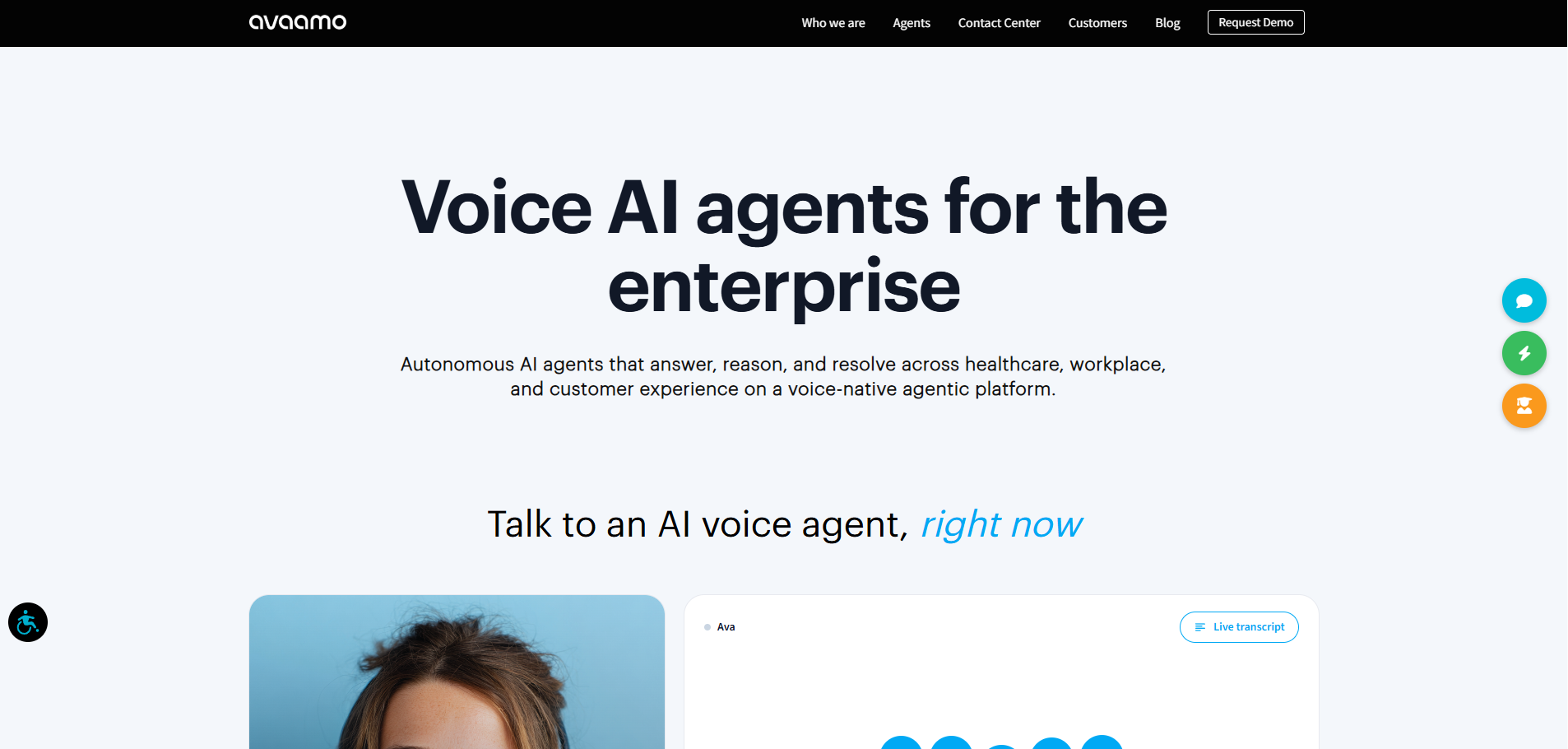
Best for enterprises that want a specialist conversational AI platform for healthcare, workplace, and customer experience use cases, with strong emphasis on voice agents, contact center AI, agent copilot, and industry-specific workflows.
Score: 6.6/10. Strong deep-learning approach (8/10), domain-specific models (8/10), and enterprise CCaaS integration (7/10). Scored lower on deployment flexibility (5/10, cloud and private cloud only), governance depth (5/10), and time-to-deployment (5/10).
Product Overview
Avaamo is an enterprise conversational AI platform focused on voice-native agents across healthcare, workplace, and customer experience. Its current public positioning emphasizes autonomous AI agents, Contact Center AI, Agent Copilot, Conversational Intelligence, healthcare agents, digital care agents, and ambient AI for clinical documentation.
Avaamo is still a direct Watson Assistant alternative for regulated enterprises, but the stronger framing is healthcare and enterprise voice specialization, not “deep-learning specialist.” Its public materials still reference deep learning and neural networks, but that language now feels secondary to its agentic AI and healthcare workflow positioning.
Pros and Cons
Pros:
- Specialist platform for healthcare, workplace, and customer experience voice agents.
- Strong healthcare, insurance, and financial services references.
- Private cloud deployment for enterprise.
- Specialized rather than broad platform positioning.
Cons:
- Smaller integration footprint than Watson, Kore.ai, or Cognigy.
- Custom enterprise pricing without public rate card.
- No genuine on-premises or air-gapped deployment.
- Lower market visibility than larger platform vendors
Pricing
Custom enterprise pricing. Sales-led with volume and use-case-based licensing.
Setup
Weeks to months for production deployments, depending on domain model customization.
Tradeoffs
Strong specialist alternative to Watson Assistant for enterprises that want healthcare, workplace, or contact-center voice automation with domain-specific workflows.
Avaamo has a narrower market footprint than IBM, Microsoft, Google, Kore.ai, or Cognigy, but its focus on healthcare and enterprise voice makes it more relevant for buyers in those specific domains.
#9. Boost.ai: Best IBM Watson Alternative for Banking and Finance
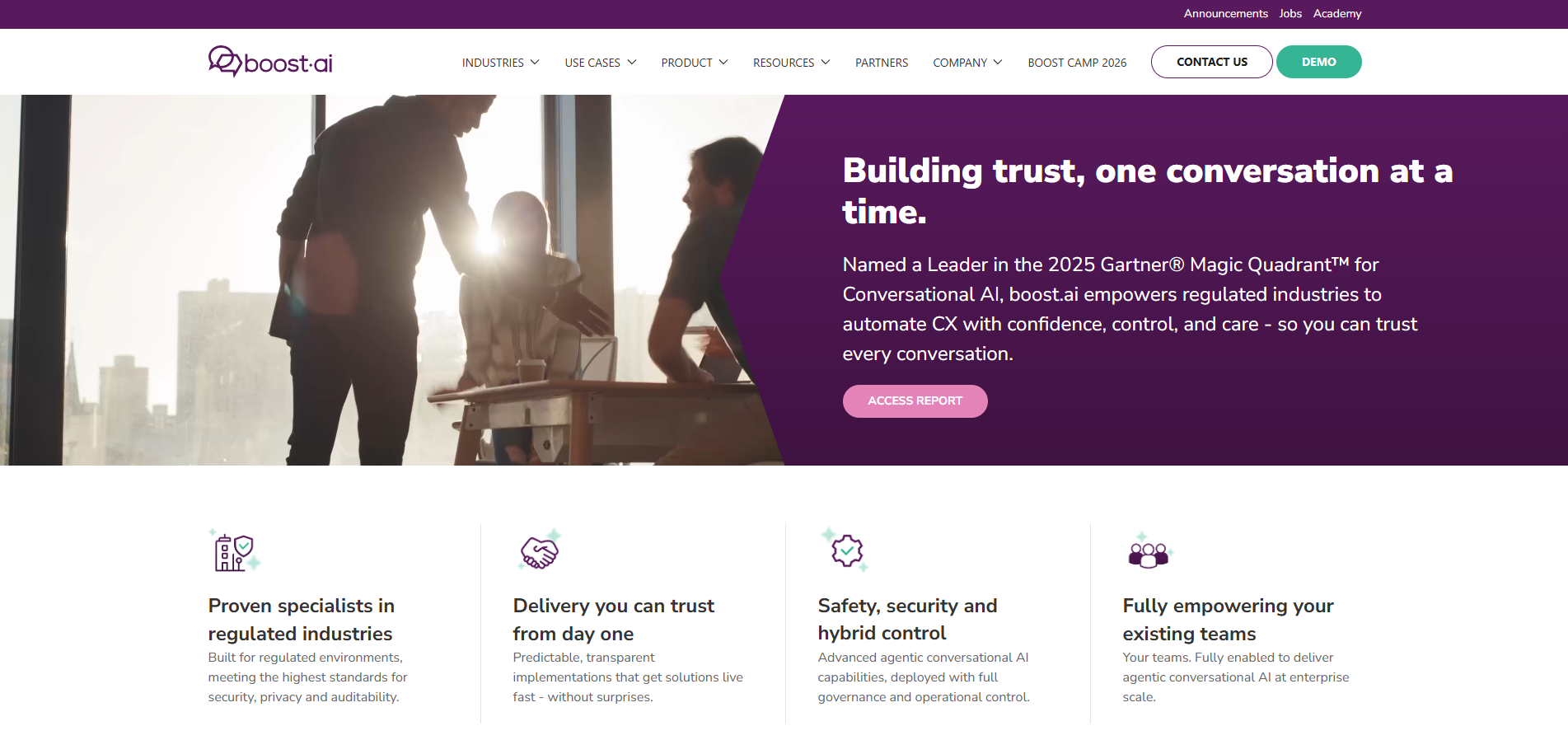
Best for European and Nordic banking and financial services enterprises wanting a BFSI-specialist conversational AI platform with strong vertical references and on-premises deployment, as a Watson Assistant alternative that goes deeper on the banking use case.
Score: 6.8/10. Strong BFSI vertical specialization (9/10), Nordic banking references (8/10), and on-premises deployment (7/10). Scored lower on global reach outside Europe (5/10), pricing transparency (5/10), and multi-vertical coverage (5/10).
Product Overview
Boost.ai is a conversational AI platform focused on regulated industries, especially financial services, insurance, telecom, and public sector. It combines traditional NLU with generative and agentic capabilities, and supports chat, voice, self-service, internal support, and agent assist.
Pros and Cons
Pros:
- BFSI vertical specialist with deep banking references.
- Strong Nordic and European bank deployments.
- Regulated-industry governance, security, auditability, and hybrid-control positioning.
- Vertical-specific accelerators for banking core systems.
Cons:
- Narrower vertical focus than Watson Assistant's multi-vertical platform.
- Less global reach outside Europe.
- Custom enterprise pricing without a public rate card.
- Smaller integration ecosystem than the broader enterprise platforms.
Pricing
Custom enterprise pricing. Sales-led with banking-specific licensing models.
Setup
Weeks for vertical accelerators. Months for custom banking core integration.
Tradeoffs
Strongest banking-specific alternative to Watson Assistant for European and Nordic BFSI deployments.
Trades Watson's multi-vertical breadth for deeper banking specialization.
Best when the AI agent will primarily serve banking workflows rather than a broader enterprise conversational AI portfolio.
#10. Botpress: Best IBM Watson Alternative for No-Code Design Teams
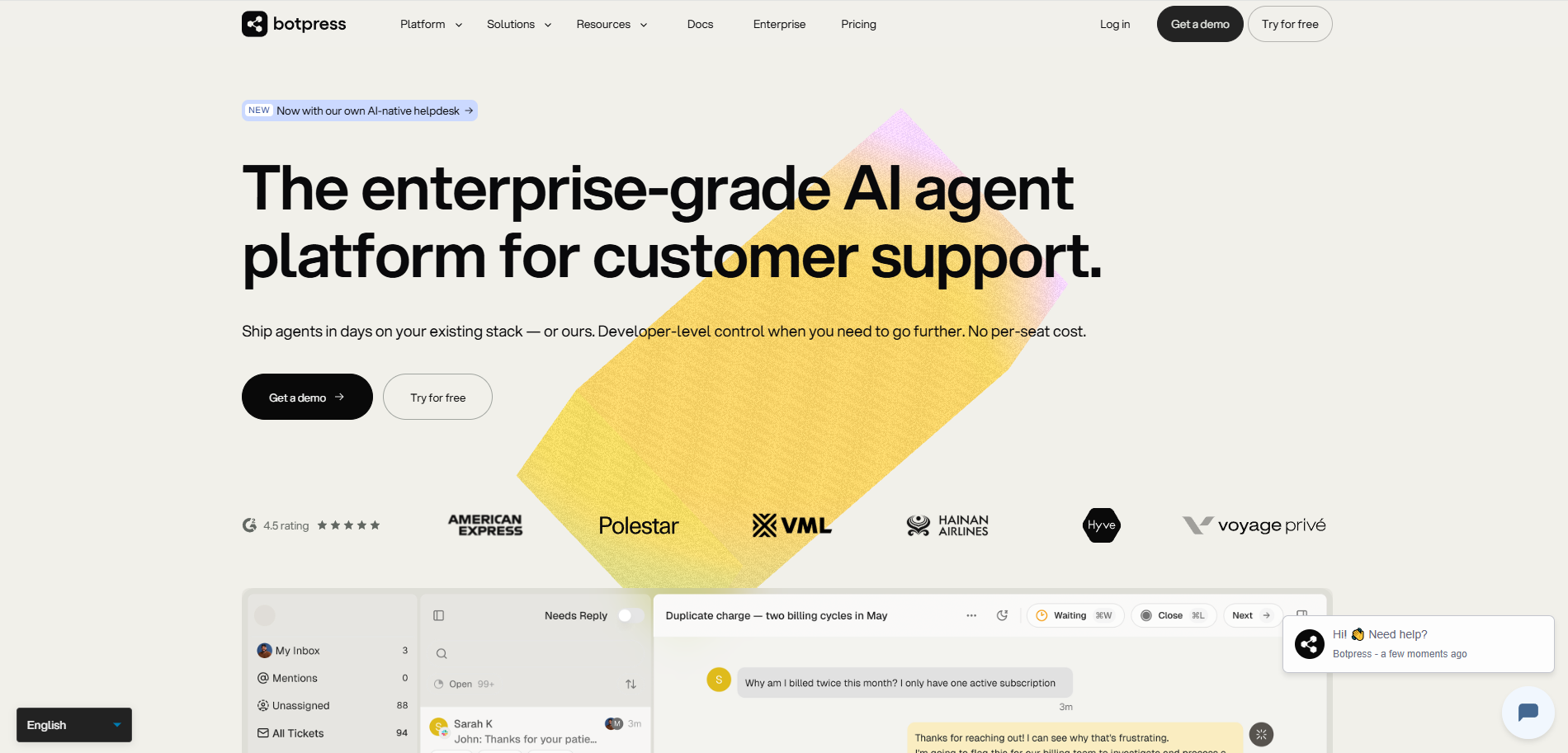
Best for design-led teams wanting an LLM-agnostic visual agent builder with 100+ pre-built integrations, as a managed no-code alternative to Watson Assistant's web-based authoring environment for organizations without IBM Cloud commitments.
Score: 6.8/10. Strong prototyping speed (9/10) and LLM flexibility (9/10). Scored lower on governance (4/10), deployment (3/10, self-hosted v12 OSS sunset), voice (2/10), and enterprise readiness (5/10).
Product Overview
Botpress is a hosted AI agent platform with visual Studio, workflows, knowledge bases, tables, custom code, APIs, integrations, analytics, human handoff, and an Agent Development Kit for building agents in TypeScript. It is stronger than a pure no-code chatbot tool, but lighter than enterprise platforms built around regulated deployment, contact-center voice, and deep governance.
Botpress supports multiple LLM providers through AI Spend, which is billed at provider cost without markup. Botpress v12 and all self-hosted versions have been officially sunset; all new development is on Botpress Cloud.
Pros and Cons
Pros:
- Fast prototyping with visual builder for design teams.
- LLM-agnostic (no model lock-in).
- Visual building plus custom code, APIs, integrations, and TypeScript ADK.
- 100+ pre-built integrations.
Cons:
- Self-hosted v12 open-source officially sunset.
- No native voice capability.
- Message-based pricing unpredictable at scale.
- Less governance depth than enterprise platforms.
Pricing
Free (500 messages). Plus $79/month. Team $495/month. Enterprise custom.
Setup
Hours for initial bots. Days for production with integrations.
Tradeoffs
Botpress is faster and more flexible than Watson Assistant for teams that want hosted visual building with developer escape hatches.
The tradeoff is enterprise operating depth: Botpress Cloud is easier to start, while IBM Watson has stronger fit for IBM-standardized enterprises, and Rasa has stronger fit for teams that want the agent platform integrated into their own engineering and deployment workflow.
#11. LangChain / LangGraph: Best IBM Watson Alternative for Developer-Led Custom Builds
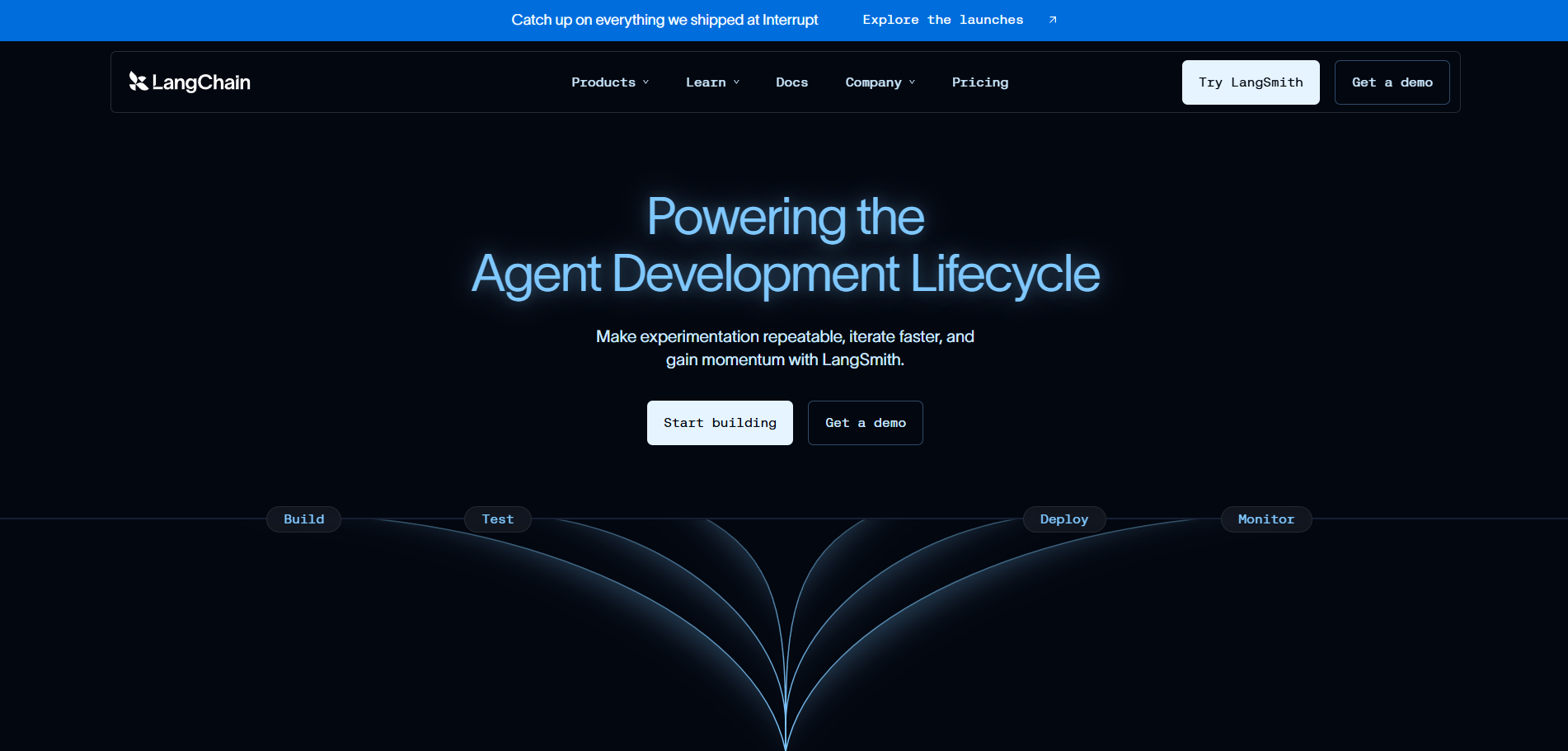
Best for engineering-led teams (typically 5+ AI engineers) that want maximum framework flexibility for custom agent builds, as a Watson Assistant alternative when the team wants to own every layer of the agent stack rather than configure inside IBM's managed platform.
Score: 7.6/10. Strongest open source LLM agent framework (10/10), maximum developer flexibility (10/10), and LangGraph for stateful workflows (9/10). Scored lower on time-to-production governance (5/10), native voice (3/10), and enterprise primitives (5/10).
Product Overview
LangChain and LangGraph are open-source frameworks for engineering teams building custom LLM applications and agents. LangChain provides the core building blocks for models, tools, retrieval, prompts, and integrations. LangGraph adds stateful graph orchestration, persistence, human-in-the-loop patterns, and multi-agent workflows. LangSmith adds tracing, evals, monitoring, deployment, prompt tooling, and agent engineering workflows.
LangChain is a strong Watson Assistant alternative when the buyer wants to build a custom agent stack instead of adopting another managed conversational AI platform.
Pros and Cons
Pros:
- Large open-source LLM agent ecosystem with strong developer adoption.
- Maximum developer flexibility with no platform constraints.
- LangGraph for stateful production agent workflows.
- MIT license, no vendor lock-in.
Cons:
- Teams own the surrounding production layer: hosting, auth, RBAC, evaluations, monitoring, release process, governance, and incident response.
- No native voice channel.
- No packaged conversation operating model for enterprise customer-service journeys.
- Enterprise controls depend on LangSmith Enterprise or customer-built infrastructure around the open-source framework.
Pricing
LangChain and LangGraph free under MIT license. LangSmith observability from $39/seat/month. LangGraph Platform custom enterprise.
Setup
Hours for prototypes. Weeks to months for production-grade deployments with governance and monitoring layers.
Tradeoffs
LangChain / LangGraph is the best Watson alternative when the team wants to build the agent stack itself. The upside is maximum flexibility and open-source control.
The tradeoff is that the team owns more of the production system around the framework, including deployment, observability, testing, governance, and channel experience.
#12. Sierra: Best IBM Watson Alternative for Premium Customer Service AI
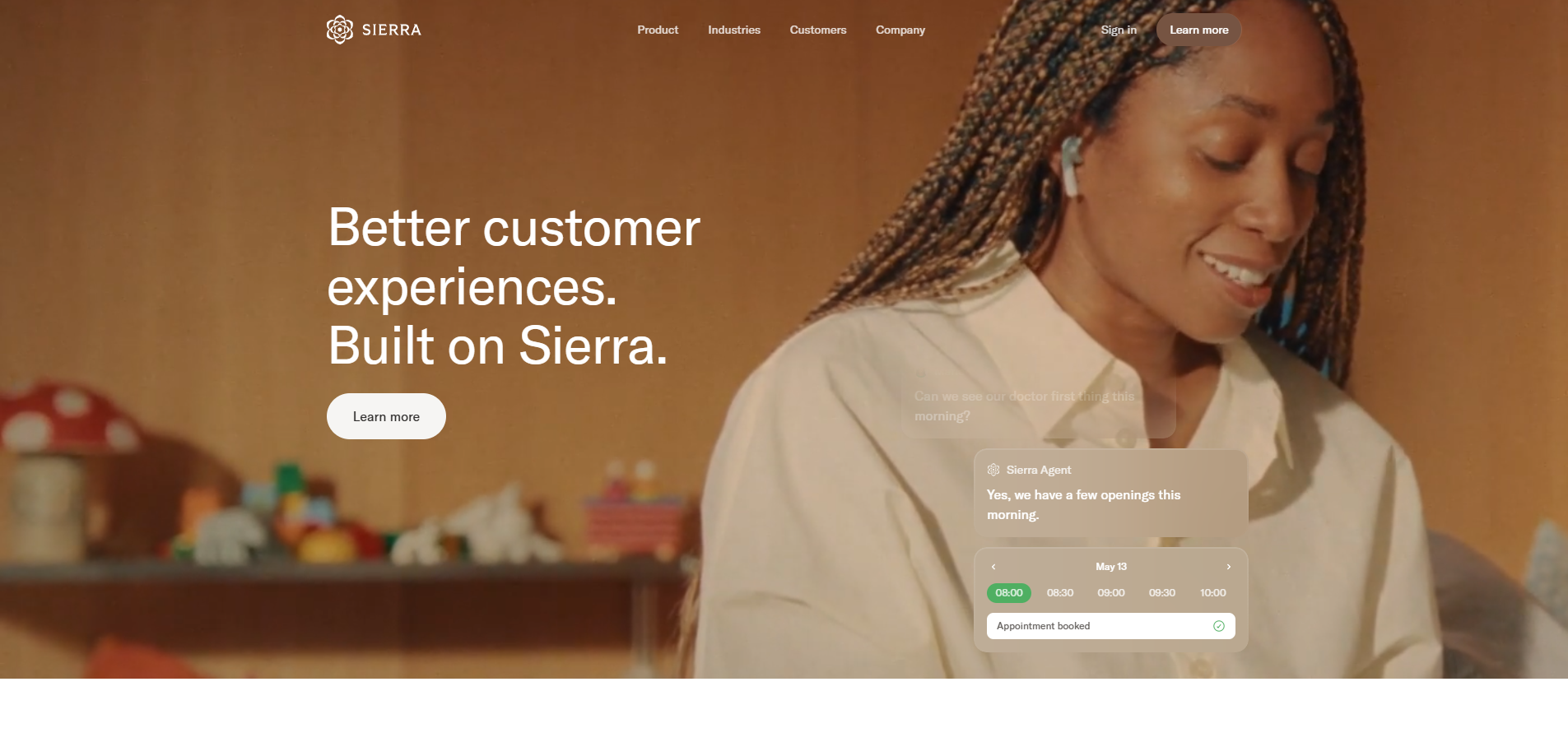
Best for large customer-service teams that want a managed AI agent platform with outcome-based pricing, as a Watson Assistant alternative for organizations where the AI agent must sound like the brand and white-glove vendor delivery is the procurement preference.
Score: 7.8/10. Strong reasoning quality (9/10), enterprise consumer brand reference list (9/10), and governance controls (8/10). Scored lower on deployment flexibility (3/10, vendor cloud only), pricing transparency (4/10), and implementation speed (5/10).
Product Overview
Sierra is an AI agent platform for customer experience, founded by Bret Taylor and Clay Bavor. Its product suite includes Agent OS, Agent Studio, Ghostwriter, Agent Data Platform, Explorer, Insights, Channels, and Live Assist. Agent Studio lets teams define journeys, connect knowledge, build integrations, test with simulations, inspect traces, and manage brand controls.
Pros and Cons
Pros:
- Premium consumer brand reference list.
- Outcome-based pricing tied to resolutions.
- Experienced founding team and strong investor backing.
Cons:
- Managed platform model
- Premium pricing ($200K+/year typical).
- Vendor-led implementation model, which may fit CX teams but gives customers less direct platform ownership than developer-led approaches.
- Depends on integrations with customer systems of record, knowledge bases, contact-center tools, and helpdesk platforms.
Pricing
Custom outcome-based pricing. $200K+/year typical based on public reporting. Year-one budgets of $200K-$350K common for enterprise consumer brand deployments.
Setup
3-7 months for enterprise implementations per public reporting.
Tradeoffs
Sierra is a strong Watson Assistant alternative for customer-service teams that want a managed AI agent platform with premium CX tooling and vendor-led delivery.
The tradeoff is the operating model: Sierra is built around a managed platform and outcome-based commercial model, while Watson fits IBM-standardized enterprises and Rasa fits teams that want the agent platform to become part of their own engineering and service operation.
Why Choose IBM Watson Alternatives
There are several reasons to choose IBM Watson alternatives. Let’s take a look at these:
Pricing Predictability Decoupled From IBM Cloud Consumption
Watson Assistant enterprise contracts typically reach $100,000+/year at production scale, plus IBM Cloud subscription, watsonx Discovery per-query charges, and IBM Cloud Pak for Data licensing for on-premises deployments via IBM Software Hub on Red Hat OpenShift.
For FinOps teams modeling three-year TCO across tens of millions of voice and chat interactions, this multi-component IBM ecosystem consumption surface makes forecasting hard. Rasa uses predictable annual conversation-volume licensing.
Cognigy uses transparent platform-plus-usage pricing. Kore.ai uses custom enterprise contracts comparable to Watson.
Deployment Flexibility Without IBM Software Hub Dependency
Watson Assistant offers on-premises deployment but requires IBM Software Hub on Red Hat OpenShift as the upstream platform.
For enterprises with sovereign cloud or sector-specific regulations that prohibit IBM Cloud and OpenShift estate, this is a hard disqualifier.
Rasa is the clearest fit in this list for self-hosted, private-cloud, and air-gapped deployment without IBM Software Hub or Red Hat OpenShift as the upstream platform. Cognigy also has enterprise deployment options for Voice Gateway. Kore.ai deployment options depend more on product line and contract.
Independence From watsonx Discovery, IBM Cloud, and IBM Ecosystem Hard Dependencies
A production Watson Assistant deployment pulls in adjacent IBM services as hard dependencies: watsonx Discovery for knowledge retrieval, IBM Cloud for hosting, IBM Speech-to-Text and Text-to-Speech for voice, and IBM Cloud Pak for Data for on-premises orchestration.
The more an implementation depends on IBM Cloud, Discovery, Speech, and Software Hub, the more migration becomes an ecosystem move rather than an enterprise chatbot solutions replacement. Rasa, Kore.ai, Cognigy, Amazon Lex (AWS), Microsoft Copilot Studio (Azure), Google Dialogflow (GCP), and the open-source alternatives all operate independently of the IBM ecosystem.
Strategic Independence From IBM's watsonx Orchestrate Pivot
IBM has increasingly shifted focus toward watsonx Orchestrate, which expands beyond chat into multi-agent workflow automation.
For enterprises that bought into watsonx Assistant as the chat-centric platform, this strategic pivot creates roadmap uncertainty.
Enterprises signing multi-year Watson Assistant contracts should evaluate where IBM's product investment will land across the next two strategic generations.
Architectural Governance for Regulated Voice and Chat Workloads
Watson Assistant’s generative answer fallback can accelerate FAQ-style and knowledge-grounded use cases. In regulated workflows, teams still need to show what the agent did, why it did it, which backend actions were called, and where stricter process controls apply.
Rasa’s Orchestrator gives teams a clearer operating model for this: flexible agent behavior where natural conversation matters, and stricter controls where the use case requires them, such as required steps, approvals, policy checks, backend actions, handoffs, or exact wording.
Native Multi-Channel Voice + Chat Without a Stitched IBM Pipeline
Watson voice deployments may involve multiple IBM and telephony components, including speech recognition, conversation logic, retrieval, generative responses, text-to-speech, and contact-center integration. That can work, but teams need to model latency, cost, monitoring, and operational complexity across the full stack.
Rasa supports voice and digital channels through the same agent operating model. Voice deployments can use connectors such as Twilio Media Streams, AudioCodes, Genesys Cloud, and Jambonz, with ASR and TTS providers configured as part of the deployment. The important difference is not that Rasa is a standalone voice API. It is that voice can share the same orchestration, backend actions, governance, testing, and release process as digital channels.
Code-as-Source-of-Truth Authoring Beyond IBM's Web-Based Skill Builder
Watson Assistant is positioned with a web-based skill builder. That accelerates initial deployment, but engineering teams building complex production agents repeatedly hit the ceiling: limited unit-testability, version control bolted on rather than first-class, and code-as-source-of-truth as a workaround rather than the default.
Rasa is strongest here because the agent logic can live in the engineering workflow: codebase, version control, CI/CD, tests, review, and controlled releases. Other platforms provide developer tooling to different degrees, but Rasa makes code-as-source-of-truth central to the operating model.
How to Choose the Right IBM Watson Alternative
Step 1: Map Current watsonx Assistant Usage by Agent, Channel, and Billing Component
Inventory every watsonx Assistant skill in production or pilot.
For each document: the deployment model (IBM Cloud, IBM Software Hub on Red Hat OpenShift), the channel (web chat, mobile, voice, WhatsApp), the billing components consuming usage (Watson Assistant license, watsonx Discovery per-query, IBM Cloud compute and storage, IBM Speech services), and the monthly cost.
This is the baseline for comparing TCO against alternatives.
Step 2: Identify Hard Requirements Your Auditors Won’t Let IBM Satisfy
List the requirements where Watson Assistant's IBM Cloud delivery, watsonx Discovery dependency, or IBM Software Hub on Red Hat OpenShift on-premises model are disqualifiers.
Typical examples: hyperscaler-independent self-hosted deployment, data residency in non-IBM jurisdictions, multi-cloud strategy without IBM ecosystem dependency, deterministic flow auditability per turn, and contractual constraints on IBM Cloud subscription.
Step 3: Score Alternatives on Deployment, Pricing Model, Governance, Voice Readiness, and Migration Cost
Build a scoring matrix with five dimensions: deployment (cloud, hybrid, on-prem, air-gapped), pricing model (annual conversation volume vs. per-component consumption), governance (RBAC, audit, multi-agent portfolio control), voice readiness (native channel vs. stitched pipeline), and migration cost (effort to rebuild intents, entities, dialog nodes, integrations).
Score each alternative against your actual constraints, not feature parity alone.
Step 4: Run a 30-Day Proof of Value With a Real Production Journey
Build a real production journey on the top two alternatives. Track containment rate, escalation quality, edge case behavior, integration failure handling, voice latency for contact center workloads, and total cost at projected annual volume.
A polished demo is not enough. A proof of value should test the exact production journey, integration path, cost model, fallback behavior, and operational workflow the team will actually run.
Step 5: Decide Based on Three-Year TCO and Operational Ownership
Model the three-year TCO across all alternatives, including: platform license, per-interaction or per-component consumption, voice channel costs, integration engineering, roadmap and migration risk across IBM’s assistant, watsonx, Discovery, Speech, and Orchestrate portfolio, and the operational cost of running the platform in your environment.
Decide based on the operating model the team can sustain for the next three years: cost, deployment, governance, integration depth, release process, and who owns the agent when real users start using it.
Key Features to Look for When Exploring IBM Watson Competitors
On-Premises, Hybrid, and Air-Gapped Deployment Without IBM Software Hub Dependency
Agent data stays in your environment without the Red Hat OpenShift upstream platform requirement that Watson Assistant on-premises deployment carries.
Critical for BFSI, healthcare, government, and any organization with sovereign cloud or air-gapped mandates outside the IBM ecosystem.
Rasa is the clearest option in this list for self-hosted, private-cloud, and air-gapped deployment without IBM Software Hub or Red Hat OpenShift as the upstream platform. Some other enterprise vendors offer private-cloud, hybrid, or dedicated deployment options, but these vary by product line and contract.
Predictable Enterprise Licensing Decoupled From Per-Component IBM Consumption
Annual conversation-volume licensing, as used by Rasa, makes the core platform cost easier to model than per-request or per-component consumption. For any IBM alternative, buyers should also model speech, retrieval, channels, infrastructure, implementation, and ongoing operations.
Watson Assistant's typical $100,000+/year enterprise contracts plus IBM Cloud subscription, watsonx Discovery per-query charges, and IBM Cloud Pak for Data licensing create a multi-component consumption surface that requires per-component monitoring.
Native Voice and Chat Orchestration From a Single Layer
Voice and chat should share the same orchestration layer, conversation state, and skill library. A customer starts in chat, switches to voice, and picks up exactly where they left off.
Rasa supports voice and digital channels through reusable skills, shared state, and connectors for enterprise voice environments. Cognigy is also strong for contact-center voice automation through Voice Gateway.
Watson voice deployments may involve multiple IBM and telephony services, including speech recognition, conversation logic, retrieval, generative response, text-to-speech, and contact-center integration. Buyers should test latency, cost, and monitoring across the full stack.
Clear Control Boundaries Between Guided Steps and Generative Behavior
Compliance teams need to understand where the agent can behave flexibly and where the process must follow defined steps. Look for platforms that let teams apply stricter controls where the use case requires them: policy checks, required steps, backend actions, approvals, handoffs, and exact wording. Rasa is strongest here when teams want those controls to live inside an engineering-owned operating model.
Engineering-Grade Authoring: Code-as-Truth, Version Control, CI/CD, Unit Tests
Conversation logic should live in code, not exclusively in a managed web-based skill builder.
Version control via Git, programmatic CI/CD for flow deployment, unit testing of dialogue policy, and code review for production changes.
Rasa is strongest here because agent logic can live in the engineering workflow: codebase, version control, CI/CD, tests, review, and controlled releases. Developer-led frameworks such as LangGraph also support code-first builds, while enterprise platforms vary in how deeply they support code-as-source-of-truth.
Granular RBAC, Audit Logging, and Data Residency Controls for Regulated Industries
Per-user, per-role access controls. Structured traces and audit logs should show what happened in the conversation, what tools or backend actions were called, what data was used, and which policy or handoff path applied.
Data residency controls aligned to your sovereign and regulated-vertical requirements (BFSI, healthcare, government, telco).
Multi-Agent Governance for Portfolios of Agents Across Departments
Enterprise workflows need multiple agents coordinating with shared state, clean handoffs, and unified memory across IT, HR, customer service, and contact center.
Rasa’s reusable skills and orchestration model are a better fit when multiple teams need to build, reuse, govern, and improve agent capabilities across channels. Watson Assistant can support multiple assistants and skills, but buyers should test how well the model scales across a coordinated portfolio of agents, teams, and shared business processes.
Open Extensibility for Models, Channels, Tools, and Observability
Configuration menus hit a ceiling. Look for platforms where engineers can connect custom APIs, tools, MCP servers, channels, model providers, storage, and observability systems. Rasa is strongest when the agent platform needs to fit the customer’s existing architecture rather than forcing the customer to reshape around the vendor’s cloud ecosystem.
Rasa provides engine-level extensibility across every module without IBM Cloud constraints.
FAQs
What are the main limitations of IBM watsonx Assistant that lead enterprises to evaluate alternatives?
Common reasons include IBM ecosystem dependency, installed deployment through IBM Software Hub on Red Hat OpenShift, multi-component pricing across assistant usage, cloud services, search/retrieval, speech, and infrastructure, voice architecture complexity, and uncertainty about how watsonx Assistant fits into IBM’s broader watsonx Orchestrate strategy.
Is IBM watsonx Assistant being deprecated in favor of watsonx Orchestrate?
Not deprecated. IBM still supports watsonx Assistant, but its public AI agent strategy increasingly centers on watsonx Orchestrate. IBM has increasingly shifted focus toward watsonx Orchestrate, which expands beyond chat into multi-agent workflow automation.
IBM now publicly positions watsonx Orchestrate as an agentic control plane for building, deploying, governing, and coordinating AI agents across enterprise systems.
Watson Assistant continues to be supported, but enterprises signing multi-year contracts should evaluate where IBM's strategic investment will land across the next product generations.
What is the difference between IBM Watson Assistant and watsonx Assistant?
Watson Assistant was rebranded to watsonx Assistant as part of IBM's broader watsonx ecosystem rollout.
The watsonx ecosystem includes watsonx.ai (foundation models), watsonx Assistant (conversational AI), watsonx Discovery (knowledge retrieval), and watsonx Orchestrate (multi-agent workflow automation).
The platform capabilities are largely continuous; the rebrand reflects positioning within the broader watsonx product strategy.
How does IBM watsonx Assistant pricing work in 2026?
Watson Assistant pricing is opaque, with custom enterprise contracts typically reaching $100,000+/year at production scale.
Depending on the architecture, additional costs can include IBM Cloud resources, search or retrieval services, speech services, telephony, and IBM Software Hub / Cloud Pak for Data infrastructure for installed deployment on Red Hat OpenShift.
Three-year TCO modeling requires per-component monitoring.
Does IBM watsonx Assistant support on-premises deployment?
Yes, but with conditions. Watson Assistant on-premises deployment is available via IBM Software Hub on Red Hat OpenShift.
For enterprises with sovereign cloud, air-gapped, or non-OpenShift infrastructure requirements, this upstream platform dependency can become a procurement blocker.
Rasa offers self-hosted, on-premises, and air-gapped deployment without IBM Software Hub or Red Hat OpenShift as upstream platform requirements.
Which IBM Watson alternatives offer on-premises or hybrid deployment?
Rasa deploys self-hosted from day one with on-premises, private cloud, and air-gapped options without IBM Software Hub or Red Hat OpenShift dependency.
Cognigy has enterprise deployment options for Voice Gateway. Kore.ai and Boost.ai should be evaluated by product line and contract for private, hybrid, or dedicated deployment needs.
Yellow.ai offers private cloud deployment for enterprise customers.
Microsoft Copilot Studio, Google Dialogflow, Amazon Lex, Botpress, Sierra, and most cloud-first alternatives are cloud-only.
Which IBM Watson alternative is best for avoiding hyperscaler lock-in?
Rasa offers the clearest path to hyperscaler-independent deployment in this list: self-hosted, private-cloud, and air-gapped options, no IBM Cloud subscription, no watsonx Discovery dependency, no upstream IBM Software Hub or Red Hat OpenShift requirement, and freedom to use your own identity, infrastructure, and observability stack.
For enterprises wanting a comparable managed-platform pattern outside IBM, Cognigy, Kore.ai, and Yellow.ai all run independently of IBM Cloud.
Microsoft Copilot Studio, Google Dialogflow, and Amazon Lex trade IBM lock-in for Microsoft, Google, or AWS lock-in, respectively.
Are there any open-source IBM Watson alternatives?
Yes. Rasa offers an open framework model with a free Developer Edition (1,000 conversations/month, full platform access) as the strongest open-source enterprise conversational AI platform alternative.
LangChain and LangGraph are MIT-licensed open source agent frameworks for developer-led custom builds.
Botpress historically offered an open-source self-hosted path (v12) but has deprecated it in favor of cloud delivery. For teams that want an enterprise conversational AI platform with an open-framework development model, Rasa is the most mature option in this list.
Rasa vs IBM watsonx Assistant: which should enterprises choose in 2026?
Choose Watson Assistant if your enterprise is already standardized on IBM Cloud with watsonx Discovery and IBM Speech services in place, your primary use case is regulated-industry conversational AI with managed IBM infrastructure, IBM Software Hub on Red Hat OpenShift is acceptable for on-premises, and IBM ecosystem dependency is acceptable.
Choose Rasa if you need customer-controlled deployment, hyperscaler-independent self-hosting without IBM Software Hub or Red Hat OpenShift upstream, regulated-vertical governance, voice and digital channels in one operating model, and pricing decoupled from IBM Cloud and watsonx Discovery consumption.
How does Rasa compare to IBM watsonx Assistant for regulated industry deployments?
Rasa deploys self-hosted from day one with on-premises and air-gapped options without IBM Software Hub or Red Hat OpenShift dependency. Rasa does not host any customer data.
The patented Orchestrator gives teams a clearer way to manage agent behavior across flexible conversation, required steps, backend actions, policy checks, handoffs, and exact responses where the use case requires stricter control.
Watson Assistant offers managed IBM compliance certifications but requires IBM Cloud or IBM Software Hub on Red Hat OpenShift deployment.
For BFSI, healthcare, government, and telco-regulated deployments where IBM ecosystem dependency is unacceptable, Rasa is the stronger fit.
Which IBM Watson alternatives support both voice and chat natively?
Rasa supports voice through connectors for Twilio Media Streams, AudioCodes, Genesys Cloud, and Jambonz, with voice and digital channels sharing the same agent operating model. Cognigy supports voice through Voice Gateway. Kore.ai and Yellow.ai both support voice and broad omnichannel automation.
Amazon Lex offers voice via AWS Connect plus chat. Microsoft Copilot Studio supports voice via Azure Speech Services plus chat. Google Dialogflow supports voice via CCAI plus chat.
Botpress and LangChain / LangGraph are not voice-first contact-center platforms. Voice use cases usually require additional channel, telephony, or custom integration work.
How do enterprises migrate off IBM watsonx Assistant without rebuilding from scratch?
Three-phase migration pattern:
(1) Inventory existing Watson Assistant artifacts: skills, intents, entities, training phrases, dialog nodes, and webhook integrations. Watson Assistant provides export formats.
(2) Map each artifact to the target platform’s primitives. For Rasa, that usually means treating Watson intents, entities, dialog nodes, webhooks, and Discovery content as inputs to a redesigned agent structure, not a one-to-one import.
(3) Run both platforms in parallel during the proof-of-value window on a limited production journey or controlled traffic slice before cutting over channels.
Expect a staged migration. Timeline depends on the number of assistants, dialog complexity, channels, integrations, knowledge sources, compliance review, and whether the target platform is replacing only chat or the broader agent operating model.
.png)
.png)
.png)