Teams evaluating an AI customer service platform ask the same three questions: can we self-host, can our team own it, and what does it actually cost? Here's how Rasa compares on the dimensions that decide enterprise deals

Botpress






Two platforms, two opposite philosophies
Visual AI agent platform built for fast agent creation. Strong Studio experience, Autonomous Nodes, Knowledge Bases, variables, tables, integrations, emulator testing, and clear prompt/token/cost inspection. Best fit for teams that want to build and ship web-first agents quickly, especially where cloud deployment, usage-based pricing, and a visual workflow model are acceptable.

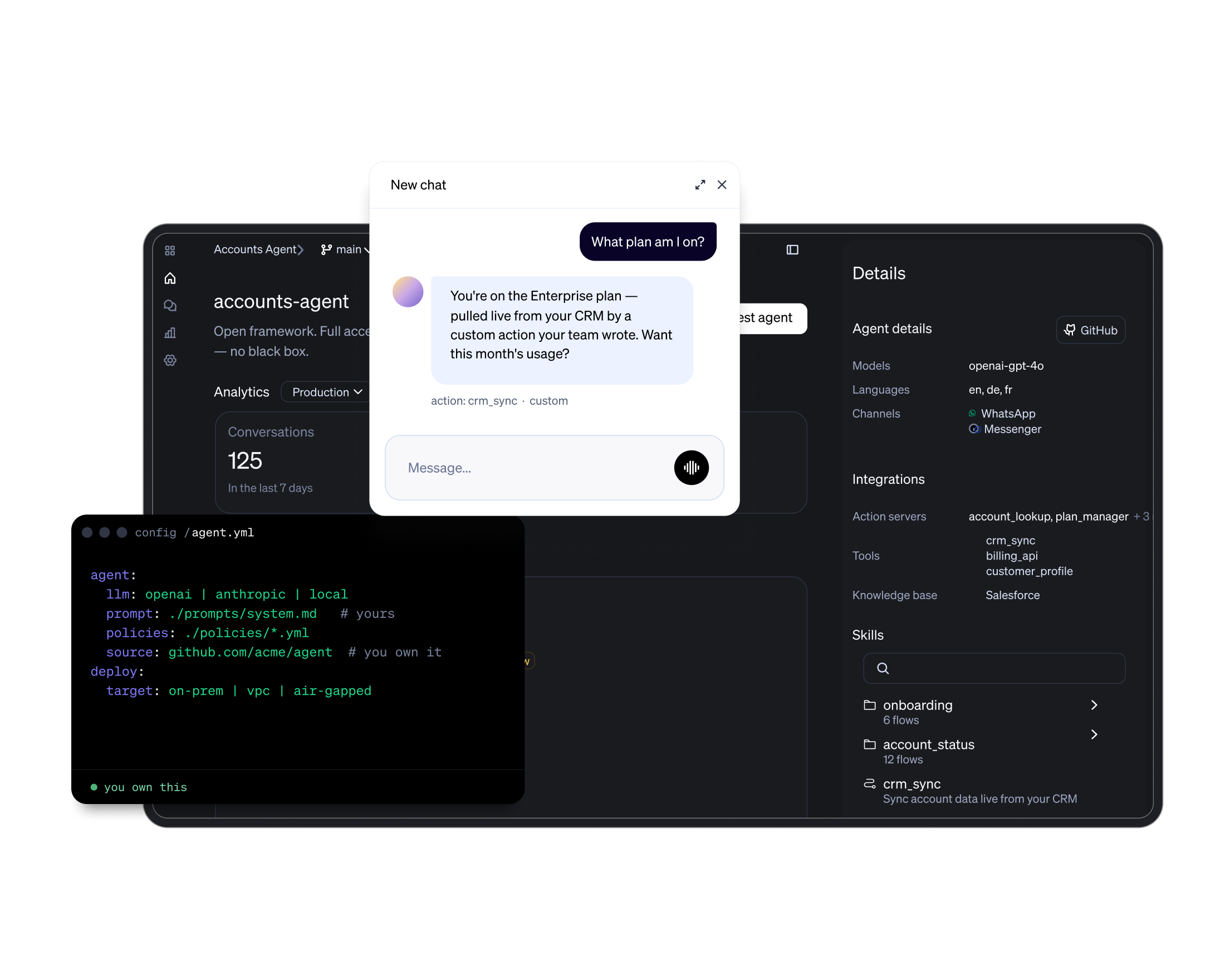
Rasa is an enterprise conversational AI platform built on a self-hosted, developer-owned architecture. Patented dialogue management (CALM) delivers guided governance: business logic controls high-risk actions through explicit policies, regardless of LLM output. Native voice (Twilio, AudioCodes, Genesys), 100% on-prem or private cloud, transparent conversation-volume pricing. Customers include N26, Deutsche Telekom, Helvetia, Autodesk.
One platform for voice and chat, running in your environment
Rasa runs the same guided-governance engine across phone and chat, fully self-hosted. Your team configures flows, policies, and integrations directly, with no managed-service dependency.
- Native voice over Twilio, AudioCodes, and Genesys, sharing context with chat.
- Explicit policies control high-risk actions on regulated workflows, regardless of LLM output.
- Deploy on-prem, in private cloud, or air-gapped, with no customer data leaving your perimeter.
Side-by-side on the dimensions that decide enterprise deals
Our methodology
This comparison draws on user reviews from G2, Capterra, TrustRadius, and GetApp, combined with vendor documentation, published pricing, enterprise buyer interviews, and production deployment research.
Our research methodology separates verified platform capabilities from vendor marketing claims. We review product documentation, pricing pages, and feature releases from both vendors directly. We analyze user reviews across G2, Capterra, TrustRadius, and GetApp for real-world deployment patterns, common friction points, and switching stories. We cross-reference with enterprise buyer interviews focused on regulated industries (banking, telco, healthcare, government) where self-hosted deployment and governance architecture are hard gates.
Conflict of interest disclosure: This comparison is published on Rasa's website. Rasa is a commercial conversational AI platform and stands to benefit from enterprises choosing its platform. We address this by (1) publishing genuine Botpress strengths in the Steel Man section, (2) using factual vendor documentation as the primary evidence, and (3) maintaining a monthly review cadence to reflect platform changes on both sides.
This page is updated monthly. Last comprehensive review: April 2026. Verified against Botpress Cloud and Enterprise documentation, Rasa Enterprise documentation, and current pricing on both vendor pricing pages.
The dimensions, side by side
Primary Philosophy and Positioning
Rasa and Botpress both serve developers building AI agents, but they optimize for different targets. Botpress gets you to a prototype fast. Rasa gets you to production safely. The difference is the Orchestrator, a patented dialogue management layer that gives teams control over how agents reason, orchestrate, and operate reliably at scale.
Botpress
| Rasa
|
"Autodesk expects to handle 200 million user conversations by 2026 on Rasa. Deutsche Telekom resolves 50% of IT inquiries autonomously. N26 uses Rasa for regulated banking."
Deployment Model and Self-Hosting
Deployment model is the single most consequential difference between Rasa and Botpress for enterprise buyers. Botpress deprecated its self-hosted version and now reserves it for the Enterprise tier only. Rasa makes self-hosted available from day one without a commercial upgrade path.
Botpress
| Rasa
|
Orchestrator Architecture
Botpress gives teams two main control modes: Standard Nodes for ordered steps, and Autonomous Nodes where the LLM decides what to say and which tools to use. The tradeoff is that high-stakes behavior depends heavily on node design, tool access, prompts, schemas, and testing.
Rasa Orchestrator tracks state, context, memory, active work, and repair patterns, then generates structured commands for what should happen next. High-risk work can stay in guided skills and backend actions, while open-ended work can use autonomous skills.
Botpress
| Rasa
|
Voice Architecture and Cross-Channel Continuity
Voice architecture is the row where the difference is structural, not incremental. Botpress has no native voice capability. Rasa built voice into the core of the platform. The gap surfaces in voice-digital parity and in sovereign voice data handling.
Botpress
| Rasa
|
Enterprise Deployment and Compliance
Regulated industry deployments require a platform the compliance team will approve. Getting sign-off from a CISO in banking, healthcare, or telco involves specific gates: self-hosted deployment, data sovereignty, audit trails, RBAC, and documented compliance posture. This is the row where the prototype-to-production gap is most concrete.
Botpress
| Rasa
|
Integration Ecosystem
Botpress and Rasa both give teams practical ways to connect agents to channels, tools, and backend systems. Botpress leans toward quick setup through Hub integrations, actions, and visual configuration. Rasa leans toward customer-owned integration logic through custom actions, MCP tools, channel connectors, and backend services the engineering team controls.
Botpress
| Rasa
|
Pricing and Total Cost of Ownership
Botpress pricing is subscription plus usage. Plans include monthly limits for incoming messages/events, bots, collaborators, storage, and features, while AI Spend is billed separately based on LLM token usage at provider cost. Add-ons cover extra messages/events, bots, collaborators, table rows, storage, and Always Alive.
Rasa pricing is custom for enterprise deployments, based on the scale and requirements of the program. It fits teams buying an enterprise agent platform, not just a monthly builder plan.
Botpress
| Rasa
|
Customer Success and Support
Botpress support follows its product model: self-serve for builders, then more hands-on help as teams move into paid plans, managed implementation, or Enterprise. Rasa support is built around enterprise agent programs where architecture, deployment, integrations, governance, and ongoing optimization usually need closer partnership.
Botpress
| Rasa
|
Botpress is a good fit when the team wants a cloud-based visual builder and the use case is mostly web chat, knowledge-base support, lead capture, routing, or simple workflow automation. It gives builders a clean Studio experience, useful inspection tools, and common integrations without requiring much platform setup.
It is less suited when the agent becomes part of a regulated service operation, needs native voice, has to run inside the customer’s infrastructure, or depends on complex backend logic across multiple systems. In those cases, the early speed of a visual builder can give way to questions about deployment control, state, governance, and long-term ownership.
Which platform wins for your use case
Botpress
- Your team wants a visual cloud builder.
- Web chat is the main channel.
- The use case is routing, or internal workflow automation.
- Common integrations cover most of what you need.
- You do not need self-hosted deployment for new projects.
- Your conversation volume is moderate and per-message pricing stays predictable at your scale.
Rasa
- The agent is part of a regulated or high-volume service operation.
- Voice is a core channel, not an add-on.
- The agent needs to connect to proprietary backend systems.
- Business logic needs to run in owned code, not only visual nodes or LLM-led actions.
- Deployment location, data storage, and auditability are part of the buying decision.
- Your team needs to test, version, deploy, review, and improve the agent like production software.
More Conversational AI Comparisons
Common questions
What is the main difference between Rasa and Botpress?
Botpress is a visual cloud platform for building AI agents quickly. It gives teams Studio, workflows, Autonomous Nodes, Knowledge Bases, integrations, variables, tables, and clear prompt/token/cost inspection.
Rasa is built for enterprise-owned agents that need customer-controlled deployment, durable conversation state, backend actions, voice and digital from the same logic, and production change workflows.
Does Botpress support self-hosted deployment?
Botpress Cloud is the current path for new deployments. Botpress v12 and other self-hosted versions are no longer available for new purchase, download, or deployment.
Rasa is designed for customer-operated deployment on Kubernetes/OpenShift, including private cloud and controlled enterprise environments.
How does the Rasa Orchestrator compare to Botpress Autonomous Nodes?
Botpress Autonomous Nodes let the LLM decide what to say and which tools to call. That is flexible and fast for many support and automation use cases.
Rasa’s Orchestrator keeps more of the conversation structure explicit. It tracks state, context, active work, repair patterns, skills, tools, and handoffs, then moves the conversation forward through structured commands.
Which is better for regulated enterprise deployments, Rasa or Botpress?
Rasa, for most regulated deployments. Self-hosted from day one, the patented Orchestrator for architectural governance over agent behavior, full audit trails, RBAC, and data sovereignty by architecture make Rasa straightforward for CISO and compliance sign-off in banking, healthcare, telco, and government.
N26 uses Rasa for regulated banking. Botpress requires Enterprise-tier commitment to reach the self-hosted baseline Rasa offers by default.
Does Botpress support voice and chat natively?
Botpress can support voice through integrations and external providers, but voice is not the center of the platform architecture.
Rasa is stronger when voice is a primary channel. Voice and digital channels can share the same agent logic, state, backend actions, and production review process.
What is Botpress's pricing model?
Botpress uses a plan-and-usage model: monthly tiers, included message/event limits, bots, collaborators, storage, add-ons, and separate AI Spend for LLM usage.
Rasa Enterprise is custom-priced for production deployments based on the scale and requirements of the program.
Which platform is easier to set up?
Botpress is straightforward if the team wants to build inside a visual cloud studio.
Rasa gives teams a different setup path: prototype with natural language, then build with coding agents inside the developer tools they already use. The agent can move quickly from idea to working project without requiring the team to know every Rasa concept upfront.
The difference is the handoff after the first build. Botpress keeps the experience centered in its Studio. Rasa lets the project become owned software: code, tests, custom actions, deployment, and production review.
How does the Rasa Orchestrator reduce AI assistant costs compared to LLM-native approaches?
The Orchestrator runs LLM inference only for conversational understanding and prompt-driven skills. Guided skills handle high-stakes business logic execution in code, not through LLM calls.
LLM-native approaches run full LLM inference for logic as well, increasing token consumption per turn. The separation reduces token cost and latency per turn, which compounds at production scale across complex workflows.
Can a team migrate from Botpress to Rasa?
Yes. Teams usually migrate when the agent needs more control over deployment, voice, backend logic, state, or production change workflows.
The practical path is to carry over the use case, content, integrations, and behavior goals, then rebuild the agent in Rasa’s architecture so it can run as part of the company’s own service environment.
AI that adapts to your business, not the other way around
See Rasa in your environment
Run Rasa self-hosted with native voice, guided governance, and transparent pricing. Talk to our team about your conversational AI roadmap.