Teams evaluating an AI customer service platform ask the same three questions: can we self-host, can our team own it, and what does it actually cost? Here's how Rasa compares on the dimensions that decide enterprise deals

LangChain






Two platforms, two opposite philosophies
Python framework of composable primitives for building LLM-powered applications: LLM chaining, RAG, memory, and tool use. LangGraph adds graph-based agent orchestration. Not a deployable platform. Optimized for maximum flexibility and the broadest LLM ecosystem access.

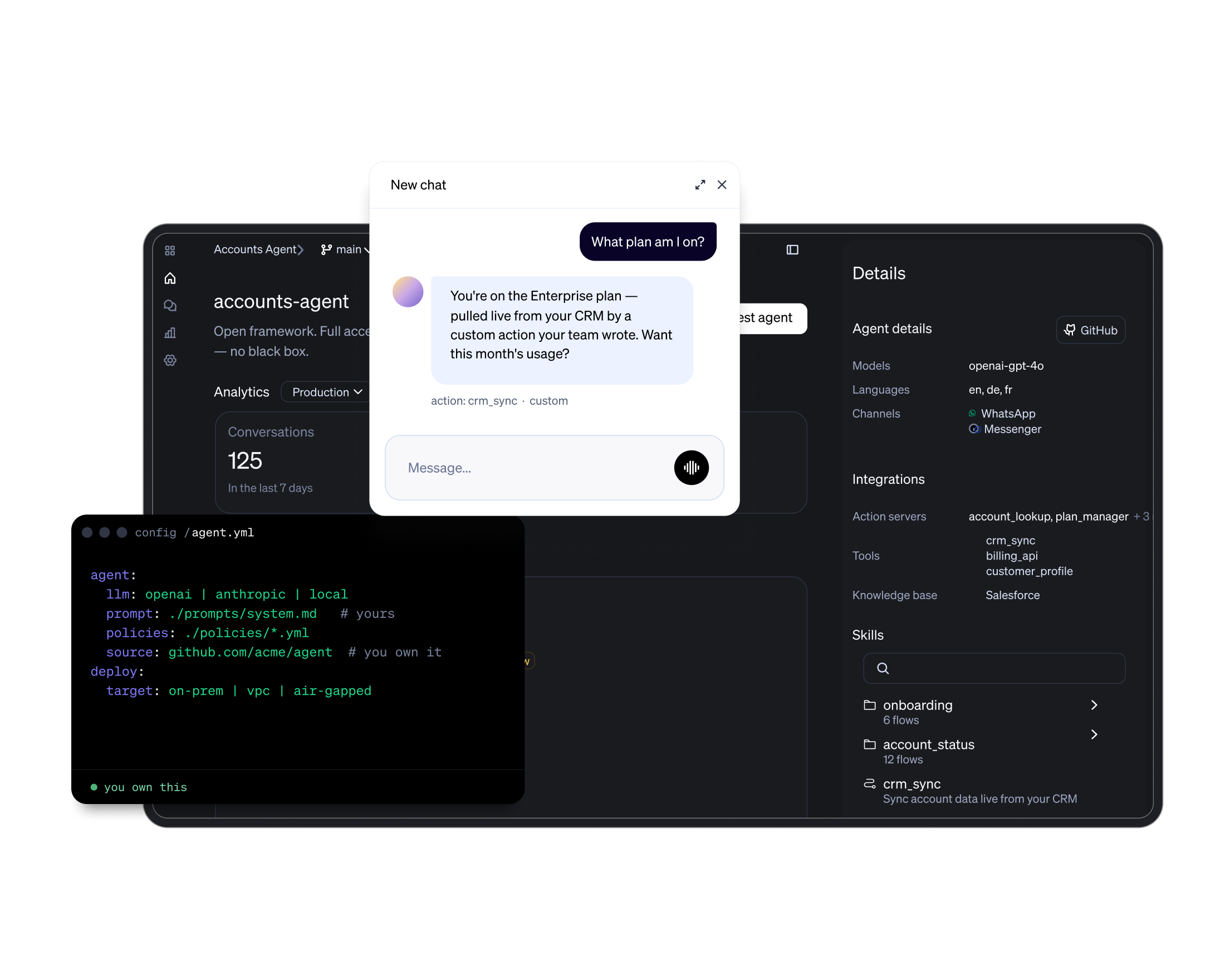
Rasa is an enterprise conversational AI platform built on a self-hosted, developer-owned architecture. Patented dialogue management (CALM) delivers guided governance: business logic controls high-risk actions through explicit policies, regardless of LLM output. Native voice (Twilio, AudioCodes, Genesys), 100% on-prem or private cloud, transparent conversation-volume pricing. Customers include N26, Deutsche Telekom, Helvetia, Autodesk.
One platform for voice and chat, running in your environment
Rasa runs the same guided-governance engine across phone and chat, fully self-hosted. Your team configures flows, policies, and integrations directly, with no managed-service dependency.
- Native voice over Twilio, AudioCodes, and Genesys, sharing context with chat.
- Explicit policies control high-risk actions on regulated workflows, regardless of LLM output.
- Deploy on-prem, in private cloud, or air-gapped, with no customer data leaving your perimeter.
Side-by-side on the dimensions that decide enterprise deals
Our methodology
This comparison draws on user reviews from G2, Capterra, TrustRadius, and GetApp, combined with vendor documentation, published pricing, enterprise buyer interviews, and production deployment research.
Our research methodology separates verified platform capabilities from vendor marketing claims. We review product documentation, feature releases, and published benchmarks from both sides directly. For cost and latency, we reference Rasa’s published CALM vs LangGraph benchmark and link the methodology directly.
We cross-reference with enterprise buyer interviews focused on regulated industries (banking, telco, healthcare, government) where production-ready dialogue management and architectural governance are hard gates.
Conflict of interest disclosure: This comparison is published on Rasa's website. Rasa is a commercial conversational AI platform and stands to benefit from enterprises choosing its platform over a framework-composition approach. We address this by (1) publishing genuine LangChain strengths in the Steel Man section, (2) using factual documentation and published benchmarks as the primary evidence, and (3) avoiding dismissiveness about what LangChain does well.
Last comprehensive review: July 2026. Verified against LangChain and LangGraph documentation, Rasa Enterprise documentation, and Rasa's published CALM vs LangGraph benchmark.
The dimensions, side by side
Primary Philosophy and Positioning
Rasa and LangChain occupy fundamentally different categories. LangChain is a framework of composable primitives. Rasa is a purpose-built platform for enterprise AI agents. The real question is where the team wants to spend its engineering time: building the conversation layer, or building the business capabilities that run on top of it. The philosophical gap shapes every downstream decision about engineering capacity, time to production, governance, and long-term maintenance overhead.
LangChain
| Rasa
|
"Autodesk expects to handle 200 million user conversations by 2026 on Rasa. Deutsche Telekom resolves 50% of IT inquiries autonomously. N26 uses Rasa for regulated banking."
Purpose-Built Dialogue Management
Dialogue management is the most consequential difference between a framework and a platform.LangGraph gives teams stateful graph orchestration, persistence, memory, human-in-the-loop, and multi-agent patterns. What it does not ship is a purpose-built conversation layer: repair patterns, channel behavior, content review, business-owned response management, and a shared operating model for improving live conversations. Rasa’s Orchestrator handles the conversation layer directly. It tracks context, generates structured commands, manages state, and activates patterns for corrections, interruptions, cancellations, clarification, handoff, chitchat, repeat, and silence handling.
LangChain
| Rasa
|
Enterprise Deployment and Data Sovereignty
LangChain/LangGraph can be deployed through LangSmith Deployment, self-hosted Agent Server, or a custom containerized service. That gives teams a production path for the agent runtime. The tradeoff is ownership: teams still design how state, data residency, auth, observability, failover, rollback, voice, and compliance evidence work for their environment.
Rasa is built for teams that want the agent platform deployed inside their own operating model. Rasa runs on Kubernetes or OpenShift, supports production tracker stores, tracing, analytics, Studio roles, and customer-controlled infrastructure.
LangChain
| Rasa
|
"Swisscom deployed Rasa from prototype to production in 20 weeks, doubling automation rates and cutting operational costs by 50%. The platform runs in Swisscom's own environment."
Cost Efficiency
The architectural difference between CALM (Rasa's dialogue management framework that powers the Orchestrator) and LangGraph has concrete cost and latency implications. Rasa published a direct benchmark comparing CALM and LangGraph on a customer service assistant task. CALM reduced AI assistant cost by 77.8% while improving reliability.
LangChain
| Rasa
|
Voice Architecture and Channel Support
LangChain does not ship a native voice architecture. Teams can build voice agents with external STT, TTS, telephony, streaming, and interruption handling, but they own the latency, channel behavior, provider choices, and maintenance surface.
Rasa supports voice through built-in channel connectors, including Twilio Media Streams, AudioCodes, Jambonz, and Genesys Cloud. Voice uses the same conversation logic as digital channels, with voice-specific behavior such as DTMF, repeat, silence handling, and interruption handling where supported.
LangChain
| Rasa
|
Compliance and Enterprise Governance
LangSmith gives teams tracing, evals, monitoring, and deployment tooling for agent runs. Regulated conversation governance still needs to be designed around the stack. Rasa gives teams a more complete governance surface for conversations: event-based conversation history, tracker stores, conversation review, role-based team workflows, controlled skills, deployment ownership, and traceable behavior across the agent lifecycle.
LangChain
| Rasa
|
LLM Ecosystem and Integration Surface
LangChain has a genuine and substantial lead on ecosystem breadth. Its library of LLM, vector store, retrieval, and tool integrations is the broadest available in any framework. Rasa's integration model is different in kind: LLM-agnostic core plus enterprise integration patterns optimized for voice, CRM, and backend systems.
LangChain
| Rasa
|
Pricing and Total Cost of Ownership
LangChain and LangGraph are open-source. LangSmith is commercial: free developer tier, paid team tier, usage-based traces, paid deployment, and custom enterprise pricing for self-hosting, SSO/RBAC, support SLA, training, and architecture guidance.
Rasa Developer Edition is free with usage limits. Enterprise pricing is custom and based on annual conversation volume, deployment needs, and support requirements. It is not seat-based, so team growth does not create a per-user tax.
LangChain
| Rasa
|
Customer Success and Support
Support and customer success models reflect each project's philosophy. LangChain is a community-driven open-source framework with commercial LangSmith observability. Rasa Enterprise includes premium support, FDE, CSM, custom onboarding, enterprise security/compliance features, and support for complex self-hosted deployments.
LangChain
| Rasa
|
LangChain is the better fit when the product is an agent system, not primarily a conversation system. If the team is building custom RAG pipelines, research agents, tool automation, internal copilots, or a bespoke multi-agent architecture, LangChain gives them more raw flexibility. LangGraph gives them stateful orchestration. LangSmith gives them tracing, evals, and deployment. For strong AI platform teams, that can be the right stack.
The tradeoff is ownership. The team also owns the conversation behavior around the graph: repair, voice, content review, business governance, compliance evidence, and the workflow for improving live customer journeys
Which platform wins for your use case
LangChain
- You are building your own agent platform layer.
- Your core workload is RAG, tool automation, research, document processing, or custom multi-agent architecture.
- Your engineers want maximum control over graph structure, state, tools, models, and deployment.
- Your team is comfortable owning the conversation behavior and operating model around the agent.
Rasa
- Your core workload is real customer or employee conversation.
- Users correct themselves, switch topics, return later, use voice, or need handoffs with context preserved.
- Multiple teams need to review, improve, and govern the agent after launch.
- You need deployment control, traceable behavior, and a platform layer built for regulated production environments.
- You want engineering time spent on business capabilities, not rebuilding the conversation operating layer.
More Conversational AI Comparisons
Common questions
What is the main difference between Rasa and LangChain?
Category. Rasa is a purpose-built developer platform for enterprise AI agents with three layers (Framework, Orchestrator, Studio), dialogue management, deployment, native voice, and architectural governance over agent behavior.
LangChain is a Python framework of composable primitives for LLM-powered applications. Rasa is production-ready; LangChain is a foundation for teams building their own production stack.
Is LangChain a conversational AI platform?
LangChain can be used to build conversational agents, but it is not a packaged conversational AI platform.
LangGraph gives stateful orchestration, persistence, memory, and human-in-the-loop patterns.
Teams still need to design the conversation layer around it: repair, voice behavior, content operations, and business review.
How does CALM compare to LangGraph on cost and performance?
CALM separates conversational understanding from business logic execution.
In Rasa's published benchmark on a customer service assistant task, CALM reduced AI assistant cost by 77.8% vs LangGraph while improving reliability.
The main difference was how much repeatable work stayed outside the LLM loop.
CALM also works with smaller LLMs (Llama 8B) where LangGraph has no known comparable-quality implementation. The cost gap widens at production scale.
Does LangChain support enterprise deployment and self-hosting?
Yes. LangChain/LangGraph can be deployed through LangSmith Deployment, a self-hosted LangSmith setup, or a custom containerized service.
That gives teams a path to production for agent workloads.
The remaining work is the surrounding production model: data residency choices, auth, rollback, failover, voice, compliance evidence, and how the team operates the agent after launch.
Does LangChain support voice agents?
Not natively. LangChain has no built-in voice architecture.
Building a voice agent on LangChain requires integrating speech-to-text, text-to-speech, telephony, and barge-in handling from separate third-party providers as a multi-month engineering project.
Rasa Voice is native with built-in Voice Stream connectors for Twilio Media Streams, Jambonz, AudioCodes, and Genesys Cloud.
How long does it take to build a production agent with LangChain vs Rasa?
LangChain can move fast when the goal is a custom agent workflow.
Rasa starts higher when the goal is a customer-facing conversation system: voice, review, analytics, conversation state, and deployment patterns are already part of the platform.
The timeline depends less on “agent works” and more on “who operates it after real users show up.”
What governance and compliance features does LangChain provide?
LangSmith provides tracing, evals, monitoring, deployment tooling, and enterprise controls such as SSO/RBAC on Enterprise plans.
For regulated customer conversations, teams still need to design policy workflows, content review, handoff rules, retention rules, and audit evidence around the stack. Rasa gives more of that conversation operating layer inside the platform.
What is the Rasa Orchestrator architecture?
The Orchestrator is the runtime layer that keeps the conversation coherent.
It reads the current turn in context, tracks state, selects the next action, and coordinates skills, tools, search, memory, and handoffs.
That is the layer LangGraph teams usually have to design themselves around the graph.
Is LangChain free?
LangChain and LangGraph are open source. LangSmith is commercial.
The free tier includes limited tracing and agent tooling; paid plans add team features, deployment, monitoring, evals, and enterprise options such as self-hosting, custom SSO/RBAC, SLA, and architecture support.
Which is better for regulated industries, Rasa or LangChain?
Rasa is usually the better fit when the agent handles regulated customer or employee journeys: identity, payments, healthcare, account changes, claims, or handoffs.
LangChain can work in regulated environments, but the team needs to assemble and validate more of the governance, data residency, audit, and conversation review layer themselves.
Can LangChain and Rasa be used together?
Yes. Rasa can own the conversation layer while LangChain components support specific retrieval, tool-calling, or agentic sub-tasks.
What does Rasa provide that LangChain does not?
Rasa provides the parts a team would otherwise have to assemble around LangChain for real customer conversations: conversation state, repair patterns, voice connectors, Tracker Store, Studio review, response management, analytics, and deployment patterns for enterprise environments.
LangChain is stronger for model/tool ecosystem breadth and custom agent architecture.
AI that adapts to your business, not the other way around
See Rasa in your environment
Run Rasa self-hosted with native voice, guided governance, and transparent pricing. Talk to our team about your conversational AI roadmap.