Enterprise Conversational AI

Rasa vs Dialogflow CX

Teams evaluating an AI customer service platform ask the same three questions: can we self-host, can our team own it, and what does it actually cost? Here's how Rasa compares on the dimensions that decide   enterprise deals
The short version
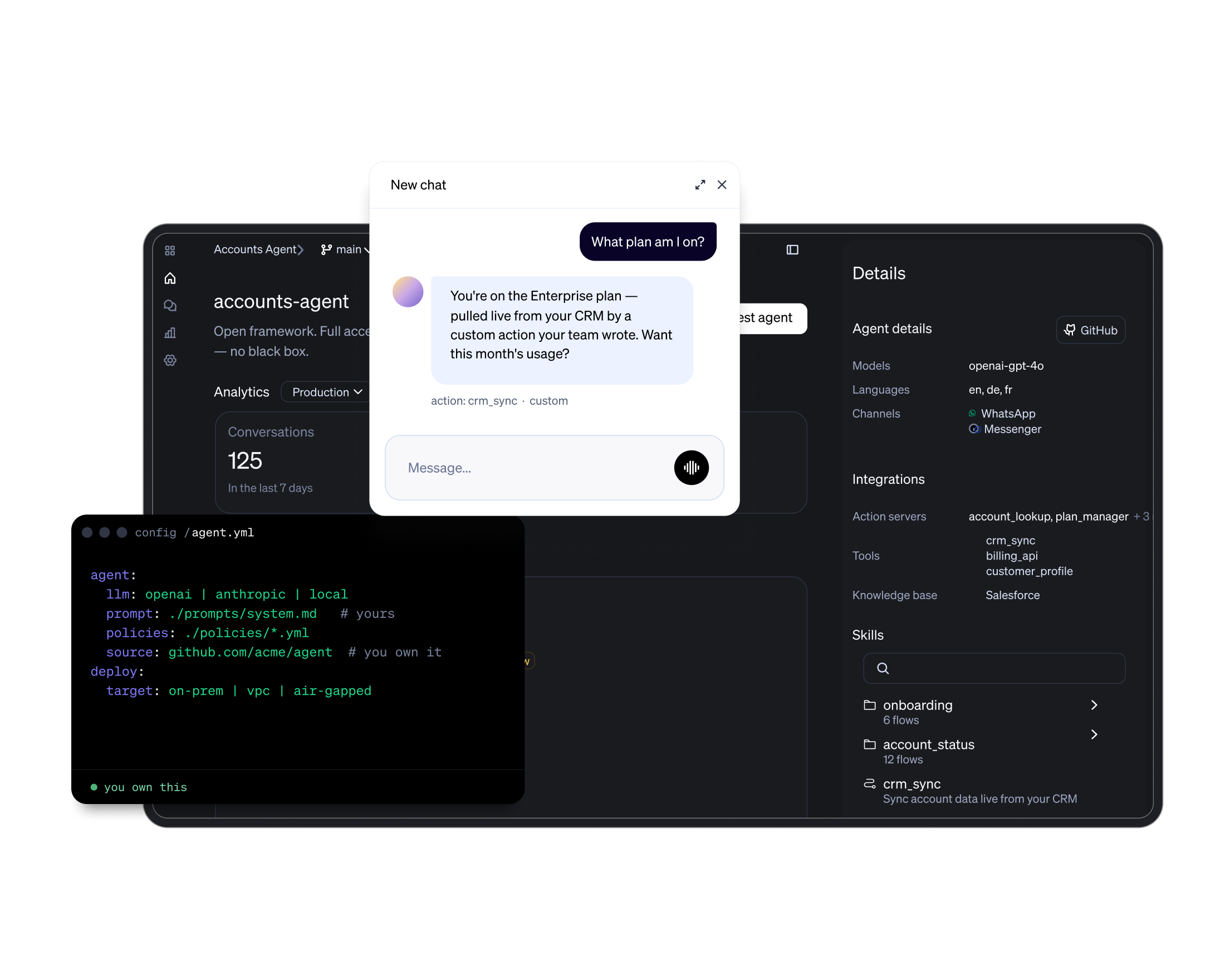
Rasa is the self-hosted, customer-owned alternative for teams that need to own the agent, run it in their own environment, and govern regulated workflows with explicit policies.
Self-hosted
Customer-owned
Native voice
Guided governance
Published pricing
Competitor

Dialogflow CX

VS
The Alternative
Rasa logo
Self-hosted, customer-owned conversational AI
Top enterprises trust Rasa
At a glance

Two platforms, two opposite philosophies

Dialogflow CX

Google's managed conversational AI service. Optimized for teams already invested in Google Cloud that need a visual state-machine flow builder, native GCP integrations, and fast time-to-deploy for structured conversation flows. Cloud-only on Google Cloud.

Founded
HQ
Funding
Capterra
Not yet rated

Rasa is an enterprise conversational AI platform built on a self-hosted, developer-owned architecture. Patented dialogue management (CALM) delivers guided governance: business logic controls high-risk actions through explicit policies, regardless of LLM output. Native voice (Twilio, AudioCodes, Genesys), 100% on-prem or private cloud, transparent conversation-volume pricing. Customers include N26, Deutsche Telekom, Helvetia, Autodesk.

Founded
2016
HQ
San Francisco / Berlin
Funding
~$70M raised
Capterra
4.7 / 5
Own the agent

One platform for voice and chat, running in your environment

Rasa runs the same guided-governance engine across phone and chat, fully self-hosted. Your team configures flows, policies, and integrations directly, with no managed-service dependency.

  • Native voice over Twilio, AudioCodes, and Genesys, sharing context with chat.
  • Explicit policies control high-risk actions on regulated workflows, regardless of LLM output.
  • Deploy on-prem, in private cloud, or air-gapped, with no customer data leaving your perimeter.
Comparison matrix

Side-by-side on the six dimensions that decide enterprise deals

The dimensions enterprise teams use when picking between a managed cloud service and a customer-owned platform.
DifferentiatorRasaDialogflow CXVerdict
Deployment ModelSelf-hosted, private cloud, or hybrid via Docker and Kubernetes. No dependency on any public cloud.Cloud-only on Google Cloud. No self-hosted or on-premises path.Rasa Win
Data Control and SovereigntyConversation data stays inside the customer's infrastructure by architecture. Rasa does not host any customer data.All conversation data processed and stored in Google Cloud. HIPAA-eligible via Google Cloud Healthcare API with BAA.Rasa Win
Customization and ExtensibilityOpen framework: full Python extensibility. Engine-level extension of RAG pipeline, command generator, NLU pipelines, rephraser. LLM-agnostic.Visual state-machine builder. Custom logic via webhooks only. Cannot modify core NLU pipeline.Rasa Win
Orchestrator / Agentic ArchitecturePatented Orchestrator coordinates autonomous reasoning, guided workflows, and shared conversational memory. Guided + prompt-driven skills.Intent-and-flow base architecture. Playbooks add generative AI (2023+). Agentic depth requires custom engineering.Rasa Win
Integration Depth (GCP)Integrates with GCP services via standard APIs. Not optimized for GCP-native deployments.Deep native integration with Google Cloud, Vertex AI, BigQuery, and CCAI telephony.Dialogflow Win
Compliance and SecuritySelf-hosted architecture satisfies data residency requirements. RBAC, audit logs within customer perimeter.Google Cloud compliance posture: SOC 2, ISO 27001, HIPAA-eligible, GDPR-compliant via DPA.Draw
Pricing ModelDeveloper Edition free. Enterprise custom pricing based on annual conversation volume. No per-session charges.$0.007 per text session, $0.06 per voice session. Scales with usage. No published enterprise ceiling.Draw
Deep dive

Five dimensions, side by side

The decisions that actually move enterprise deals, explored one by one.

Primary Philosophy and Positioning

Dialogflow CX

  • Managed cloud service: Google operates the infrastructure, runtime, and underlying models.
  • Intent-and-flow visual builder: state-machine architecture optimized for structured conversations.
  • GCP-native: designed to integrate tightly with Vertex AI, BigQuery, and Contact Center AI.
  • Google LLMs: NLU and generative capabilities use Google proprietary models.
  • Fast time-to-first-bot for teams already operating on Google Cloud.

Rasa

  • The developer platform for enterprise AI agents. Three layers: Framework (Build), Orchestrator (Run), and Studio (Refine).
  • Patented Orchestrator (dialogue manager): orchestrates autonomous reasoning, guided workflows, and shared conversational memory. No hallucinations in your business rules.
  • Cloud-agnostic: runs self-hosted, on-premise, private cloud, or hybrid via Docker and Kubernetes.
  • LLM-agnostic: bring your own model (OpenAI, Anthropic, fine-tuned domain models).
  • Built for regulated enterprises where data sovereignty and voice-digital parity are production requirements.
Autodesk expects to handle 200 million user conversations by 2026 on Rasa. N26 uses Rasa for regulated banking. Deutsche Telekom resolves 50% of IT inquiries autonomously.

Deployment Model and Data Sovereignty

Deployment architecture is the single most consequential difference between Rasa and Dialogflow CX. For regulated enterprises, this row alone determines whether Dialogflow CX is even viable.

Dialogflow CX

  • Cloud-only: runs exclusively on Google Cloud infrastructure.
  • No self-hosted, on-premises, or air-gapped deployment option.
  • All conversation data transits Google Cloud and is subject to Google data handling terms.
  • Data residency limited to Google Cloud regions; cannot satisfy customer-infrastructure mandates.
  • Viable path for organizations already operating on Google Cloud with no on-premises requirement.

Rasa

  • Self-hosted, cloud, or hybrid via Docker and Kubernetes from day one.
  • Full data sovereignty: conversation data never leaves internal infrastructure in self-hosted deployments.
  • Air-gapped deployment supported for high-security environments.
  • Rasa does not host any customer data, systems, or applications.
  • Satisfies GDPR, HIPAA, and sector-specific data localization by architecture, not by policy.
Swisscom deployed Rasa from prototype to production in 20 weeks, doubling automation rates and cutting operational costs by 50%. The platform runs in Swisscom's own environment.

NLU Capabilities and Customization

Both platforms provide enterprise-grade natural language understanding. The divergence is architectural: Dialogflow CX delivers NLU as a managed Google service, while Rasa gives engineering teams code-level control of the entire pipeline.

Dialogflow CX

  • Visual state-machine flow builder with intent and entity recognition.
  • Google NLU accuracy is strong for well-defined, structured conversation paths.
  • Custom logic implemented via webhook integration.
  • Cannot modify core NLU pipeline or swap the underlying Google language models.
  • Hits a ceiling when workflows deviate from Google's supported flow patterns.

Rasa

  • Open framework with full Python extensibility: custom NLU components, dialogue policies, featurizers, and tokenizers.
  • LLM-agnostic: plug in any compatible language model (OpenAI, Anthropic, Mistral, fine-tuned domain models).
  • Engine-level extension: teams modify the RAG pipeline, command generator, NLU pipelines, and rephraser.
  • Rasa Studio is the UI tool for prototyping, testing, and refining agents. Studio lets non-technical team members (conversation designers, IT SMEs) design and review without touching code.
  • NLU pipeline configurable per use case: domain-specific intent classifiers, entity extractors, RAG retrievers.

Security, Privacy, and Compliance

Both platforms meet enterprise security baselines. The difference is where the data lives, not whether compliance certifications exist. For regulated buyers, architecture-level guarantees matter more than policy-level certifications.

Dialogflow CX

  • SOC 2, ISO 27001, and Google Cloud's broader compliance portfolio.
  • HIPAA-eligible via Google Cloud Healthcare API with Business Associate Agreement.
  • GDPR-compliant via Google Data Processing Addendum; data processed in designated GCP regions.
  • On-premises deployment not available; regulated environments must accept Google Cloud processing.
  • Data sovereignty governed by Google's regional controls, not customer infrastructure.

Rasa

  • Self-hosted deployment enables GDPR and sector-specific data residency by architecture.
  • HIPAA-eligible by design in self-hosted deployments: PHI never transits third-party infrastructure.
  • Role-based access controls, audit logs, and full observability within the customer's own security perimeter.
  • Supports air-gapped deployment for the most sensitive government and defense workloads.
  • Rasa does not hold keys, credentials, or data on behalf of customers in self-hosted configurations.

Developer Experience and the Orchestrator Architecture

Developer experience determines long-term total cost of ownership. Rasa's patented Orchestrator is the technical centerpiece of this comparison, and it changes the operating model for engineering teams in ways that matter at the 18- and 24-month horizons. The Orchestrator selects which skill to activate, routes into and out of skills, and manages conversation state across every turn. Guided skills control high-stakes actions programmatically. Prompt-driven skills handle open-ended interactions where flexibility is valuable.

Dialogflow CX

  • Visual flow builder reduces time-to-first-bot for standard use cases.
  • Intent-and-flow architecture: predictable for well-scoped structured conversations.
  • Playbooks (2023+) add generative AI capability alongside Flows; hybrid supported.
  • Agentic orchestration at enterprise depth requires significant custom engineering.
  • Developers work inside Google's supported patterns; extension means webhooks, not pipeline modification.

Rasa

  • Patented Orchestrator coordinates autonomous reasoning, guided workflows, and shared conversational memory.
  • Composable, reusable skills, each a productized unit of capability that carries the boundaries the business cares about, work across agents and channels.
  • Context switches mid-conversation without losing state, even across CRM lookups, authentication, and policy checks.
  • MCP server integration (beta), A2A (Agent-to-Agent) protocol (beta), custom Action Server.
  • Rasa requires a builder mindset: Python developers and conversational AI architecture knowledge. The tradeoff is full ownership and architectural governance over agent behavior that no managed platform provides.

Integration Ecosystem

Integration depth is where Dialogflow CX has a genuine and substantial advantage. If the enterprise stack is Google-native, Dialogflow CX's integration surface is hard to match. Rasa's integration model prioritizes bespoke backend depth and voice-digital parity from a single runtime.

Dialogflow CX

  • Deep native integration with Google Cloud services: Vertex AI, BigQuery, Cloud Functions, Pub/Sub.
  • Contact Center AI (CCAI) for telephony and agent-assist inside Google's contact center stack.
  • Pre-built integrations with Google Workspace, Gmail, and Google Chat.
  • Webhook-based integration with third-party CRMs, ITSM, and backend systems.
  • One-click connection to Vertex AI for RAG and retrieval patterns.

Rasa

  • Rasa Voice brings the same orchestration logic to voice: built-in Voice Stream connectors for Twilio Media Streams, Jambonz, AudioCodes, and Genesys Cloud.
  • Choose your ASR (Deepgram, Azure) and TTS (Cartesia, Deepgram, Azure, Rime) providers.
  • Action Server pattern for CRM (Salesforce, Zendesk), ITSM (ServiceNow, Jira), ERP, and ticketing.
  • MCP server integration (beta) and A2A (Agent-to-Agent) protocol (beta) for emerging agent ecosystems.
  • Works with any cloud (AWS, Azure, GCP, on-premises). No platform-specific lock-in.

Pricing and Commercial Model

Pricing model diverges in structure as well as magnitude. Dialogflow CX uses transparent per-session pricing that becomes unpredictable at volume. Rasa uses a free Developer Edition plus custom Enterprise licensing based on annual conversation volume, with no per-session charges.

Dialogflow CX

  • Text sessions: $0.007 per session.
  • Voice sessions: $0.06 per session.
  • Generative AI features billed separately via Vertex AI.
  • No published enterprise ceiling; volume discounts available via Google Cloud sales.
  • Cost scales with automation success: higher containment means more sessions, which means higher cost.

Rasa

  • Developer Edition (Free): full access to Rasa. One bot per company, up to 1,000 external conversations/month (100 for internal agents). Community support via the Rasa Forum.
  • Enterprise (Custom): premium support, dedicated CSM, advanced security features, custom onboarding, Rasa Studio for refining design and review.
  • Pricing is based on annual conversation volume, not per-user or per-seat.
  • No per-session or per-conversation charges at the Enterprise tier.
  • Predictable cost structure at scale: the volume license is fixed, usage growth does not inflate the invoice.

Customer Success and Support

Support and customer success models reflect each platform's commercial philosophy. Dialogflow CX inherits Google Cloud's support tiers. Rasa provides direct CSM engagement on Enterprise with an active community base.

Dialogflow CX

  • Support delivered through Google Cloud Support tiers (Basic, Standard, Enhanced, Premium).
  • Technical account manager access on higher Google Cloud Support tiers.
  • Documentation on Google Cloud docs site; strong for standard patterns.
  • Community support via Stack Overflow and Google Cloud community.
  • Generative AI and Playbooks documentation still maturing relative to the core flow builder.

Rasa

  • Rasa Enterprise: premium support with dedicated customer success manager.
  • Community support via the Rasa Forum, active since 2016.
  • Documentation at rasa.com/docs. Learning at learning.rasa.com.
  • Direct engineering engagement available on Enterprise for complex deployments.
  • Partner network for implementation and systems integration.
The Forrester Wave
The Forrester Wave Strong Performer Q2 2026
Analyst recognition

Independently recognized for enterprise conversational AI

Rasa's standing in the Forrester Wave reflects the strategy enterprises are buying: a platform they own and govern, not a managed service they rent. Evaluate the architecture, then evaluate the analyst view.
Talk to sales
The wider field

Ten alternatives enterprises evaluate

The conversational AI field at a glance, with Rasa shown for reference and a note on where each platform fits. Compare each head-to-head on its own page.

This comparison draws on user reviews from G2, Capterra, TrustRadius, and GetApp, combined with vendor documentation, published pricing, enterprise buyer interviews, and production deployment research. We separate verified platform capabilities from vendor marketing claims, and cross-reference enterprise buyer interviews in regulated industries (banking, healthcare, telco, insurance) where deployment flexibility and governance are hard gates.

Conflict of interest disclosure: This comparison is published on Rasa's website. Rasa is a commercial conversational AI platform and stands to benefit from enterprises choosing its platform. We address this by (1) publishing genuine competitor strengths in the steel-man section, (2) using factual vendor documentation as primary evidence, and (3) maintaining a monthly review cadence.

This page is updated monthly. Last comprehensive review: April 2026.

Platform
Founded
HQ
Funding
Rating
Rasa
2016
San Francisco / Berlin
~$70M
4.7 / 5 (Capterra)
Dialogflow CX
Not yet rated
Decagon
2023
San Francisco, CA
$481M+
Not yet rated
DRUID AI
2017
Bucharest, Romania
$124M
4.8 / 5 (Gartner)
Gorgias
2015
San Francisco, CA
$104M
4.6 / 5 (Capterra)
Zendesk AI
2007
San Francisco, CA
PE-owned (Hellman & Friedman / Permira)
4.4 / 5 (Capterra)
Intercom Fin
2011
San Francisco, CA
$511M
4.5 / 5 (Capterra)
Parloa
2018
Berlin, Germany
$560M+
4.0 / 5 (G2)
Ada
2016
Toronto, Canada
$200M
4.7 / 5 (Capterra)
Salesforce Agentforce
1999
San Francisco, CA
Public (NYSE: CRM)
Not yet rated
Kore.ai
2013
Orlando, FL
~$300M
4.6 / 5 (Capterra)
Sierra AI
2024
San Francisco, CA
$1.4B+ raised
4.8 / 5 (Capterra)
Data current as of May 2026; sources: company announcements, Crunchbase, and Capterra/G2/Gartner Peer Insights. Ratings are Capterra unless tagged (G2 or Gartner). "Not yet rated" indicates too few public reviews for a reliable score. Funding reflects total disclosed capital raised; "PE-owned" and "Public" denote companies not on a venture funding track. Review and verify before each publish cycle.

When Dialogflow CX is the better fit

Dialogflow CX is a genuinely strong platform for the right profile, and pretending otherwise weakens the comparison. Three scenarios make Dialogflow CX the stronger choice.

For teams already standardized on Google Cloud that need to ship a structured customer service bot quickly, Dialogflow CX's time-to-first-bot is hard to beat. The visual flow builder genuinely works for FAQ automation, structured triage, and appointment booking, and Google NLU accuracy on well-defined intents is excellent. Native Vertex AI (RAG) and CCAI telephony remove integration work other platforms solve externally.

Dialogflow CX is the stronger choice for contact centers already running Google CCAI. AgentAssist, Conversational Analytics, and CCAI Insights integrate more deeply when Dialogflow CX is the NLU layer underneath.

Organizations with moderate conversation volume and no regulatory gate on cloud hosting will find per-session pricing ($0.007 text, $0.06 voice) transparent and easy to model. Rasa is the stronger choice when deployment flexibility, customization depth, or data sovereignty is a hard requirement.

The verdict

Which platform wins for your use case

The dimensions enterprise teams use when picking between a managed cloud service and a customer-owned platform.
choose

Dialogflow CX

  • Teams already standardized on Google Cloud with no on-premises requirement.
  • Organizations that want a managed service and have no internal engineering capacity for a platform.
  • Use cases with well-defined, structured conversation flows (FAQ, triage, structured self-service).
  • Contact centers on Google CCAI where native telephony integration shortens deployment.
  • Teams with moderate conversation volume where per-session pricing stays predictable.
CHOOSE

Rasa

  • Regulated enterprises (banking, healthcare, telco, insurance, government) with data residency mandates.
  • Engineering-led teams that want to own conversation logic, models, and infrastructure.
  • Complex enterprise business logic that exceeds visual flow builder ceilings.
  • Voice-primary or omnichannel deployments where voice-digital parity from a single runtime is a production requirement.
  • Multi-cloud or sovereign-cloud environments where Google Cloud dependency is a strategic risk.
Choose Dialogflow CX if you are standardized on Google Cloud, your use cases are structured flows, and engineering capacity is limited. Choose Rasa if you need data sovereignty, architectural governance over agent behavior, complex agentic workflows, or voice-digital parity at predictable enterprise pricing.
FAQ

Common questions

What is the main difference between Rasa and Dialogflow CX?

Architecture and deployment. Rasa is a self-hosted developer platform with three layers (Framework, Orchestrator, Studio). The patented Orchestrator provides architectural governance over agent behavior through guided and prompt-driven skills. Dialogflow CX is Google's managed cloud service with a visual state-machine flow builder on Google Cloud. Rasa suits regulated enterprises needing data sovereignty and voice-digital parity. Dialogflow CX suits GCP-native teams building structured flows.

Does Dialogflow CX support on-premises deployment?

No. Dialogflow CX is cloud-only and runs exclusively on Google Cloud infrastructure. There is no self-hosted, on-premises, or air-gapped deployment option. Organizations that need on-premises deployment for regulatory, data sovereignty, or security reasons evaluate alternatives. Rasa deploys self-hosted from day one via Docker and Kubernetes.

How does Rasa pricing compare to Dialogflow CX?

Different models. Dialogflow CX charges per session: $0.007 for text, $0.06 for voice. Costs scale with automation volume. Rasa Developer Edition is free. Rasa Enterprise uses custom annual pricing based on conversation volume, not per-session. Predictability favors Rasa at high enterprise volume where per-session pricing becomes unpredictable.

Which is better for regulated industries, Rasa or Dialogflow CX?

Rasa, for most regulated deployments. Rasa's self-hosted architecture keeps conversation data inside the customer's infrastructure, satisfying GDPR, HIPAA, and sector-specific residency by architecture. Dialogflow CX is HIPAA-eligible via Google Cloud Healthcare API with BAA but cannot satisfy on-premises residency requirements. For banking, healthcare, and government with hard on-prem mandates, Rasa is the viable choice. N26 uses Rasa for regulated banking.

Can Rasa and Dialogflow CX both handle voice and chat?

Yes, both handle voice and chat. Rasa Voice brings the same orchestration logic to voice with built-in Voice Stream connectors for Twilio Media Streams, Jambonz, AudioCodes, and Genesys Cloud. Choose your own ASR and TTS. Dialogflow CX offers voice through Contact Center AI (CCAI). Rasa voice is self-hostable with voice-digital parity; Dialogflow CX voice runs in Google Cloud.

What is the Rasa Orchestrator and how does it differ from Dialogflow CX flows?

The Orchestrator is Rasa's patented dialogue manager. It orchestrates autonomous reasoning, guided workflows, and shared conversational memory. Guided skills control high-stakes actions programmatically. Prompt-driven skills handle open-ended interactions. Dialogflow CX uses intent-classification plus state-machine flows, with Playbooks adding generative AI. The Orchestrator is designed for agentic workflows requiring architectural governance over agent behavior.

How long does a migration from Dialogflow CX to Rasa typically take?

Most migrations run 12 to 24 weeks depending on complexity. Rasa provides migration guidance and tools for Dialogflow assistant assets. Simple FAQ bots migrate faster. Complex enterprise agents with dozens of flows and custom webhook integrations take longer. Swisscom rebuilt a major customer service agent in 20 weeks on Rasa, doubling automation rates.

Which platform is easier to implement, Rasa or Dialogflow CX?

Dialogflow CX is easier for first-time implementations with structured conversation flows and teams already on Google Cloud. Rasa requires a builder mindset: Python developers and conversational AI architecture knowledge. However, Rasa Studio lets non-technical team members (conversation designers, IT SMEs) design and review without touching code. The ease-of-implementation advantage reverses at scale: Rasa's code-level extensibility avoids the ceilings teams hit with visual flow builders for complex enterprise business logic.

Does Dialogflow CX offer HIPAA compliance?

Yes, with caveats. Dialogflow CX is HIPAA-eligible via the Google Cloud Healthcare API with a signed Business Associate Agreement (BAA). Conversation data is processed in Google Cloud. Organizations that need PHI to stay inside their own infrastructure cannot satisfy that requirement with Dialogflow CX. Rasa self-hosted keeps PHI entirely within the customer's environment.

How does Dialogflow CX session pricing scale at enterprise conversation volume?

Session-based pricing scales linearly with volume and unpredictably with automation success. More containment means more sessions, which means higher cost. Voice sessions at $0.06 each add up quickly in contact center deployments. Enterprise agreements with Google Cloud sales can provide volume discounts. Rasa's conversation-volume licensing avoids the success-penalty of per-session billing.

Can I migrate existing Dialogflow CX agents to Rasa?

Yes. Rasa provides guidance and migration tooling for Dialogflow assistant assets including intents, entities, and training phrases. Custom webhook logic moves into Rasa Action Server implementations. Flows are rebuilt as composable, reusable skills within the Orchestrator, typically improving maintainability. Teams find the migration investment pays back in deployment flexibility, voice-digital parity, and pricing predictability.

Is Rasa free to use?

Rasa Developer Edition is free with full platform access. One bot per company, up to 1,000 external conversations per month (100 for internal agents). Community support via the Rasa Forum. Rasa Enterprise is custom-priced for production deployments that need premium support, dedicated CSM, advanced security features, custom onboarding, and Rasa Studio for refining design and review.

AI that adapts to your business, not the other way around

See Rasa in your environment

Run Rasa self-hosted with native voice, guided governance, and transparent pricing. Talk to our team about your conversational AI roadmap.