
I've been lucky to see Rasa transform over the years into the agent platform it is today. AI technology has changed massively, and Rasa has evolved to stay one step ahead. But one thing hasn't changed within Rasa: our commitment to a relentless pursuit of innovation.
It’s one of the reasons I joined Rasa in the first place. Back in 2021, I was working for another company building “chatbots” (I know, you can tell I’m a dinosaur with that word). In the five years I spent there, the product I was using had barely changed. Rasa, however, has not only kept up with every massive technology change but has managed to stay on the cutting edge of conversational AI technology since its founding year, 2016.
What makes me excited about Rasa’s evolution into an agent-building platform is our commitment to building specifically for AI product teams. Rasa’s platform is accessible, manageable, and, importantly, easy to use. That’s the magic balance behind any successful software product: it's powerful and intuitive for both the builder and the end-user.
In this article, I’ll share why Rasa is not a chatbot framework. Rasa is an agent platform for product teams building customer-facing AI. Let’s dive into what that means.
Short answer: Is Rasa a chatbot framework?
Is Rasa a chatbot framework? No. Rasa is an agent-building platform for enterprise voice and chat agents: a language model helps orchestrate the conversation (not intents), and what your agent can do lives in skills (not flows or stories). Companies run these agents in their own infrastructure.
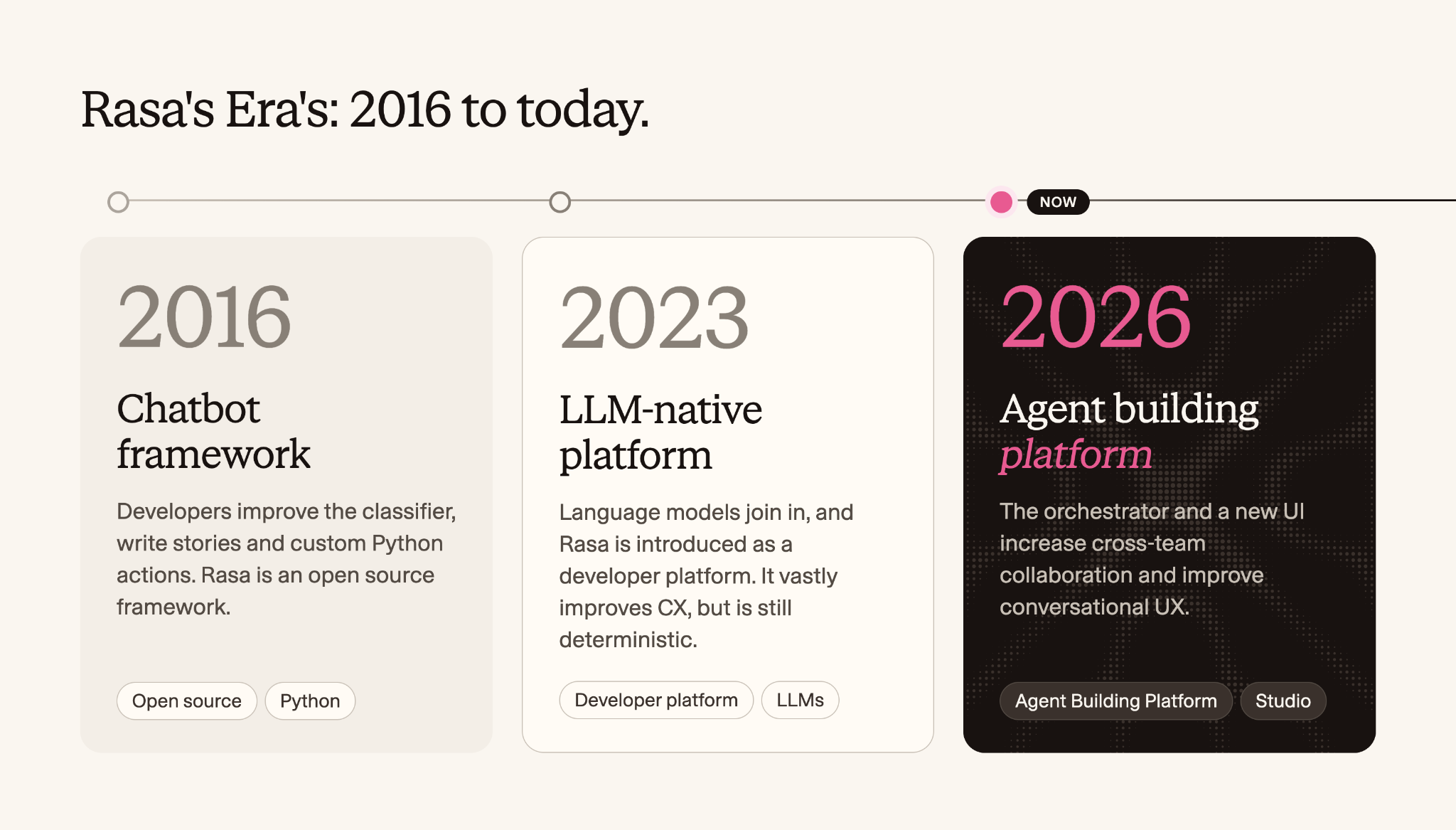
Here’s a quick Rasa history lesson:
- 2016 - 2022: Open-source Python libraries for building machine-learning chatbots
- 2023: CALM (Conversational AI with Language Models), Rasa's first LLM-native dialogue orchestrator, and Studio, a visual builder for business teams
- 2026: Mantle, Rasa's orchestrator, brings skills, memory, and voice together in one agent platform for teams building customer-facing AI
Chatbot framework vs. agent building platform: what's the difference?
Before we continue, let’s take a step back to understand the difference. A chatbot framework gives developers libraries to build one bot. An agent building platform gives a whole team what it needs to build, test, run, and improve many agents. For how platforms compare, see the best AI agent builders for enterprise.
Why was Rasa known as a chatbot framework?
Rasa was a self-described chatbot framework in 2017. The founding team published Rasa: Open Source Language Understanding and Dialogue Management, describing two Python libraries: Rasa NLU and Rasa Core. The goal was to make machine-learning dialogue usable by developers who weren’t ML specialists.
How did the original Rasa framework work?
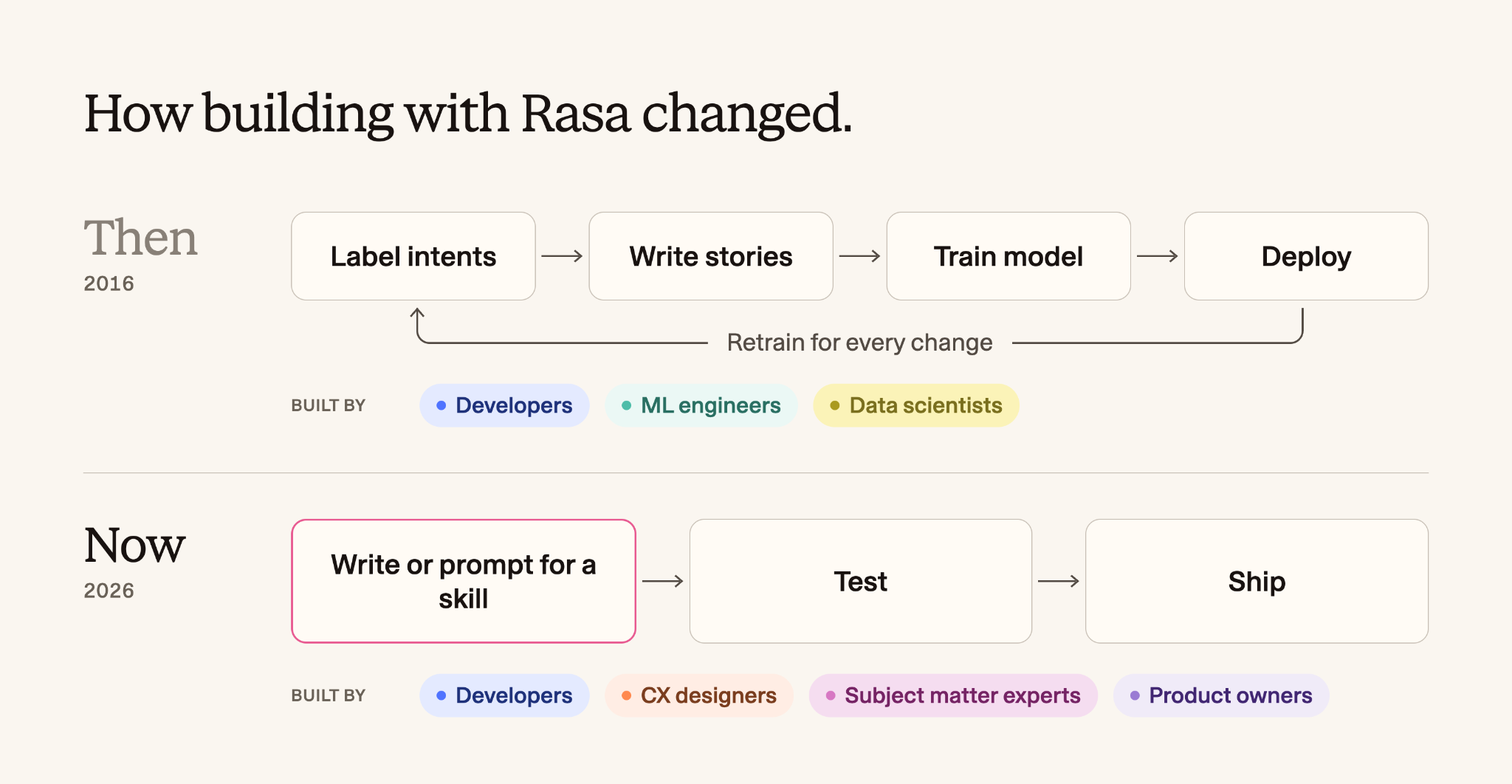
Developers built a chatbot from training data, not prompts:
- Intents and entities: label example messages and add to intent buckets so a classifier can tell what the user wants and route the conversation
- Stories and rules: write sample conversations so a dialogue model can predictively handle what to do next
- Custom actions: call APIs and business systems from Python code
- Train and deploy: retrain the model with every change, then host it yourself. Back in the day, this didn’t happen instantly, but took some time depending on how big the model was, and more coverage meant more training data and even longer training times.
Who used the Rasa chatbot framework?
The core users of the Rasa Framework were developers at banks, telcos, insurers, and governments who used it to build assistants that had to run inside their own walls. In some ways, that still represents some of our core customer base today, given that Rasa can be run on-premises. By February 2024, Rasa reported more than 50 million downloads by developers.
What changed: How did Rasa move from chatbots to AI agents?
Large language models changed what teams expected from a conversation. Users stopped accepting menus and rephrasing. Teams stopped wanting to label thousands of training examples. Rasa rebuilt its core around LLMs in three steps.
Step 1: An LLM-native dialogue orchestrator (2023)
In November 2023, Rasa made its LLM-native platform generally available. Its first LLM-native dialogue engine, CALM (Conversational AI with Language Models), used language models to understand users and pre-defined business logic to run the process. Intent training data became optional instead of required.
Step 2: Studio for business teams (2023)
The same launch introduced Studio, a visual builder where CX and business teams design and refine conversations in the UI. Developers kept working in code. For the first time, both groups built the same agent from their own tools.
Step 3: Mantle and skills are the next orchestrator iteration (2026)
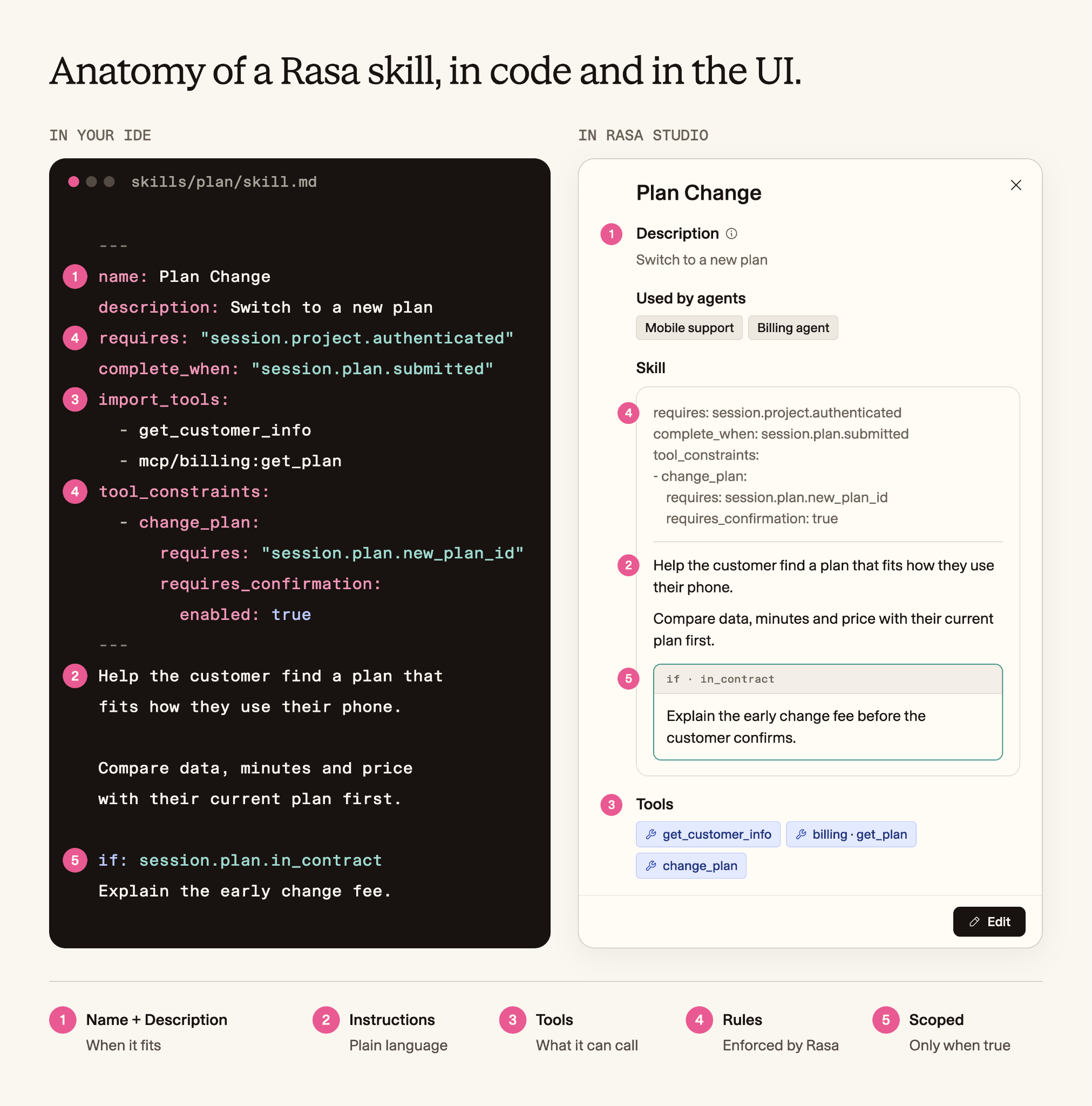
Mantle is the name of Rasa's current orchestrator, replacing CALM. The biggest change for builders: instead of training data or flows, teams now build with skills: portable .md files that outline a business process. The Rasa orchestrator picks the right skill, hands off between skills, and calls tools during the conversation.
What is Rasa today? An agent-building platform
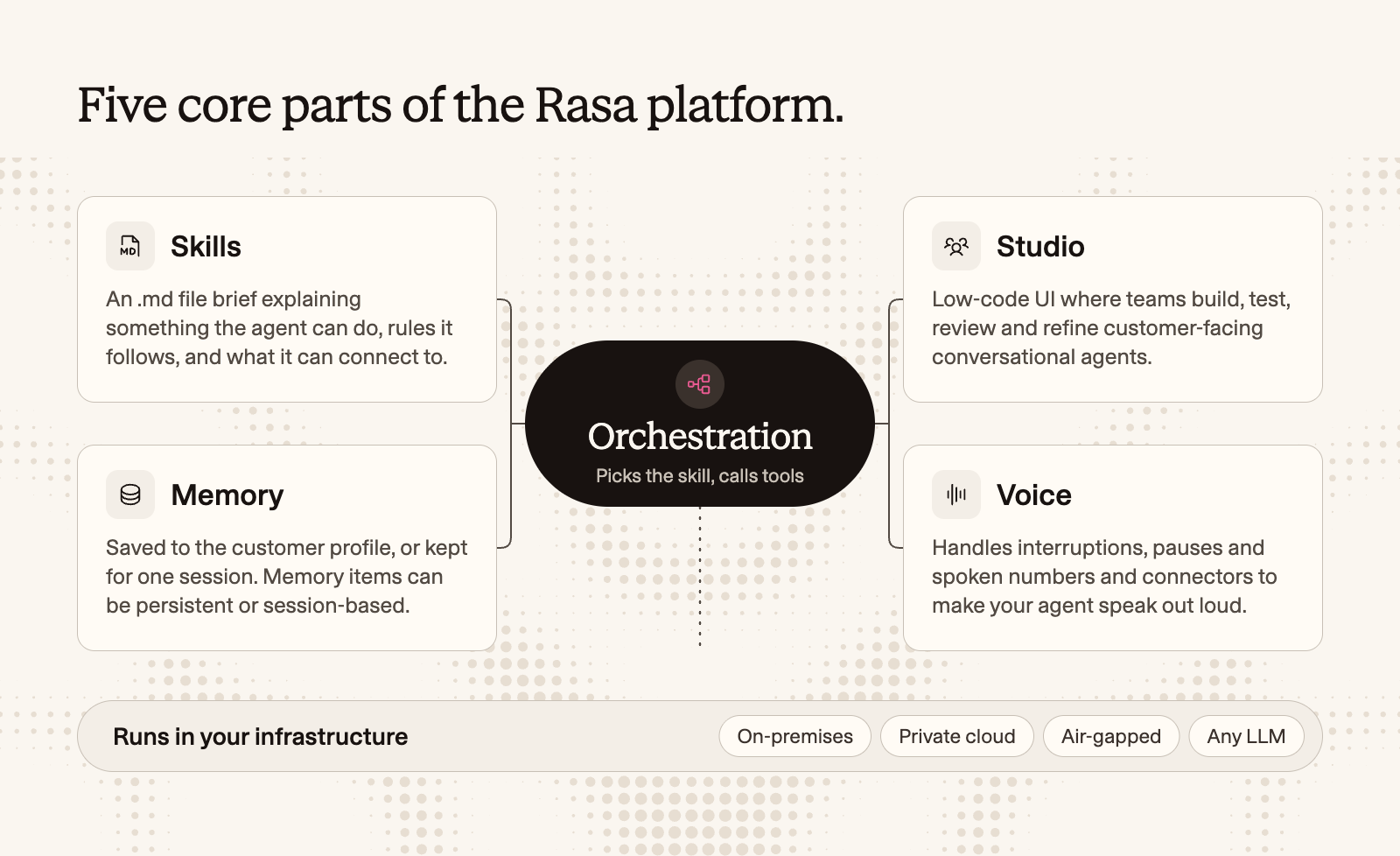
Rasa today is an agent-building platform for enterprise AI product teams who build customer-facing voice and chat agents. It gives teams the ownership of building in-house with the speed of a platform. The Rasa platform has five parts: skills, orchestration, memory, Studio, and voice.
What is a skill in Rasa?
A skill is a unit of business logic: a brief about something your agent can do. It starts as a portable .md file with plain-language instructions about how the agent should behave and which tools it can access. Teams add memory, responses, and stricter rules only where the business needs them, up to defining every step the agent follows. See Skills in the Rasa docs.
What are the core parts of the Rasa agent-building platform?
- Skills: Reusable briefs, one per job your agent does. Skills use the open Agent Skills format, so teams share them across agents and projects.
- Orchestration: Mantle, Rasa's orchestrator, selects the active skill, hands off between skills, calls tools, and tracks what it has learned in the conversation.
- Memory: Rasa keeps customer details and choices across steps, sessions, and channels.
- Studio: the workspace where product, CX, and business teams test, review, and refine agent behavior in the UI.
- Voice: Built for calls, not adapted from chat. Rasa keeps speech short, reads numbers and dates aloud, fills pauses during tool calls, and handles interruptions.
Where does Rasa run?
Rasa runs in your infrastructure: on-premises, private cloud, or air-gapped. It works with the LLM you choose and connects to APIs, MCP servers, and Python code. That matters in banking, telecom, insurance, healthcare, and government, where conversation data cannot leave the company.
Who builds agents on Rasa?
According to Rasa, two of the three top US banks and five national governments run agents on Rasa. The longest continuously running Rasa agent has been in production for eight years, which means it started on the chatbot framework and still runs today.
What has the shift looked like from inside Rasa?
I joined Rasa in 2021, when most people met Rasa as the open-source framework on GitHub. I had worked in conversational AI since 2016, designing conversations, training language models, and shipping things that talk as an AI consultant at IBM.
- What changed: Back in 2021, you could expect Rasa projects to be run by big teams with loads of ML engineers and Data scientists tweaking the ML models and adjusting the NLU classifier. Rasa NLU + Rasa Core were extremely flexible, powerful, cutting-edge products at the time but they were not very accessible to the business side of the project. Every user journey had to be hand-coded by a developer, and the UX part of the project often ran very separate from the engineering part. The opposite is true today in 2026. Today we are seeing smaller, faster teams full of folks from the business collaborating with developers to create conversational experiences.
- What didn’t change: AI product teams still choose Rasa for its flexibility, innovation, and ability to handle just about any type of conversation. Rasa has never limited what is possible for teams, and that remains the case today. Moreover, because Rasa can be self-hosted, Rasa products are still very much built with regulated industry standards in mind so that we can support the banks, governments, healthcare providers, and beyond that need extra safety, security, and control.
FAQ
Is Rasa still a chatbot framework?
No. Rasa is an agent-building platform for voice and chat AI agents, built around skills, orchestration, memory, and Studio.
Is Rasa still open source?
The original Rasa Open Source framework is still available as a community project, but it is no longer actively maintained by Rasa. Today’s Rasa platform is paid and open source: that means you can read the code, change it, and run it where you choose, so you stay in control of your agents and your data.
Developers who want to build with Rasa today can start for free with the Developer Edition, which gives full access to the platform at no cost (limited to one agent per company and 1,000 conversations a month).
What happened to Rasa NLU and Rasa Core?
They merged into a single Rasa library in 2019 and evolved through versions 2.0 and 3.0. Today, intent-based understanding is only supported with the CALM orchestrator. We suggest trying the newest iteration of the Rasa orchestrator, “Mantle”, which is much more powerful and flexible.
What is Mantle?
Mantle is Rasa's newest orchestrator, the core of the Rasa platform. It runs each conversation: it selects the right skill, hands off between skills, calls tools, and keeps track of what it has learned. See the Rasa docs.
Why the name? In geology, the mantle is the thick layer between a planet's crust and its core. Rasa's Mantle sits between everything your teams build and every conversation your customers have. If we stick with the theme, future versions of the orchestrator might be named after other geological wonders: “Tectonic”, “Strata”, or “Geode”.
Does Rasa still use CALM?
CALM is no longer the recommended orchestrator. It is still supported, and intent-based agents keep running on it. Mantle is the better choice for new builds.
Can I still use intents with Rasa?
Yes. If you stick with the CALM orchestrator, intent-based agents keep running; however, we recommend trying our new orchestrator, Mantle, as it is much more accurate, powerful, and dynamic than CALM.
What is an agent building platform?
An agent building platform gives a team one place to build, test, run, and govern AI agents. It covers how agents are written, how conversations are orchestrated, how they are governed across teams, and where the agents run. See the best AI agent frameworks for how it differs from a framework.
Who is Rasa built for?
Enterprise AI product teams building customer-facing agents for customer or employee experiences. Because Rasa is self-hosted, we often work well in regulated industries such as banking, telecom, insurance, healthcare, and government, where teams need to own their stack and their data protection policies.
Is Rasa good for building AI agents?
Yes, for enterprise teams looking to automate customer conversations internally and externally. Rasa is built for customer-facing voice and chat agents in regulated industries such as banking, telecom, insurance, healthcare, and government. Not RPA or Teams build with skills, add rules where the business needs them, and run the agents in their own infrastructure. According to Rasa, two of the three top US banks run agents on Rasa.
Does it matter whether you call it a chatbot or an agent?
Yes and no. The words matter because they signal what a product was built to do: to many buyers, "chatbot" still means menus, scripts, and dead ends, while "agent" means software that can reason through a request and act on it. But the label is not stuck to the product. A chatbot and an agent are both things that talk, software that can hold a conversation with a customer- and the customer never simply doesn’t care about the category name. What matters is whether the conversation gets the job done, how fast your team can improve it, and how much trust you can build with your customers over time.
Key takeaway: Rasa is not a chatbot framework
Rasa began as an open-source chatbot framework and became an agent-building platform. The build model moved from training data to skills, the builders grew from developers to whole product teams, and the channels grew to include voice. What stayed the same: teams that want to own what they build, extend it freely, and run it where they choose.
Next step: Explore the Rasa platform or read the docs to build your first skill.