Enterprises are moving past packaged chatbots and pilot AI agents into production-grade AI agents they can own, govern, and deploy across voice and digital channels at scale.
The buyers searching for the best AI agents in 2026 have already trialed vendor-packaged options for customer support, built LLM prototypes, and run pilots inside their contact centers.
They know where these systems break under real load: hallucinated answers in regulated conversations, brittle handoffs across CRM and telephony, unpredictable behavior as the agent scope grows beyond the original demo, and per-conversation or per-token pricing that compounds unpredictably as containment improves.
This guide evaluates 15 best-rated enterprise AI agents across the categories that drive real production decisions: customer service automation, multi-agent workflows, voice-first contact center, enterprise task automation, research and analysis, document analysis, coding, and workflow automation.
Each platform is scored on the same weighted criteria: hallucination control, voice readiness, multi-channel continuity, deployment model, integration depth, and total cost of ownership. This means that CIO, CTO, contact center, and CX leaders can match real production requirements to the right AI agent.
Whether you need an AI agent for customer service inside a regulated industry, an autonomous agent for sales support, the best AI agents for business automation across departments, or research and analysis agents your engineering and operations teams will use daily, the framework below filters against the criteria sophisticated buyers now apply to AI agent procurement.
Best AI Agents in 2026: Quick Comparison Table
| Platform | Best For | Key Differentiator | Deployment | Starting Price | Integrations | Score |
|---|---|---|---|---|---|---|
| Rasa | Enterprise overall + regulated industries | Patented Orchestrator, native voice + chat, self-hosted | Self-hosted / Private cloud / Air-gapped | Custom enterprise | MCP, A2A, CRM, CCaaS, Voice Stream | 9.4 |
| Sierra | Premium enterprise customer service | Bret Taylor + Clay Bavor team, outcome-based pricing | Cloud (managed) | ~$150K+/yr custom | Zendesk, Salesforce, telephony | 7.8 |
| Decagon | Customer service mid-market to enterprise | AOPs, natural-language agent definition, omnichannel CX | Cloud (managed) | Custom per-conversation + platform | Zendesk, Salesforce, API integrations | 7.6 |
| Salesforce Agentforce | Salesforce-native enterprise CRM | Atlas Reasoning Engine, deep Service Cloud integration | Cloud (Salesforce) | ~$2/conversation; $500/100k credits | Salesforce Service Cloud, Data 360 | 7.4 |
| Cognigy (NICE) | Voice-first enterprise contact center | Native Voice Gateway, ~500ms latency, Gartner Leader | Cloud / On-prem | ~$2,500/mo; ent. ~$115K/yr | 100+ integrations, CCaaS, CRM | 7.6 |
| LangGraph | Stateful production multi-agent workflows | Graph state machines, durable execution, Klarna/Uber refs | Self-hosted / LangGraph Platform | Free OSS; Platform custom | MCP, 700+ via LangChain | 8.4 |
| CrewAI | Multi-agent role-based collaboration | 47K+ stars, role/goal/task primitives, fast prototyping | Self-hosted / CrewAI AMP | Free OSS; AMP enterprise custom | Salesforce, Slack, Sage via AMP | 7.2 |
| Cursor | Coding agent IDE for engineering teams | AI-first IDE, multi-file editing, agent-mode workflows | Desktop app + cloud | Free; Pro $20/mo; Business $40/mo | GitHub, VS Code extensions | 7.6 |
| Wizr AI | Enterprise agentic automation + regulated industries (pharma/life sciences) | Pre-built agents across functions + AI Assembly modular components; platform paired with AI engineering services | Cloud (managed) | Custom | Zendesk, Jira, Slack, Salesforce, Gmail, Confluence, WhatsApp, Outlook + open APIs/SDKs | 7.2 |
| Claude Agent SDK | Autonomous coding and research agents | Built-in file, bash, edit, computer-use tools | Cloud (Anthropic) | Pay-as-you-go | MCP, Claude tools, sub-agents | 7.4 |
| Lindy | Purpose-built AI workflow agents | Agent-first design, deep SaaS integrations, triggers + memory | Cloud | Free; Pro $49.99/mo; Business custom | Gmail, Calendar, CRM, custom APIs | 7.0 |
| Zapier Agents | Workflow automation across SaaS | 7,000+ app integrations, no-code triggers | Cloud only | From $20/mo; Agents tiered | 7,000+ SaaS apps | 6.6 |
| Glean | Enterprise knowledge and research agents | Enterprise search foundation, federated knowledge | Cloud / Private deployment | Custom enterprise | M365, Slack, Salesforce, GDrive | 7.2 |
| Perplexity | Public-web research and analysis | Live web grounding, citation-first answers, Pro Search | Cloud | Free; Pro $20/mo; Enterprise from $40/seat/mo | Web sources, file uploads, APIs | 7.0 |
| NotebookLM | Document analysis and source-grounded synthesis | Source-grounded, Google-powered, free consumer tier | Cloud (Google) | Free; Enterprise via Workspace | Google Workspace, Drive | 6.8 |
The brief framing for this evaluation: most enterprise buyers are choosing between three approaches. Vendor-packaged AI agents like Sierra, Decagon, Salesforce Agentforce, and Ada rent speed but trade ownership and extensibility.
Enterprise AI agent platforms like Rasa let teams own the agent, evolve it across channels, and deploy where compliance requires. DIY agent stacks built on open-source frameworks deliver full control with a large engineering tax to reach production-grade.
Each path fits a different organizational reality. The right choice depends on whether the agent is a 12-month customer service deflection bet or a multi-year platform investment across voice, chat, and internal channels.
Top 15 Best-Rated Enterprise AI Agents
The best enterprise AI agents listed below are organized by the use case that drives the buying decision: regulated enterprise overall, premium customer service, mid-market customer service, Salesforce-native CRM, voice-first contact center, multi-agent workflows, coding, workflow automation, enterprise knowledge research, and document analysis.
#1. Rasa: Best AI Agent Overall for Enterprise
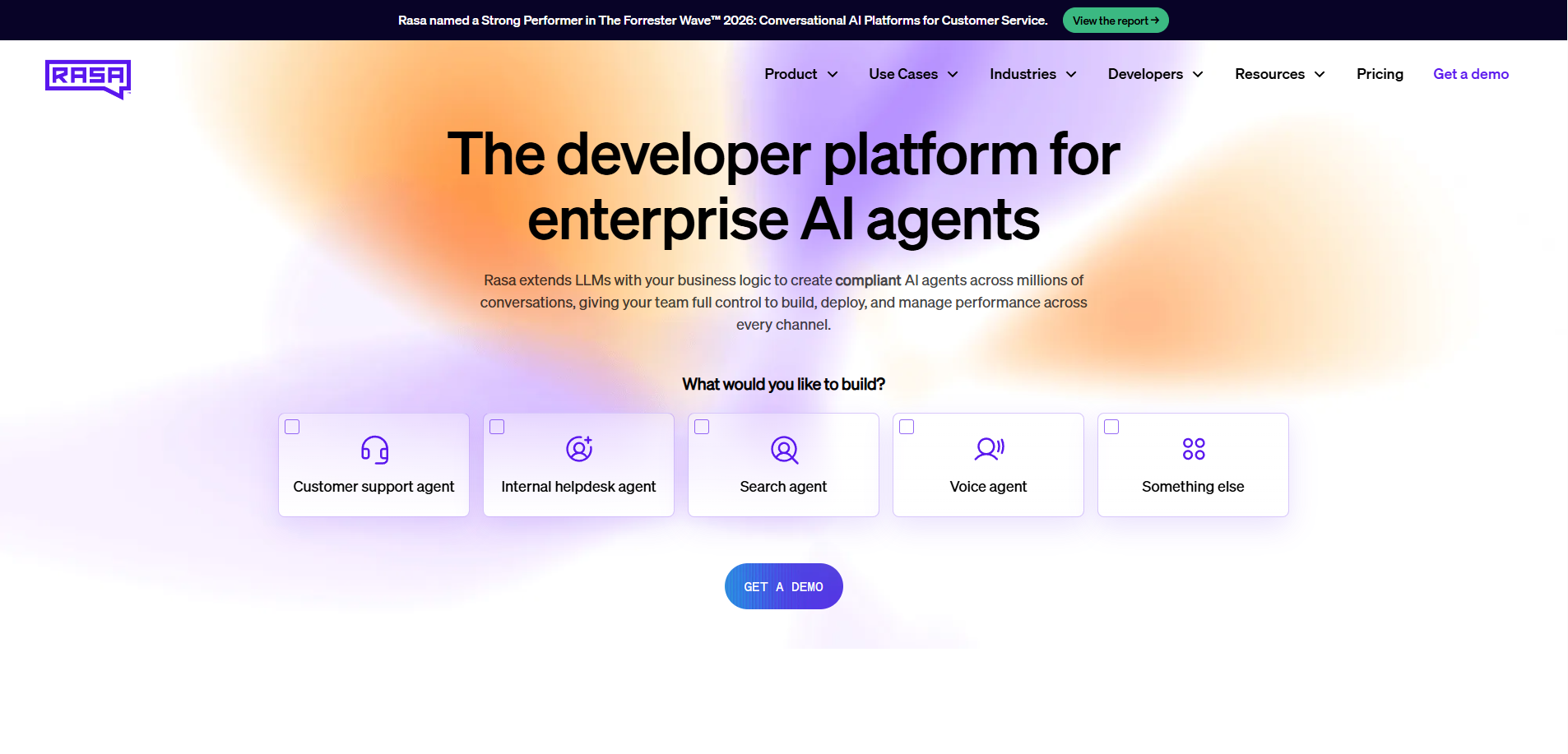
Rasa is the developer platform for enterprise AI agents. For teams running customer-facing and employee-facing AI agents at production scale across voice, chat, and internal channels, Rasa is the platform that delivers ownership, multi-channel coverage, and architectural governance over agent behavior.
Deutsche Telekom, Autodesk, Swisscom, and Groupe IMA run Rasa in production across voice and digital channels in regulated industries.
Best for enterprise CX, contact center, and platform leaders building AI agents for regulated industries (Financial Services, Insurance, Telco, Government, Healthcare) where hallucination control, voice readiness, multi-channel continuity, self-hosted deployment, and total cost of ownership over a 3-5 year horizon are the buying criteria.
Score: 9.4/10. Highest marks for governance (10/10), deployment flexibility (10/10), voice (10/10), and multi-channel continuity (10/10). Scored lower on time-to-first-production-agent (6/10) vs. vendor-packaged options that ship narrow customer service flows in two weeks.
Product Overview
Three core enterprise pains that drive Rasa selection in 2026, each mapped to a specific platform capability:
Pain 1: Hallucination and uncontrolled LLM behavior in regulated conversations.
Rasa's patented Orchestrator (dialogue manager) provides architectural governance over agent behavior. The Orchestrator constrains the LLM within defined business policies and action guardrails so AI agents stay on-policy across complex multi-turn flows.
Guided skills control high-stakes actions programmatically (KYC voice flows, claims intake, account closure, healthcare triage, prescription refills). Prompt-driven skills handle open-ended interactions where flexibility is valuable.
No hallucinations in your business rules. The boundary between deterministic flows and LLM-driven turns is explicit and auditable per turn, not blurred inside an agent reasoning loop.
Pain 2: Inconsistent agent behavior across voice and digital channels.
Rasa Voice delivers the same agent logic, skills, integrations, and analytics across voice and chat, with no rebuild for each channel.
Rasa's multi-agent orchestration maintains shared state, clean handoffs, and unified memory across voice and digital channels. A customer starts in chat, switches to voice mid-task, and picks up exactly where they left off.
Voice Stream connectors for Twilio Media Streams, AudioCodes, Genesys Cloud, and Jambonz with pluggable ASR (Deepgram, Azure) and TTS (Cartesia, Deepgram, Azure, Rime) providers.
Pain 3: Loss of ownership and governance with packaged AI agents.
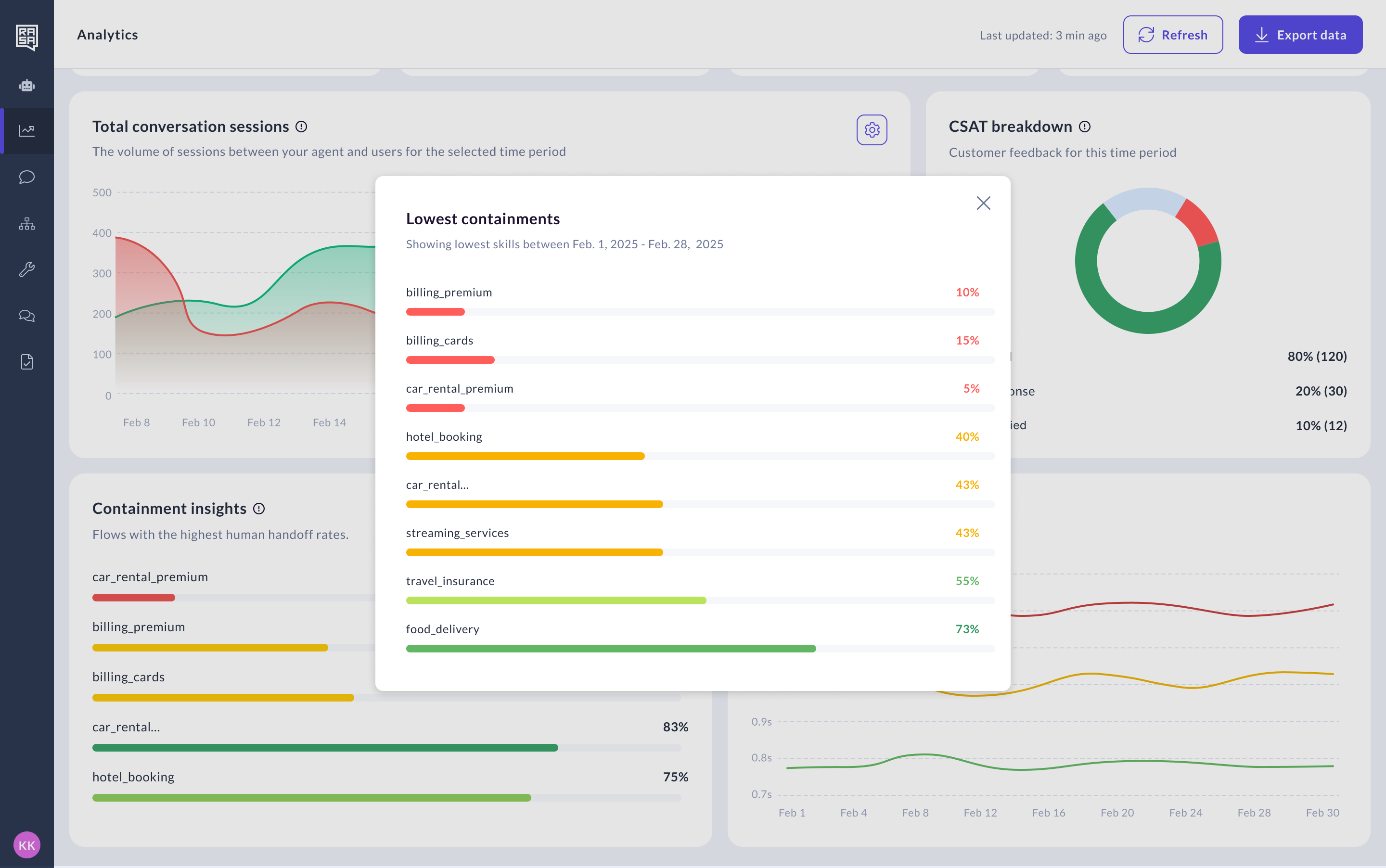
Self-hosted deployment from day one. Conversation-level audit trails. Full visibility into every agent decision and action taken on the user's behalf.
Rasa doesn’t host any customer data, systems, or applications. Engineering teams own the conversation logic, training data, and flow definitions as code in their own repository. Composable, reusable skills, each a productized unit of capability that carries the boundaries the business cares about, work across agents and channels.
Rasa has three platform layers: Framework (Build), Orchestrator (Run), and Studio (Refine). Rasa Studio lets non-technical team members (conversation designers, IT SMEs) design and review without touching code.
Engineering teams keep code-as-source-of-truth: version control, CI/CD, unit tests, and code review for conversation logic.
Pricing
Developer Edition (Free): Full access to Rasa. One bot per company, up to 1,000 external conversations/month (100 for internal agents). Community support via the Rasa Forum.
Enterprise (Custom): Premium support, dedicated CSM, advanced security features, custom onboarding, Rasa Studio for refining design and review. Contact Rasa for a quote.
Pricing is based on annual conversation volume, decoupled from per-conversation or per-token consumption.
For enterprises modeling three-year TCO across tens of millions of voice and chat interactions, the conversation-volume licensing protects against unpredictable cost compounding as containment improves and volume scales.
Integrations and Extensibility
Native: MCP server integration (beta), A2A (Agent-to-Agent) protocol (beta), custom Action Server.
CRM integrations: Salesforce Service Cloud, Zendesk, custom CRM via Action Server.
Telephony: Twilio Voice, Twilio Media Streams, AudioCodes VoiceAI Connect, AudioCodes Voice Stream, Genesys Cloud, Jambonz, Jambonz Stream, Amazon Connect via custom connectors.
ITSM and enterprise backend: ServiceNow, Jira Service Management, custom systems of record via Action Server.
Authentication and identity: Okta, Auth0, custom identity providers via configuration.
Extensible at the engine level: teams modify Rasa core (RAG pipeline, rephraser, command generator, NLU pipelines) without waiting on a vendor roadmap. Not just configure pre-built connectors.
Deployment and Setup
Self-hosted in your own environment, on your infrastructure, under your security model from day one. On-premises, private cloud, and air-gapped deployment options. Cloud deployment also available.
Rasa does not host any customer data, systems, or applications.
Initial deployment timeline: weeks for prototype, 8-20 weeks for production agent, including integrations and governance configuration. Swisscom went from prototype to production in 20 weeks, doubling automation rates and cutting operational costs by 50 percent.
On-premises and hybrid deployment are the differentiators for regulated industries with data sovereignty mandates that cloud-only AI agents cannot meet.
Tradeoffs
Rasa requires a builder mindset and is more platform than you need if you want a customer service AI agent live in two weeks with no engineering investment.
The payoff is ownership, multi-channel coverage from one platform, code-level extensibility teams can carry across many AI agent use cases, and the architectural governance that lets agents pass regulated-industry compliance review.
Teams that need a working customer service agent for narrow FAQ deflection often prefer vendor-packaged options like Decagon or Ada for the initial deployment.
Rasa is for teams running AI agents as a long-term production system, not for teams that need a customer service agent live by next Friday. Rasa is the best AI agent builder for enterprise teams that need self-hosted deployment, composable skills, and full code-level control over agent behavior.
Support
Enterprise tier includes premium support with a dedicated customer success manager and defined SLAs for production deployments.
Enterprise onboarding with deployment architecture review, conversation design support, and integration partnership.
Community support via the Rasa Forum. Documentation at rasa.com/docs. Learning resources at learning.rasa.com.
Mini Case Study
Deutsche Telekom deployed Rasa for internal IT support across 10,000+ employees in German and English.
Rasa AI agents resolved 50 percent of service desk inquiries autonomously. 30 percent reduction in agent workload.
Non-technical IT experts use Rasa Studio to design conversation flows while engineering teams retain code-as-source-of-truth and CI/CD discipline.
Read the full case study here >
See Rasa Compare Against Vendor-Packaged AI Agents
#2. Sierra: Best Premium Enterprise AI Agent for Customer Service
Best for premium enterprise consumer brands wanting persistent AI agents with governance controls, supervision layers, and policy-driven behavior across digital surfaces, where Sierra's high-touch managed deployment and ~$150K+/year contracts fit the procurement model.
Score: 7.8/10. Strong reasoning quality (9/10), enterprise consumer brand reference list (9/10), and governance controls (8/10). Scored lower on deployment flexibility (3/10, vendor cloud only), pricing transparency (4/10), and implementation speed (5/10, 3-7 month deployments per public reporting).
Product Overview
Sierra was founded in 2024 by Bret Taylor (ex-Salesforce co-CEO) and Clay Bavor with a focus on configurable enterprise AI agents for customer service.
In terms of being a strong competitor for developing the best AI customer service agents, the platform emphasizes deep customization, brand consistency, and Agent OS as the runtime for persistent agents across chat, voice, email, and SMS.
Outcome-based pricing tied to measurable resolutions.
Tier-1 named vendor in 70%+ of enterprise CX bake-offs per public 2026 reporting.
Pros and Cons
Pros:
- Highest reasoning quality among vendor-packaged customer service AI agents.
- Enterprise consumer brand reference list and Tier-1 vendor positioning.
- Agent OS for persistent agents across digital surfaces.
- Outcome-based pricing tied to resolutions.
Cons:
- Vendor cloud only, no self-hosted or on-premises option.
- Premium pricing ($150K+/year contracts typical).
- 3-7 month implementation timelines.
- Managed deployment model can slow rate of change post-launch.
Pricing
- Custom enterprise pricing.
- $150K+/year typical based on public reporting.
- Outcome-based pricing tied to measurable resolutions.
Deployment and Integrations
- Vendor cloud only.
- Native Zendesk, Salesforce, and telephony integrations.
- No self-hosted or on-premises option.
Setup
3-7 months for enterprise implementations per public reporting.
Tradeoffs
Highest reasoning quality and premium consumer brand positioning, but premium pricing and managed deployment trade time-to-first-launch against rate-of-change post-launch.
For regulated industries with on-premises requirements, Sierra is disqualified by the cloud-only deployment model.
Intercom Fin (Tier-1 for in-app chat and outcome-based deflection) and Cresta (Tier-1 for unified AI agent plus real-time human agent guidance) address adjacent CX positioning at lower price points.
#3. Decagon: Best AI Agent for Customer Service Mid-Market to Enterprise
Best for support teams wanting natural-language agent definition through Agent Operating Procedures (AOPs) plus engineering-led integration and guardrails, as a Sierra alternative with cleaner pricing transparency.
Score: 7.6/10. Strong AOPs natural-language authoring (9/10), omnichannel customer resolution (8/10), and pricing model clarity vs. Sierra (7/10).
Scored lower on deployment flexibility (3/10, vendor cloud only), multi-agent coordination (5/10, single-primary-agent design), and helpdesk independence (5/10, requires separate helpdesk).
Product Overview
Decagon (founded 2023) delivers fast omnichannel customer-service AI with Agent Operating Procedures (AOPs) that let support teams define agent logic in natural language while engineers manage integrations, workflows, and guardrails.
Customers include enterprise CX teams across chat, email, voice, and SMS.
Watchtower analytics tracks AI and human interactions.
G2 Rating: 4.9/5 (~15 reviews). Tier-1 named vendor in 70%+ of enterprise CX bake-offs.
Pros and Cons
Pros:
- AOPs let non-technical CX teams define agent logic in natural language.
- Omnichannel resolution across chat, email, voice, SMS.
- Cleaner pricing model than Sierra (per-conversation + platform fee).
- Tier-1 enterprise CX vendor positioning.
Cons:
- Vendor cloud only, no on-premises option.
- Single-primary-agent design limits multi-agent coordination.
- Requires separate helpdesk (Zendesk, Salesforce) for human agent workflows.
- Forward-deployed engineering model adds implementation cost.
Pricing
- Custom per-conversation pricing + platform fee.
- Sales-led for enterprise.
Deployment and Integrations
- Vendor cloud only.
- Native Zendesk and Salesforce integrations.
- API access to back-office systems.
- No self-hosted option.
Setup
Weeks to months, depending on integration complexity and AOP definition.
Tradeoffs
Strong middle path between Sierra's premium and packaged FAQ deflection.
AOPs let CX teams own behavior definition while engineering retains technical control.
Cloud-only deployment and single-primary-agent design constrain regulated enterprise and multi-agent scenarios.
#4. Salesforce Agentforce: Best AI Agent for Salesforce-Native Enterprise CRM
Best for enterprises already standardized on Salesforce Service Cloud that want AI agents born with CRM context, using the Atlas Reasoning Engine to execute service workflows directly on customer data.
Score: 7.4/10. Strong Salesforce ecosystem integration (10/10), Atlas Reasoning Engine + Einstein Trust Layer (8/10), and low-code AI agent builder (8/10).
Scored lower on deployment outside Salesforce (3/10), pricing predictability with per-conversation billing (5/10), and dialogue authoring sophistication vs. conversational AI platforms (6/10).
Product Overview
Salesforce Agentforce is the AI agent layer for Service Cloud with native Data 360 access, Atlas Reasoning Engine for decision-making, and Einstein Trust Layer for data masking and policy enforcement.
~$2 per conversation pricing or $500 per 100,000 credits.
G2 Rating: 4.3/5 (~750 reviews).
Best fit for enterprises with deep Salesforce investment, where AI agents should inherit CRM context natively rather than search for it.
Pros and Cons
Pros:
- Deepest CRM integration of any AI agent platform.
- Atlas Reasoning Engine + Einstein Trust Layer.
- Low-code AI agent builder.
- Multi-agent coordination across Sales, Service, and Marketing Clouds.
Cons:
- Optimized for Salesforce ecosystem; limited outside Service Cloud.
- Requires Service Cloud at $175+/user/month before Agentforce is available.
- Implementations typically $50K-$150K with $10K-$25K/month ongoing consulting.
- Per-conversation pricing charges for every interaction, including failures.
Pricing
- $500 per 100,000 credits, approximately $2 per conversation.
- Requires Service Cloud license at $175+/user/month.
Deployment and Integrations
- Salesforce cloud.
- Native Service Cloud, Data 360, Sales Cloud, Marketing Cloud, Einstein Trust Layer.
- Service Cloud Voice for telephony integration.
Setup
Weeks to months. Typical $50K-$150K implementation cost.
Tradeoffs
Strongest choice for enterprises already on Salesforce Service Cloud, where AI agents should inherit CRM context.
Salesforce ecosystem dependency is the deliberate tradeoff. Outside Service Cloud, utility narrows significantly.
#5. Cognigy (NICE): Best Voice-First Enterprise Contact Center AI Agent
Best for enterprise contact centers running high-volume voice workloads that need native voice capability with ~500ms latency and an on-premises deployment option, beyond what cloud-only customer service AI agents like Sierra or Decagon offer.
Score: 7.6/10. Strong native voice (9/10), on-prem option (8/10), and Gartner Magic Quadrant Leader status (9/10).
Scored lower on time-to-first-launch (5/10, 2-4 month enterprise deployments), pricing transparency (5/10), and NICE acquisition roadmap risk (6/10).
Product Overview
Cognigy is a Gartner Magic Quadrant Leader for Conversational AI with native voice via Voice Gateway.
Handles tens of thousands of concurrent voice calls with approximately 500ms latency.
100+ pre-built integrations. On-premises and air-gapped deployment available.
Acquired by NICE in late 2025 for $955M. Mercedes-Benz, Nestle, and Lufthansa enterprise deployments.
Pros and Cons
Pros:
- Gartner Magic Quadrant Leader status.
- Native voice via Voice Gateway with ~500ms latency.
- On-premises and air-gapped deployment options.
- Tens of thousands of concurrent voice calls.
Cons:
- NICE acquisition roadmap uncertainty.
- $100K-$350K+ annual enterprise pricing.
- 2-4 month implementations.
- Multi-line billing (platform + voice + LLM + add-ons).
Pricing
- Pilots from $2,500-$5,000/month.
- Enterprise $100K-$350K+/year.
- Voice minutes and LLM tokens are billed separately.
Deployment and Integrations
Cloud and on-premises. 100+ pre-built integrations, including CCaaS, CRM, and contact center voice channels.
Setup
Weeks for pre-built templates. 2-4 months for enterprise deployments.
Tradeoffs
Strongest voice-first vendor-packaged AI agent for high-volume contact center workloads.
Higher pricing than customer-service-only agents, but materially better voice architecture than Sierra/Decagon/Agentforce when voice is the primary channel.
4.7/5 Gartner Peer Insights (100+ reviews).
#6. LangGraph: Best AI Agent for Stateful Production Multi-Agent Workflows
Best for engineering teams building production AI agents with branching workflows, durable execution, checkpointing, and multi-agent coordination at enterprise scale.
Klarna, Uber, LinkedIn, BlackRock, Cisco, Elastic, and JPMorgan run LangGraph in production.
Score: 8.4/10. Strongest stateful workflow modeling (10/10), durable execution (10/10), and a large-scale enterprise deployment list (9/10).
Scored lower on time-to-first-prototype vs. CrewAI (6/10), learning curve (5/10), and out-of-the-box conversational AI primitives (5/10).
Product Overview
LangGraph models agents as explicit state graphs: nodes, edges, and persistent state. Built by the LangChain team.
Surpassed CrewAI in GitHub stars in early 2026, driven by enterprise adoption.
The graph model maps cleanly to production requirements (retries, checkpoints, human-in-the-loop, multi-agent orchestration).
Durable execution lets agents preserve progress across transient API failures and application errors. Time-travel debugging via LangSmith.
Pros and Cons
Pros:
- Most mature general-purpose production agent framework.
- State graph is the right abstraction for complex branching workflows.
- Durable execution and checkpointing for long-running tasks.
- Time-travel debugging via LangSmith.
- Klarna, Uber, LinkedIn, BlackRock, JPMorgan production references.
Cons:
- Steeper learning curve than CrewAI's role/goal/task abstraction.
- More code per agent than higher-level abstractions.
- Python is primary (TypeScript supported but lags).
- No native voice channel for contact center workloads.
Pricing
- LangGraph open-source (MIT license) is free.
- LangGraph Platform for managed deployment has custom enterprise pricing.
- LangSmith observability from $39/user/month.
Deployment and Integrations
Self-hosted (OSS) or LangGraph Platform managed. 700+ integrations via the LangChain ecosystem. MCP-compatible.
Setup
Days for prototype graphs. Weeks for production deployments with checkpointing and durable execution.
Tradeoffs
Strongest production agent framework for engineering teams that need precise control over stateful workflows with checkpoint recovery.
Like CrewAI, it doesn’t ship deterministic dialogue management, native voice, or enterprise governance primitives; those still need to be built on top.
For multi-channel regulated CX, Rasa is the platform that pairs with LangGraph workflows underneath.
#7. CrewAI: Best AI Agent for Multi-Agent Role-Based Workflows
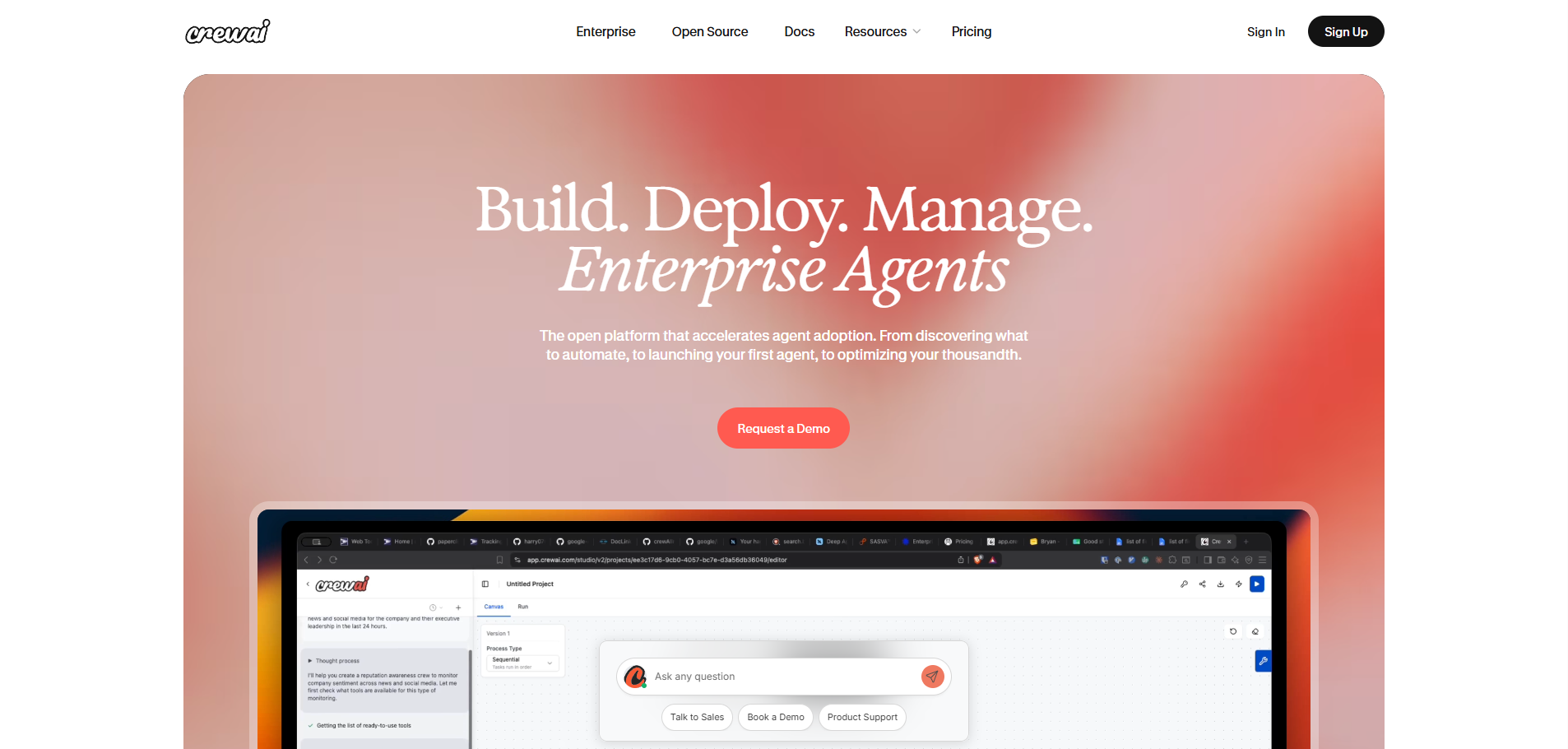
Best for content generation, research pipelines, and analysis workflows where multiple specialized agents need to collaborate quickly through role, goal, and task primitives.
Score: 7.2/10. Fastest multi-agent prototyping (10/10), role-based delegation primitives (9/10), and largest Python agent framework community (10/10).
Scored lower on debugging inside the abstraction (5/10), production-grade observability (6/10), and enterprise governance (5/10).
Product Overview
CrewAI ships agents as roles with goals, tasks, and built-in delegation.
47,000+ GitHub stars and 5 million monthly PyPI downloads by early 2026, the most downloaded agent framework in the Python ecosystem.
Sequential and hierarchical process types control how agents coordinate.
CrewAI AMP (enterprise tier) adds Gmail, Slack, and Salesforce triggers.
Best for content generation, research pipelines, and analysis workflows where multiple specialized agents need to collaborate.
Pros and Cons
Pros:
- Idea-to-production in under a week for multi-agent prototypes.
- Role/goal/task primitives map cleanly to specialized agents.
- Built-in agent delegation.
- Largest Python agent framework community.
Cons:
- Heavy abstraction makes failures hard to diagnose.
- Less suited for safety-critical regulated production.
- No native voice channel.
- Opinionated structure constrains custom control flow.
Pricing
- CrewAI open-source free.
- CrewAI AMP enterprise custom pricing.
Deployment and Integrations
Self-hosted (open-source) or CrewAI AMP managed. AMP adds Gmail, Slack, and Salesforce triggers. LLM-agnostic.
Setup
Hours for working multi-agent crew. Days for production deployments.
Tradeoffs
Fastest multi-agent prototyping path with the largest community.
Teams building safety-critical regulated production systems typically need more control than CrewAI's opinionated structure allows, where Rasa or LangGraph win.
For research and content workflows, CrewAI is genuinely strong.
#8. Cursor: Best AI Coding Agent IDE for Engineering Teams
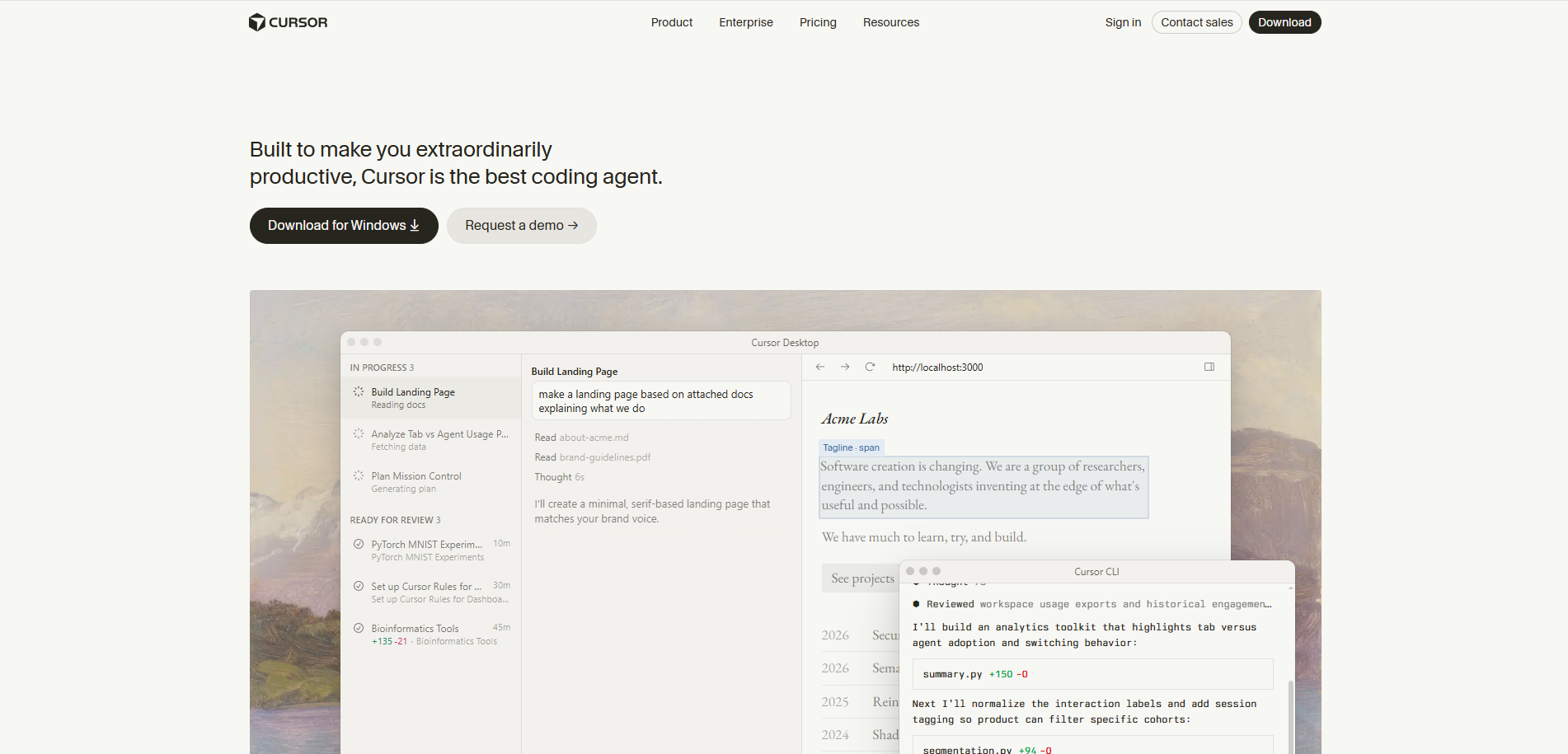
Best for engineering teams that want an AI-first IDE with multi-file editing, agent-mode workflows, and tight VS Code compatibility, as the most-adopted coding agent in 2025-2026, displacing standalone tools like Devin AI and Windsurf for most production engineering teams.
Score: 7.6/10. Strongest IDE integration (10/10), multi-file editing depth (9/10), and adoption across engineering teams (9/10).
Scored lower on autonomous-mode reliability for unsupervised long tasks (6/10), enterprise governance (5/10), and self-hosted deployment (3/10).
Product Overview
Cursor is an AI-first code editor built as a VS Code fork with deep agent-mode capabilities, multi-file editing, codebase-aware completion, and tab-completion that predicts edits across the file.
Acquired the most engineering mindshare across 2025-2026 with public adoption at Stripe, Shopify, and Notion.
Agent mode handles multi-step coding tasks with file system access.
Direct alternative to Devin AI and Windsurf for engineering teams that prefer an IDE-native coding agent over a separate autonomous agent product.
Pros and Cons
Pros:
- Most-adopted AI coding agent in 2025-2026.
- Deep multi-file editing and codebase awareness.
- VS Code compatibility with existing extensions.
- Transparent tiered pricing.
Cons:
- IDE-bound, not a headless production agent.
- Limited enterprise governance vs. Claude Agent SDK.
- No self-hosted deployment option.
- Autonomous mode less reliable than human-in-the-loop coding.
Pricing
- Free tier. Pro $20/month.
- Business $40/user/month with admin controls and privacy mode.
Deployment and Integrations
Desktop app for macOS, Windows, and Linux. Cloud-backed AI inference. GitHub integration. VS Code extension compatibility.
Setup
Minutes for individual developers. Days for team rollout with Business tier admin configuration.
Tradeoffs
Best coding agent for human-in-the-loop development inside an IDE.
Claude Agent SDK is the alternative for headless autonomous coding workflows.
Devin AI is the alternative for fully autonomous task delegation, though Cursor has captured more day-to-day engineering adoption.
#9. Wizr AI: Best for Enterprise AI Automation and AI-Driven Software Engineering
Best for enterprises looking to build autonomous operations through AI agents, agentic workflows, and AI-powered software engineering while maintaining enterprise-grade governance, security, and scalability.
Product Overview
Wizr AI is an enterprise AI company that helps organizations automate business operations and accelerate software delivery using AI. Its offerings combine the Wizr Enterprise AI Platform, Enterprise AI Services, AI-powered Software Engineering, and pre-built AI agents to help enterprises move from AI pilots to production.
The Wizr Enterprise AI Platform enables organizations to build, deploy, and govern AI Agents, AI Assistants, and Agentic Workflows using enterprise data and existing business systems. Beyond the platform, Wizr AI delivers Enterprise AI Services for strategy, custom AI development, model optimization, and AI adoption, along with AI-powered Product Engineering and Enterprise Digital Engineering to accelerate software development, modernization, testing, and delivery.
Pre-built AI agents are available for Customer Support, IT Support Management (ITSM), and Finance & Accounting, while custom AI applications and workflows can be tailored to specific enterprise use cases.
Best fit for medium and large enterprises seeking an end-to-end AI partner that combines enterprise AI software, implementation services, and AI-powered engineering to scale AI across business and IT operations.
Pros and Cons
Pros
- Combines an Enterprise AI Platform with implementation and consulting services.
- Supports AI Agents, AI Assistants, and Agentic Workflows for enterprise automation.
- Pre-built AI agents for Customer Support, ITSM, and Finance & Accounting.
- AI-powered software engineering capabilities, including Glidepath AI SDLC and AI Assembly.
- Enterprise-grade security, governance, and integrations.
Cons
- Enterprise-focused platform that may be more than smaller organizations require.
- Pricing is available through custom enterprise engagement.
- Deployment timelines depend on workflow complexity and enterprise integrations.
Pricing
Custom enterprise pricing based on implementation scope, AI use cases, and deployment requirements.
Deployment and Integrations
Cloud-based deployment with enterprise integrations, secure governance, and support for custom AI applications, enterprise knowledge bases, and business systems.
Setup
Organizations can accelerate implementation using pre-built AI agents or work with Wizr AI's Enterprise AI Services team to design and deploy custom AI solutions based on their business requirements.
Tradeoffs
Wizr AI is well suited for organizations seeking more than an AI agent platform. Its combination of enterprise AI software, implementation services, and AI-powered engineering makes it a strong choice for enterprises looking to automate business operations while accelerating software delivery. Organizations looking for a lightweight, self-service AI agent builder may prefer simpler platforms, while enterprises pursuing organization-wide AI transformation will benefit from Wizr AI's broader capabilities.
#10. Claude Agent SDK: Best AI Agent for Coding and Autonomous Research
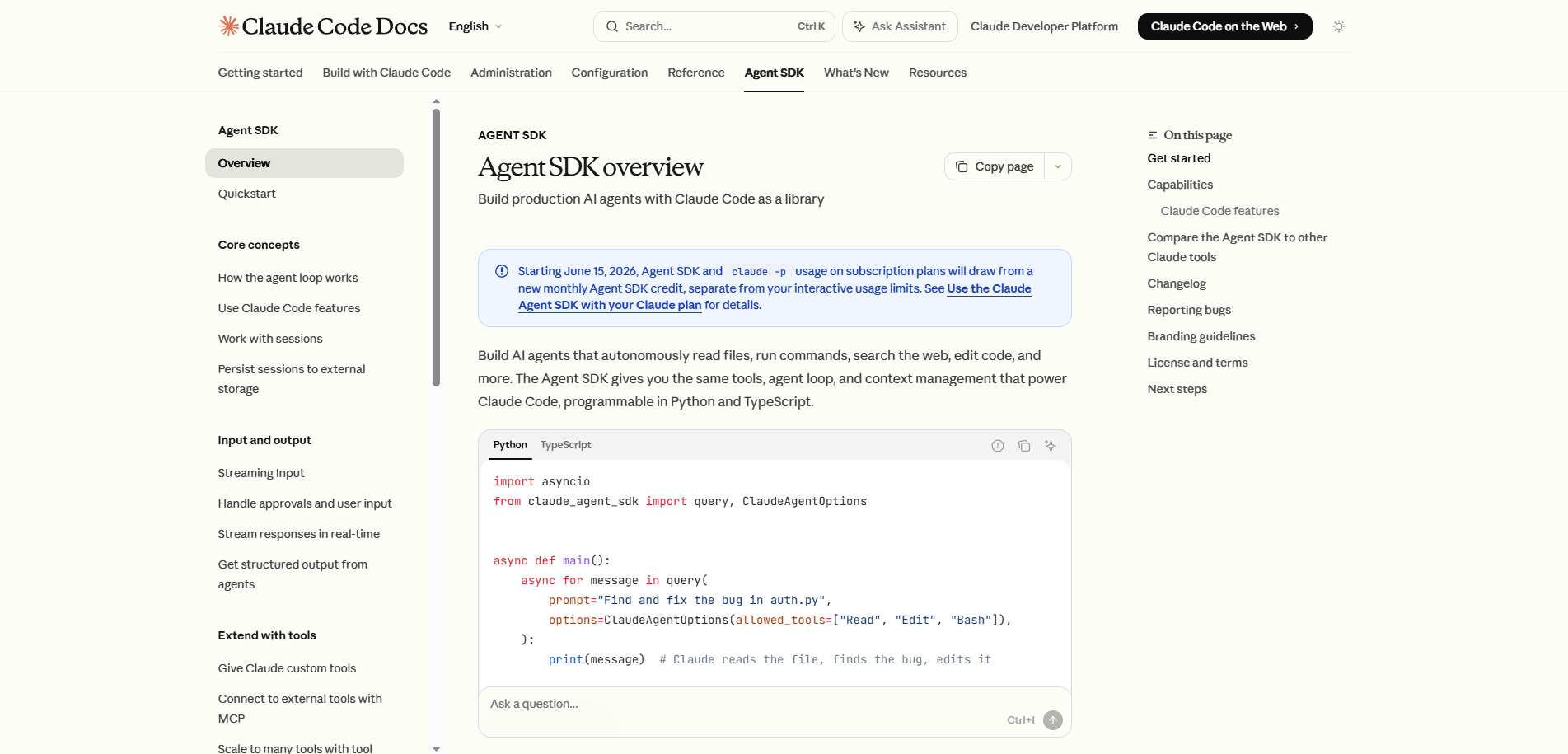
When it comes to building the best autonomous ai agents, Claude Agent SDK shines. It’s the best for engineering teams building autonomous coding agents, research workflows, and tool-using agents on Claude, where Anthropic's reasoning depth and built-in computer-use tools justify the model coupling, replacing standalone coding agents like Devin and Windsurf.
Score: 7.4/10. Strongest built-in tooling for coding agents (10/10), Anthropic reasoning quality (9/10), and same agent loop as Claude Code (9/10).
Scored lower on multi-provider portability (3/10), deployment flexibility (4/10), and deterministic dialogue management (3/10).
Product Overview
Anthropic's first-party agent SDK (formerly Claude Code SDK, renamed late 2025). Same agent loop, tool execution, and context management that powers Claude Code.
Built-in tools for reading files, running bash commands, editing code, search, and computer use.
Multi-agent sessions and outcomes shipped to public beta in May 2026.
Direct replacement for standalone coding agents like Devin AI and the Windsurf IDE for teams committed to Claude.
Pros and Cons
Pros:
- Best path to Claude Opus 4.7 and Sonnet 4.6 for agent work.
- Built-in file ops, bash, edit, search, computer-use tools.
- Same agent loop battle-tested by Claude Code.
- Strong sub-agent and multi-agent patterns.
Cons:
- Anthropic-first design; other providers second-class.
- High token cost at scale per public production reviews.
- Latency trails lower-level frameworks for high-volume workloads.
- No deterministic dialogue management.
Pricing
- Pay-as-you-go Anthropic token pricing.
- SDK is free.
Deployment and Integrations
Anthropic cloud. MCP integration for external tools. Built-in computer-use, file, bash, and edit tools.
Setup
30 minutes for first coding agent. Days for production deployments.
Tradeoffs
Fast to build with Claude reasoning depth.
Public production reviews flag higher token cost and slower latency than typed Python frameworks at scale, with teams typically using the Claude Agent SDK as the orchestrator with typed sub-agents underneath for hot paths.
#11. Lindy: Best Purpose-Built AI Workflow Agent
Best for business operations teams wanting purpose-built AI workflow agents with deep SaaS integrations, persistent memory, and trigger-based execution as an alternative to Zapier's general-automation model for workflows where the AI agent is the centerpiece rather than one node in a larger workflow.
Score: 7.0/10. Strong agent-first workflow design (9/10), trigger and memory primitives (8/10), and SaaS integration depth (8/10).
Scored lower on enterprise governance (5/10), deployment flexibility (3/10, cloud only), and regulated industry fit (3/10).
Product Overview
Lindy is an AI workflow agent platform built agent-first with persistent memory, trigger-based execution across email, calendar, CRM, and custom APIs.
Strong adoption among sales operations and customer success teams running multi-step workflow automation where the agent reasons across SaaS data rather than executing rule-based zaps.
Cloud-only deployment.
Pros and Cons
Pros:
- Agent-first design (vs. Zapier's trigger-rule model).
- Persistent memory across workflow executions.
- Deep Gmail, Calendar, CRM integrations.
- Predictable tiered pricing.
Cons:
- Cloud-only deployment.
- Smaller integration footprint than Zapier (7,000+ apps).
- Limited conversational AI depth for customer-facing CX.
- Not suited for regulated enterprise governance.
Pricing
- Free tier.
- Pro $49.99/month.
- Business custom enterprise pricing.
Deployment and Integrations
Cloud only. Native Gmail, Calendar, CRM, custom API integrations. Trigger-based workflow execution.
Setup
Hours for initial workflow agents. Days for production with multi-step workflows.
Tradeoffs
Strongest agent-first workflow alternative to Zapier Agents for teams where the AI agent is the workflow centerpiece.
Smaller integration footprint than Zapier, but deeper agent reasoning across SaaS data.
Gumloop addresses an adjacent niche with similar tradeoffs.
#12. Zapier Agents: Best AI Agent for Workflow Automation Across SaaS
Best for business teams wanting AI agents wired into 7,000+ SaaS app triggers for cross-system workflow automation, replacing the previous category of standalone workflow AI agents like Lindy and Gumloop for SaaS-heavy operations teams.
Score: 6.6/10. Largest SaaS integration footprint (10/10), no-code triggers (9/10), and fast deployment (9/10).
Scored lower on conversational AI primitives (4/10), deployment flexibility (3/10, cloud only), enterprise governance (4/10), and regulated industry fit (3/10).
Product Overview
Zapier Agents add AI agent capabilities to Zapier's 7,000+ app integration platform.
Trigger-based agent execution across SaaS workflows. No-code agent authoring. Cloud-only.
For organizations exploring the best AI agents for enterprise task automation, Zapier Agents is the best for business-team-led workflow automation, where the agent is one node in a larger SaaS workflow rather than the centerpiece.
Lindy and Gumloop are similar standalone competitors in the workflow automation space, with Zapier Agents winning on integration breadth.
Pros and Cons
Pros:
- 7,000+ SaaS app integrations.
- No-code agent authoring.
- Fastest path to a workflow-embedded agent.
- Predictable tiered pricing.
Cons:
- Cloud-only deployment.
- Limited conversational AI depth.
- No native voice channel.
- Not suited for regulated enterprise governance.
Pricing
- Zapier base from $20/month.
- Agent tiers add to base pricing.
Deployment and Integrations
Cloud only. 7,000+ SaaS app integrations via Zapier's existing trigger ecosystem.
Setup
Hours for initial workflow agents.
Tradeoffs
Fastest path to a workflow-embedded agent for SaaS-heavy operations teams.
Not an enterprise conversational AI platform replacement, and not suited for regulated industries with on-premises requirements.
Lindy, Gumloop, and IBM watsonx.ai address overlapping workflow automation niches with different tradeoffs.
#13. Glean: Best AI Agent for Enterprise Knowledge and Research
Best for enterprises wanting AI agents grounded in federated enterprise knowledge (Slack, Google Drive, Microsoft 365, Salesforce, GitHub, Notion) across organizational data sources, as a knowledge-grounded agent platform purpose-built for enterprise search.
Score: 7.2/10. Strong enterprise knowledge federation (9/10), multi-source grounding (9/10), and enterprise SaaS integration depth (8/10).
Scored lower on deployment flexibility (5/10, cloud and private deployment but no air-gapped), conversational depth vs. CX-purpose platforms (6/10), and voice (3/10).
Product Overview
Glean started as an enterprise search platform and evolved into a knowledge agent platform with federated data access across Microsoft 365, Slack, Salesforce, Google Workspace, Notion, GitHub, and other enterprise SaaS sources.
AI agents ground responses in tenant knowledge with permissions enforcement.
Direct alternative for enterprises wanting AI agents over their own knowledge base rather than open-web research.
Pros and Cons
Pros:
- Federated enterprise knowledge across SaaS sources.
- Permissions enforcement at search time.
- Strong M365, Slack, Salesforce integration.
- Private deployment option for enterprise.
Cons:
- Knowledge-search-first design, less mature for customer-facing CX.
- Custom enterprise pricing without public rate card.
- No native voice channel.
- Cloud-first deployment with private option, no air-gapped.
Pricing
Custom enterprise pricing. Sales-led for enterprise deployments.
Deployment and Integrations
Cloud and private deployment. Native M365, Slack, Salesforce, Google Workspace, Notion, GitHub integrations.
Setup
Days to weeks for federated knowledge agents.
Tradeoffs
Strongest enterprise knowledge-grounded AI agent platform.
Best for internal knowledge agents (employee help desk, internal research, document discovery) rather than customer-facing CX.
ChatGPT Deep Research, Perplexity, and Elicit address similar research use cases with a public-web focus rather than enterprise knowledge federation.
#14. Perplexity: Best AI Agent for Public-Web Research and Analysis
Best for teams wanting live-web research with citation-first answers across the public web, as a research and analysis agent that grounds responses in current web sources rather than enterprise knowledge or user-provided documents.
Score: 7.0/10. Strong live-web grounding (9/10), citation depth (9/10), and consumer-to-enterprise adoption (8/10).
Scored lower on enterprise governance (5/10), self-hosted deployment (3/10), and conversational AI primitives for CX (4/10).
Product Overview
Perplexity is the leading public-web research agent with citation-first answers, Pro Search for deep multi-step research, and Spaces for team-shared research contexts.
Strong enterprise adoption through 2025-2026, driven by analysts, consultants, and product researchers replacing Google Search for research-heavy workflows.
Direct alternative to ChatGPT Deep Research and Elicit for public-web grounding, complementary to Glean for enterprise knowledge and NotebookLM for user-document analysis.
Pros and Cons
Pros:
- Live-web grounding with citations to specific sources.
- Pro Search for deep multi-step research.
- Strong analyst, consultant, and researcher adoption.
- Predictable per-seat enterprise pricing.
Cons:
- Public-web focus, not enterprise knowledge federation.
- Cloud-only deployment.
- Limited enterprise governance vs. Glean.
- No native voice channel for contact center.
Pricing
- Free tier.
- Pro $20/month.
- Enterprise from $40/seat/month.
Deployment and Integrations
Cloud only. Public-web grounding. File upload for document analysis. API access for programmatic research.
Setup
Minutes for individual research. Days for team Spaces with shared research contexts.
Tradeoffs
Best public-web research agent with citation discipline.
For enterprise knowledge agents grounded in internal SaaS data, Glean fits better. For user-document analysis, NotebookLM fits better. For competitive intelligence and external research, Perplexity is the production choice.
#15. NotebookLM: Best AI Agent for Document Analysis and Source-Grounded Research
Best for research, document analysis, and source-grounded synthesis where outputs must cite specific sources in user-provided documents, as a Google-powered document analysis tool with strong consumer adoption and Workspace enterprise integration.
Score: 6.8/10. Strong source-grounded synthesis (9/10), document analysis depth (8/10), and free consumer tier (9/10).
Scored lower on enterprise governance (5/10), deployment outside Google (3/10), multi-channel orchestration (3/10), and conversational AI primitives for CX (3/10).
Product Overview
NotebookLM is Google's AI agent for document analysis with source-grounded synthesis: every response cites specific passages from user-provided documents.
Audio overview feature generates podcast-style summaries.
Strong consumer adoption in 2024-2025 driving enterprise interest through Google Workspace.
AgentGPT, Perplexity, Elicit, and ChatGPT Deep Research address adjacent document and research use cases with different positioning.
Pros and Cons
Pros:
- Source-grounded synthesis with citations to specific document passages.
- Strong document analysis depth across user-provided sources.
- Free consumer tier.
- Google Workspace enterprise integration path.
Cons:
- Google ecosystem dependency.
- Limited enterprise governance vs. CX platforms.
- No native voice channel for contact center.
- Document analysis specialist, not a full conversational AI platform.
Pricing
- Free consumer tier.
- Enterprise via Google Workspace.
Deployment and Integrations
Google cloud. Native Google Workspace, Drive integration.
Setup
Minutes for document analysis. Days for production research workflows.
Tradeoffs
Best document analysis and source-grounded research agent for individual and team workflows where source citation is mandatory.
Not a customer service or contact center AI agent.
For organizations needing source-grounded synthesis across enterprise knowledge with permissions, Glean fits better.
How to Choose the Best AI Agents for Businesses in 2026
Step 1: Define Your Deployment and Compliance Requirements First
This is the non-negotiable filter. If your organization has data sovereignty mandates, on-prem requirements, or regulated audit needs, eliminate cloud-only AI agents from the shortlist before comparing any other capability.
Vendor-packaged agents that only run in someone else's cloud cannot meet financial services, healthcare, or government compliance baselines.
Sierra, Decagon, Agentforce, Glean, NotebookLM, and Zapier Agents are cloud-only.
Rasa, Cognigy (with on-prem option), and CrewAI (open-source self-hosted) are the best in terms of AI agents for financial services, as they survive this filter for regulated production.
Step 2: Map Your Highest-Value Agent Use Cases
Simple FAQ deflection is a solved problem. Pressure-test each AI agent against the most complex flow you intend to automate, multi-step claims, account changes, billing disputes, and prior authorization.
If the demo only shows a linear happy path, push for multi-system tasks, exception handling, and what happens when an integration fails mid-conversation.
The complex flow is where vendor-packaged AI agents typically hit their ceiling and where the platform choice diverges sharply.
Step 3: Assess LLM Governance and Hallucination Controls
Every vendor will claim safe AI agents. The real differentiator is governance: can you define exactly what the agent is and is not allowed to say or do? Can you enforce topic constraints, action policies, and full audit trails at the conversation level?
In regulated conversations, this is the single capability that determines whether the agent makes it past compliance review.
Rasa's Orchestrator provides architectural governance over agent behavior through guided and prompt-driven skills with the deterministic-vs-LLM boundary auditable per turn.
Vendor-packaged agents typically blend deterministic and generative responses inside a managed reasoning abstraction.
Step 4: Evaluate Voice and Multi-Channel Architecture
Enterprise customer experience spans voice, web chat, mobile, and messaging.
Ask each vendor whether the same AI agent logic, integrations, and analytics apply across channels, or whether voice is a separate product. What happens when a customer moves from chat to a voice call mid-task? How is state maintained across the channel transition?
Rasa Voice delivers the same agent logic across voice and chat from one orchestration layer. Cognigy's Voice Gateway delivers native voice.
Most customer service AI agents (Sierra, Decagon, Agentforce) treat voice as a secondary channel or rely on third-party telephony for voice handling.
Step 5: Test Integration Depth Against Your Real Stack
Ask for a live integration demonstration with your CRM, ITSM, telephony, and authentication systems.
Specifically, are custom business rules and action policies defined through a configuration UI, or at the code level? What happens when the AI agent needs to do something the vendor has not pre-built?
Code-level extensibility (Rasa's Action Server, CrewAI custom tools) survives novel requirements.
Configuration-UI-only platforms hit a ceiling when the integration is not in the pre-built connector library.
Step 6: Run a Production Pilot on Your Most Complex Use Case
Pick one high-stakes customer journey and run it from start to finish in a pre-production environment.
Track time-to-first-meaningful-action, containment rate, escalation quality, and whether the AI agent behaves predictably across edge cases and failure modes, not just the scripted demo path.
A 30-day proof of value on real production data is the only artifact procurement and compliance teams should rely on for the final decision.
Step 7: Evaluate Total Cost of Ownership Over a 3-Year Horizon
Compare beyond license cost: implementation engineering time, per-conversation or per-token usage that compounds at scale, the cost of switching if the AI agent hits its architectural ceiling, and the cost of standing up additional vendors for new use cases.
Ownership models pay back over 3-5 years; rental models look cheap in year one and expensive in year three.
Rasa's annual conversation-volume licensing protects TCO at scale.
Per-conversation pricing (Agentforce, Decagon) and per-resolution pricing (Sierra) can compound unpredictably.
AI Agent Pricing Models and Costs in 2026
AI agent pricing falls into five distinct models in 2026, and the model the vendor uses shapes the cost curve more than the headline price.
1. Per-Conversation Pricing
Pay for every conversation the AI handles, regardless of resolution. If the AI fails and escalates to a human, you still pay.
Salesforce Agentforce ($500/100k credits, ~$2/conversation), Decagon (custom per-conversation + platform fee), and Ada use this model.
Compounds unpredictably as volume scales.
2. Per-Resolution Pricing (Outcome-Based)
Pay only when the AI agent fully resolves a customer issue without human involvement.
Sierra, Fin, and Zendesk use this approach.
Directly ties cost to value delivered but obscures escalation cost.
3. Per-Token Consumption
Pay for LLM token input and output.
OpenAI Agents SDK, Claude Agent SDK, and DIY open-source agents on commercial LLMs use this model.
Compounds with structured output bloat, validation retries, and tool-calling round trips.
4. Per-Agent Seat
Pay per human user accessing the agent system.
Less common for customer-facing agents, more common for internal knowledge agents (Glean) and workflow agents (Zapier Agents tiered + base).
5. Flat Enterprise License (Conversation Volume)
Annual conversation-volume licensing decoupled from per-interaction consumption.
Rasa uses this model.
Predictable TCO at production scale.
Three real buyer questions to bring to every pricing conversation:
- How does the total cost change as monthly conversation volume doubles?
- Are there usage caps, overage fees, or pricing tiers tied to LLM API costs?
- What is the cost of adding a second or third AI agent for a different use case?
Per-conversation and per-resolution pricing can create incentive misalignment: as your agent containment improves, your bill grows. Per-conversation pricing also charges for failures.
Flat enterprise license aligns vendor incentives with your TCO goals.
Questions to Ask Before Choosing an AI Agent
1. Deployment model: self-hosted vs. cloud-only?
Can the agent deploy in your environment (VPC, on-premises, air-gapped) or only in the vendor's cloud? Cloud-only is disqualifying for regulated industries with data sovereignty mandates.
2. LLM governance and constraint capability?
Can business and compliance teams define exactly what the agent can and cannot say or do? Is the boundary between deterministic flows and LLM-driven responses explicit and auditable per turn?
3. Voice and multi-channel architecture?
Does the same agent logic, integrations, and analytics apply across voice and chat? What happens when a customer moves channel mid-task? Is voice a separate product or built into the orchestration layer?
4. Integration and extensibility limits?
Are custom business rules defined through configuration UI only, or at the code level? Can engineers modify the agent at the engine level, or wait on a vendor roadmap?
5. Vendor and model lock-in risks?
Are intents, flows, knowledge sources, and conversation logic portable, or locked into the vendor's tenant? Can you swap LLM providers without rebuilding the agent?
6. What happens when you outgrow the AI agent?
Can the platform grow to additional use cases (sales support, employee help desk, voice IVR replacement) without standing up a new vendor each time? Or will you fragment across multiple vendors at scale?
7. Total cost of production ownership?
Beyond the license: implementation engineering, per-conversation or per-token consumption that compounds, switching cost if the agent hits its architectural ceiling. Model three-year TCO, not first-year sticker.
AI Agent Integrations: What to Verify Before Deploying
Integration depth is where AI agent decisions fail in production. Broken handoffs, silent integration failures, and stale context are the top reasons containment rates collapse three months after launch.
The pre-built connector library is the starting point, not the answer.
Critical handoffs to verify before deploying:
- CRM: Salesforce Service Cloud, HubSpot, Zendesk. Verify both native connectors and the ability to extend at the code level when the agent needs to do something the connector does not support.
- ITSM: ServiceNow, Jira Service Management. Verify ticket creation, update, and lifecycle handoff, including custom fields.
- Telephony: Genesys Cloud CX, Twilio, Amazon Connect. Verify voice channel architecture, latency under load, and barge-in handling.
- Authentication and identity: Okta, Auth0. Verify SSO, RBAC, and conversation-level audit logging tied to user identity.
- Core systems of record: Custom backends via Action Server (Rasa) or vendor SDK. Verify the path when the integration is not pre-built.
- Collaboration and messaging: Microsoft Teams, Slack as both native connectors and as escalation surfaces for human handoff.
The integration that breaks the deployment is rarely the one in the demo. Test the integration that the vendor has not pre-built before committing.
Key Features to Look for in Enterprise AI Agents
Multi-Turn Dialogue and Task Orchestration Across Systems
Production AI agents need to maintain conversation state across multiple turns, multiple systems, and multiple channels.
Look for platforms with first-class dialogue management, slot-filling, conditional branching, and state transitions that orchestrate tool calls across CRM, ITSM, telephony, and core systems of record in a single conversation.
LLM Governance and Hallucination Controls
Architectural governance over agent behavior is the differentiator between agents that pass compliance review and agents that get pulled from production after the first hallucinated response.
Look for platforms where the boundary between deterministic flows and LLM-driven turns is explicit and auditable per turn, not blurred inside a managed reasoning abstraction.
Rasa's patented Orchestrator separates guided skills for high-stakes deterministic actions from prompt-driven skills for open-ended interactions.
Native Multi-Channel Support: Voice and Digital From One Platform
Voice and chat should share the same agent logic, skills, integrations, and analytics. A customer starts in chat, switches to voice mid-task, and picks up exactly where they left off.
Rasa's multi-agent orchestration maintains shared state across channels via composable, reusable skills. Cognigy's Voice Gateway delivers native voice.
Most customer service AI agents treat voice as a secondary channel.
Self-Hosted and On-Premises Deployment for Regulated Industries
Agent data stays in your environment. Critical for BFSI, healthcare, government, and telco with data sovereignty, audit, and on-prem or hybrid deployment requirements.
Rasa deploys self-hosted from day one with on-premises and air-gapped options. Cognigy offers on-premises. CrewAI open-source can be self-hosted.
Most vendor-packaged AI agents (Sierra, Decagon, Agentforce, Ada) are cloud-only.
Conversation-Level Observability, Audit Trails, and Analytics
Every agent decision, every tool call, every action taken on the user's behalf must be auditable per turn.
Look for platforms with full conversation traces, agent decision logging, and exportable audit trails that satisfy compliance requirements without manual reconstruction after the fact.
Memory and Context Continuity Across Sessions and Channels
Production agents need shared memory across sessions and channels. A customer who started a billing dispute in chat yesterday should not have to re-explain it on a voice call today.
Look for multi-agent orchestration that maintains shared state and unified memory across the entire customer journey.
CRM, Telephony, and Enterprise Backend Integration Depth
Native connectors to Salesforce Service Cloud, Zendesk, ServiceNow, Genesys Cloud CX, Twilio, Amazon Connect, Microsoft Teams, and Slack are the baseline.
Verify each integration handles your real-world failure modes (API timeouts, stale data, missing permissions) without breaking the conversation.
Code-Level Extensibility, Not Just Vendor-Provided Connectors
Configuration menus hit a ceiling.
Look for platforms where engineers can modify core agent behavior: custom NLU pipelines, multiple model providers, custom channels, custom storage backends, and replaceable observability stacks.
Rasa provides engine-level extensibility across every module.
What Are the Best AI Agents for Regulated Industries?
Regulated industries (banking, insurance, healthcare, telco, government) operate under data sovereignty mandates, sector-specific compliance baselines (PCI DSS, HIPAA, FINRA, FedRAMP), and conversation-level audit requirements that most cloud-only AI agents cannot meet.
The procurement filter for regulated AI agents is sharper than for general enterprise:
- Self-hosted, on-premises, and air-gapped deployment as a first-class option, not a workaround. Agent data stays in your environment. Cloud-only AI agents (Sierra, Decagon, Salesforce Agentforce on Salesforce cloud, NotebookLM, Zapier Agents) are disqualified by this filter for many regulated workloads.
- Data sovereignty and residency controls aligned to your jurisdiction. Some regulated workloads require data to remain in specific geographic regions or under specific national sovereignty. Vendor-cloud-only platforms cannot guarantee this beyond their published region list.
- Conversation-level audit trails tied to user identity and agent decision. Every tool call, every LLM response, and every action taken on behalf of a user must be auditable per turn for regulator review. Native audit logging exported to your SIEM stack is the production standard.
- Policy enforcement at the conversation level, not the configuration toggle. Compliance teams need to define what the agent is and is not allowed to say or do, with architectural enforcement that prevents drift even when LLM behavior changes. Rasa's Orchestrator provides architectural governance over agent behavior, not just runtime guardrails.
Rasa is the production-proven option for regulated AI agent deployments. Deutsche Telekom (10,000+ employees, German and English), Autodesk, Swisscom (20-week prototype-to-production, doubled automation rate, 50 percent cost reduction), and Groupe IMA run Rasa in production.
Cognigy offers on-premises solutions for regulated contact center workloads. IBM watsonx.ai is the IBM-stack alternative.
For regulated industries with hard on-premises requirements, the shortlist narrows to platforms that ship self-hosted deployment as a first-class option, not a managed-service workaround.
AI in Enterprise AI Agents: What You Need to Know
LLM governance, hallucination, and accountability are the dominant concerns in enterprise AI agent buying decisions in 2026.
The position that survives compliance review: AI as a structured, governed tool operating within defined business policies, not an unconstrained reasoning engine.
How does the AI agent govern and constrain LLM behavior in production?
Rasa's patented Orchestrator (dialogue manager) provides architectural governance over agent behavior. Guided skills control high-stakes deterministic actions programmatically. Prompt-driven skills handle open-ended interactions where flexibility is valuable.
The boundary between deterministic flows and LLM-driven turns is explicit and auditable per turn, not a confidence-check guardrail bolted onto an LLM agent loop.
Can business and compliance teams define exactly what the agent can and cannot say or do?
Yes. Conversation designers and compliance teams define policies and action constraints.
Engineering teams enforce them at the code level through composable, reusable skills, each a productized unit of capability that carries the boundaries the business cares about.
What audit trail exists for every AI-generated response and action taken on the user's behalf?
Conversation-level audit trails capture every agent decision, every tool call, every LLM response, and every action with full traceability tied to user identity.
Exportable to enterprise SIEM and audit log systems for compliance reporting.
What does the AI actually do (intent, action selection, response generation) vs. what humans still oversee?
In Rasa's architecture, the LLM handles open-ended generation within prompt-driven skills (rephrasing, knowledge answers, conversational style).
The Orchestrator handles routing between skills, state management, and policy enforcement.
Guided skills handle deterministic high-stakes actions (KYC, payment authorization, account closure) without LLM involvement.
Humans oversee policy definition, exception escalation, and conversation review.
How is the agent prevented from hallucinating in regulated conversations?
No hallucinations in your business rules.
Rasa's patented Orchestrator constrains the LLM within defined business policies and action guardrails so AI agents stay on-policy across complex multi-turn flows.
Guided skills run deterministic actions without LLM involvement for paths that must not hallucinate.
Prompt-driven skills are scoped to open-ended interactions where the response space is bounded by the surrounding flow.
Is Rasa Worth the Investment?
Honest assessment, framed around the three-path framework that most enterprise buyers are actually evaluating in 2026.
Path 1: Vendor-packaged AI agent (Sierra, Decagon, Salesforce Agentforce, Ada).
Makes sense when: scope is narrow (customer service deflection, no voice channel, no on-premises requirement), time-to-launch is the dominant constraint, the team has no AI engineering capacity, and the agent will not need to extend beyond its original demo flow.
Rents speed, trades ownership, and extensibility. Per-conversation or per-resolution pricing compounds as volume scales.
Path 2: DIY agent stack on open-source frameworks (LangGraph, CrewAI, Pydantic AI, Claude Agent SDK).
Makes sense when: the team has a large engineering capacity (5-10+ AI engineers), the workload is non-customer-facing or low-governance, rapid prototyping outweighs production-grade governance, and the team is willing to absorb the engineering tax of building production hardening (observability, audit, multi-channel, voice, RBAC) themselves.
Path 3: Enterprise AI agent platform (Rasa).
Makes sense when: the agent will run in production for multiple years, regulated industries with data sovereignty and audit requirements are involved, multi-channel coverage (voice plus chat) matters, the agent scope will grow across multiple use cases (customer service, sales support, employee help desk, voice IVR replacement), and total cost of production ownership over a 3-5 year horizon matters more than time-to-first-launch.
Rasa is for teams running AI agents as a long-term production system, not for teams that need a customer service agent live by next Friday.
The payoff is ownership, multi-channel coverage from one platform, code-level extensibility teams can carry across many AI agent use cases, and the architectural governance that lets agents pass regulated-industry compliance review.
Teams that need a working customer service agent for narrow FAQ deflection in two weeks typically prefer vendor-packaged options for the initial deployment, then migrate to Rasa when the agent scope grows past the vendor ceiling.
Which AI Agent Is Right for Your Enterprise?
Need an enterprise AI agent platform you own across voice and chat in regulated industries: Rasa. Patented Orchestrator for architectural governance over agent behavior, native voice and chat orchestration, self-hosted and air-gapped deployment, no vendor cloud dependency.
- Need a premium enterprise customer service AI agent: Sierra. Highest reasoning quality, Bret Taylor + Clay Bavor team, outcome-based pricing.
- Need a customer service AI agent with natural-language behavior definition: Decagon. Agent Operating Procedures (AOPs), omnichannel CX across chat, email, voice, SMS.
- Need a Salesforce-native AI agent for Service Cloud: Salesforce Agentforce. Atlas Reasoning Engine, deep Service Cloud + Data 360 integration.
- Need voice-first enterprise contact center automation: Cognigy (NICE). Native Voice Gateway, ~500ms latency, on-prem option.
- Need multi-agent role-based collaboration for content and research: CrewAI. Role/goal/task primitives, 47K+ stars, fastest multi-agent prototyping.
- Need stateful production multi-agent workflows: LangGraph. Graph state machines, durable execution, Klarna/Uber/JPMorgan production references.
- Need an AI coding agent IDE for engineering teams: Cursor. AI-first IDE, multi-file editing, most-adopted coding agent.
- Need autonomous coding and headless research agents on Claude: Claude Agent SDK. Built-in file/bash/edit/computer-use tools, sub-agent patterns.
- Need purpose-built AI workflow agents with memory: Lindy. Agent-first design, persistent memory, deep SaaS integrations.
- Need workflow automation across 7,000+ SaaS apps: Zapier Agents. No-code triggers, predictable tiered pricing.
- Need enterprise knowledge and research agents across SaaS: Glean. Federated enterprise knowledge, permissions-enforced search, private deployment.
- Need public-web research with citations: Perplexity. Live-web grounding, Pro Search, analyst and consultant adoption.
- Need document analysis with source-grounded citations: NotebookLM. Google-powered, source-grounded synthesis, free consumer tier.
FAQs
What are the best AI customer support agents for enterprise?
Sierra, Decagon, Salesforce Agentforce, and Cognigy are Tier-1 vendor-packaged enterprise customer support AI agents in 2026.
Rasa is the enterprise platform alternative for teams wanting full ownership, multi-channel coverage (voice plus chat), self-hosted deployment, and architectural governance for regulated industries.
If you’re looking for best AI agents for customer support, the right choice depends on whether speed-to-launch or long-term platform ownership is the dominant constraint.
What are the best AI voice agents in 2026?
Cognigy (NICE) leads enterprise voice with native Voice Gateway at ~500ms latency, on-premises deployment, and Gartner Magic Quadrant Leader status.
Rasa Voice ships native Voice Stream connectors for Twilio Media Streams, AudioCodes, Genesys Cloud, and Jambonz with pluggable ASR and TTS providers from the same orchestration layer as chat.
For developer-led voice deployments, Retell AI provides transparent $0.07/minute pricing.
Which AI agent is best for regulated industries (banking, healthcare, government)?
Rasa is the production-proven option for regulated AI agent deployments with self-hosted, on-premises, and air-gapped deployment as a first-class option. Deutsche Telekom, Autodesk, Swisscom, and Groupe IMA run Rasa in production.
Cognigy offers on-premises solutions for regulated contact center workloads.
Cloud-only AI agents (Sierra, Decagon, Agentforce, Ada) are typically disqualified by data sovereignty mandates.
What is the best self-hosted AI agent for on-premises deployment?
Rasa is the leading self-hosted enterprise AI agent platform with self-hosted, on-premises, and air-gapped deployment from day one.
Rasa does not host any customer data, systems, or applications.
CrewAI open-source can be self-hosted for multi-agent workflows. Cognigy offers on-premises deployment for regulated contact center voice.
Most vendor-packaged AI agents are cloud-only.
Which AI agent gives the most control over LLM behavior and hallucination?
Rasa's patented Orchestrator provides architectural governance over agent behavior with explicit deterministic-vs-LLM boundaries auditable per turn.
Guided skills control high-stakes deterministic actions without LLM involvement. Prompt-driven skills handle open-ended interactions in bounded contexts. No hallucinations in your business rules.
Vendor-packaged AI agents typically rely on confidence-check guardrails and topic restrictions inside a managed reasoning abstraction.
What are the best AI agents for lead generation and sales?
For organizations looking for the best AI sales agents, Salesforce Agentforce leads for sales-side automation inside Service Cloud and Sales Cloud with Atlas Reasoning Engine and Data 360 access.
Rasa supports sales-side AI agents through the same platform that powers customer service, with consistent agent logic across both teams.
Zapier Agents and Lindy address lighter-weight SaaS-workflow sales automation across CRM and outreach tools.
What are the best AI agents for healthcare?
Rasa is the leading platform for healthcare AI agents with self-hosted, HIPAA-compatible deployment, conversation-level audit trails, and architectural governance for patient triage, scheduling, prior authorization, and care coordination flows.
IBM watsonx.ai is the IBM-stack alternative with on-prem deployment. Cognigy supports healthcare contact center voice automation.
Cloud-only AI agents typically face HIPAA BAA and data residency constraints in healthcare procurement.
What are the best AI agents for the finance industry?
When it comes to looking at the best AI agents for the finance industry, Rasa is the leading platform for financial services AI agents with self-hosted deployment, conversation-level audit trails, and architectural governance for banking, claims, payments, and fraud flows.
Salesforce Agentforce supports financial services on Service Cloud with Einstein Trust Layer. Cognigy supports financial services contact center voice. Sierra and Decagon serve financial services CX but require vendor cloud deployment.
What are the best AI agents for the legal industry?
In terms of the best AI agents for the legal industry, Glean and NotebookLM lead for document-grounded research agents in legal workflows (case research, document analysis, citation tracking).
Rasa supports client-facing legal automation (intake, scheduling, status updates) with self-hosted deployment for confidentiality-sensitive deployments.
CrewAI supports multi-agent legal research pipelines.
The legal industry's confidentiality requirements typically push toward self-hosted or private deployment.
What are the best AI agents for work automation in the enterprise environment?
Zapier Agents leads for SaaS workflow automation across 7,000+ apps. Lindy and Gumloop address overlapping niches.
Microsoft Copilot Studio (where covered separately) leads inside the Microsoft 365 ecosystem. IBM watsonx.ai supports IBM-stack enterprise automation.
For employee-facing internal agents, Glean leads with federated knowledge access.
Rasa supports internal AI agents across IT support, HR help desk, and operations with full ownership and self-hosted deployment.
What is the difference between an AI agent and a chatbot?
A chatbot is reactive and rule-based: it answers prompts within a scripted flow.
An AI agent is proactive and has agency: it can use tools, access data, make decisions, and execute multi-step tasks across systems autonomously.
AI agents handle exceptions, multi-system orchestration, and tool calling that chatbots cannot.
The boundary is collapsing in 2026 as conversational AI platforms add agent capabilities and AI agent platforms add conversational capabilities.
Rasa’s CALM (Conversational AI with Language Models) is a dialogue framework that combines LLM-based language understanding with deterministic business logic to build reliable, controllable conversational AI assistants.
Can one AI agent handle both voice and chat consistently?
Yes, if the platform is built for it.
Rasa Voice delivers the same agent logic, skills, integrations, and analytics across voice and chat from one orchestration layer.
Cognigy's Voice Gateway provides native voice within an omnichannel platform.
Most customer service AI agents (Sierra, Decagon, Agentforce) treat voice as a secondary channel or rely on third-party telephony, which fragments state and analytics across channels.
How do I evaluate AI agents for enterprise use?
Define deployment and compliance requirements first as the non-negotiable filter.
Map the highest-value agent use cases. Assess LLM governance and hallucination controls. Evaluate voice and multi-channel architecture.
Test integration depth against your real CRM, ITSM, telephony, and authentication stack. Run a 30-day production pilot on your most complex use case. Model three-year TCO.
The 30-day proof of value is the only artifact procurement and compliance teams should rely on.
The best AI agent framework is not the one that builds the most impressive demo. It’s the one that stays reliable when complexity, traffic, and regulatory scrutiny increase.
How much technical skill is needed to deploy enterprise AI agents?
Depends on the path. Vendor-packaged AI agents (Sierra, Decagon, Agentforce) require CX team configuration plus forward-deployed vendor engineering for integrations and guardrails.
Enterprise AI agent platforms (Rasa) require engineering capacity for self-hosted deployment, conversation logic in code, and CI/CD discipline, plus Rasa Studio for non-technical conversation designers.
DIY open-source frameworks (LangGraph, CrewAI, Pydantic AI, Claude Agent SDK) require large engineering teams (5-10+ AI engineers) to reach production-grade.